“Hy-Brasil,” Fiction, Sean Padraic McCarthy.
“Today is not so bad with the rain,” said the woman in the booth. “Just a handful of people or so. But you should see it in December, despite the cold. Everyone out looking for a glimpse of the divine, a taste of what was, and what might be, I suppose. We even outdo Stonehenge, you know? And the Brits think they’re something. Our people were navigating by the stars while they were still rubbing sticks together, hoping to get a spark. And that was long before the Romans.”
Colin McLoughlin smiled. “They tell it differently.”
“All lies, you know,” said the woman, running Colin’s card through the machine. “All lies. The Irish discovered America.” She winked. “Had a nice bed and breakfast with a pillow and a mint waiting for Christopher Columbus.”
“It would have been a little easier getting across back then,” said Aileen. “With the island in the middle. They could always stop to get provisions.” It had started to rain again, a little more than a heavy mist, and beads of water clung to Aileen’s hair. She wore a long overcoat, belted. It was August and warm despite the rain, but she shivered a bit. She was just a year out of college, Saint Anselm’s, and looked much like her mother, or maybe a cross between her and him, Colin thought. Colins eyes and mouth, but the blonde hair and seemingly year-round tan of her Mom.
The woman glanced up at her. “The island in the middle?”
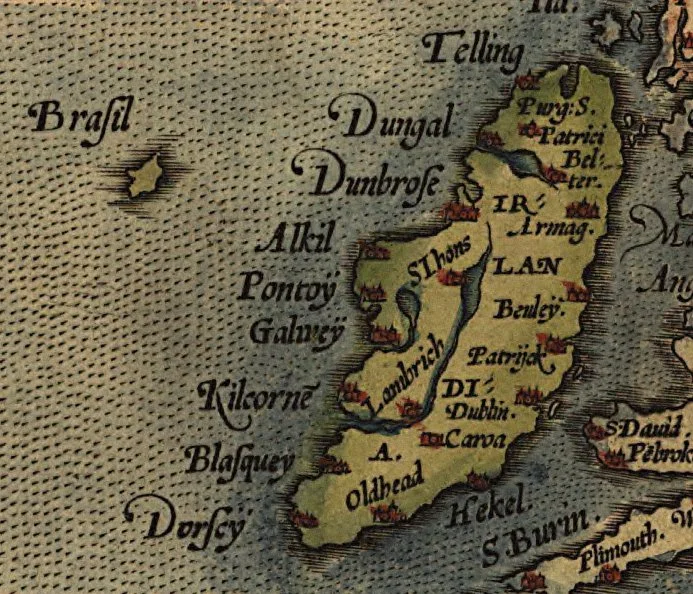
“The lost one,” said Aileen. “The one that sank to the bottom of the ocean. Well, some people say it sank—like Atlantis—and others say you can still see it here every seven years off the west coast. Just before it disappears back into the fog.”
“Do they now?” said the woman. “And which island is that?”
“Hy-Brasil,” said Aileen.
“Ahhh,…,” said the woman, “Hy-Brasil.”
“It was still on the maps right up until the late nineteenth century. And this year is supposed to be the seventh year.” Aileen smiled. “It was magical.”
The woman winked at her. “As is this place, too, love. I think you’ll enjoy it.”
Colin’s last visit to Ireland was closing in on a quarter a century back, eight days married—Aileen’s mother, Sonia--and following excursions to Paris, the Loire Valley, and Ducey a medieval town near Normandy and mon Saint Michele. Then onto Dublin, a few days to see the museums, the Martello Tower, the nightlife in Temple bar, and then a drive up here to see New Grange, before traveling south with a plan to hit the far west and see the mist running through the broken hills of Galway. The woman who owned the bed and Breakfast they had stayed at in Dublin, Anne, had looked at Colin’s last name on his license, after he handed her the voucher, and she had smiled a bit.
“If you’re heading south that way, you’ll be wanting to visit your clan’s castle. It’s been there forever,” she had said, and “maybe a bit longer. A last stronghold for your clan. I was down there once. A beautiful spot, not far from the ring of Kerry on the Loch Lein. I imagine it was really something else in its time. It’s not quite as preserved as the Blarney but then again what it is? We’re lucky we have any of the old structures around at all, aren’t we? All the death and plundering and destruction our people have endured, and for what?”
Sonia, slim with hooded gray-blue eyes, measuring and cautious, had been sitting with her knees tight together, faded jeans, sipping her tea, her hair up, quietly listening. Whenever she wore her hair up, to Colin she always seemed even more beautiful than that first time he had seen her, sitting at cast iron table, reading her book outside of a café in the Back Bay in Boston, some three years before.
Ann had spread out the table with sausage, eggs, toast, marmalade, bowls of fruit, yogurt, coffee and about six different types of bread. An amazing amount of food on a white linen table, the trays all silver, and china accented with gold.
“But you enjoy New Grange first before heading down there,” she said. “An amazing monument. A civilization long gone. It was Queen Maeb who built New Grange.”
“It wasn’t Maeb, Ann,” broke in a man taking breakfast with them. His voice warm and wet, almost as if you could feel it on your skin as he spoke. The man had told them his name was William. Thick glasses magnifying his eyes, a jacket and tie and a bad comb over. He told them he had defected to England—Heath—over twenty years before, but he came back every year for a fortnight and stayed with Ann. “Although Maeb might’ve overseen a few things,” he added
“For sure it was her,” Ann had said.
“No, no, no, it was the Dagda who built it and lived there. He and his son Aengus, a lover of youth, love, and summer and poetry. All the wonderful things.”
“You must be confusing it with some lore from your new country, your new home land, aren’t you?” Ann had said, “just like you would.”
“I may be, I may be, but I don’t think so, Anne.” He raised his cup of tea to Colin and Sonia, and winked. “You two enjoy your youth, it comes and goes too quickly. And if you can make your love and life like poetry, that much the better.”
Colin and Sonia had planned it so they would be at New Grange on the summer solstice. It was something of a day for them—they had met on the solstice, he had proposed on the solstice a year before, and they planned the Ireland portion of their trip so they could catch the monument with the light coming in through passageway, the chambers, as the sun began to rise. And then they arrived only to find out that Colin had his solstices mixed up; New Grange was aligned for the winter solstice, not the summer. The darkest day, but the beginning of the return of the light. Slow but sure, illuminating the back chamber and the remains that lay there. Once people, now dust.
Winter is about beginnings and summer is about endings, he remembered somebody in the crowd whispering.
Now he and Aileen took their place at the end of the tour group. The rain picked up even more, and the sheep on the hill in the distance had huddled together. A chicken and a small wet dog had followed them up the road from the parking lot. And a second dog had lunged at the chicken and chased it away. The rain had let up a bit, and the sun was trying to break through above, slants of light filtering down through the mist.
The mound was enormous and circular, overlooking the River Boyne, and encased in a wall built of stone, the top covered in a grass even greener than Jack remembered, and a guide who looked like he stepped out a tour book on Ireland. Tweed cap, a barrel-chest chasing his belly, a twist to his nose making it look like a pear. “Some of the stones here came from as far as the Wicklow Mountains,” he said. He whistled a bit. “Now tell me how they did that way back then? The structure is at least five thousand years old, going back to at least 3,200 B.C., older than the Great Pyramid at Giza, but there’s many who think it’s even older than that. The Irish culture, history, is one of the most ancient in the world.”
Aileen smiled at Colin. “If it was built by the fairies, it is even older,” she whispered. “Ten thousand years, twenty. Fifty. Maybe longer.” She glanced over at him just before they went in. “Are you feeling okay? If you want to rest, we can rest. We don’t have to do the whole tour.”
“It’s not that long, if I remember,” Colin said. “But it’s kind of cool looking inside. The passageway is tight though. People were smaller back then.”
Aileen winked. “Little people.”
The group itself was fairly small, and Aileen and Colin kept to the rear, ducking in the passageway as the slope of the floor rose beneath them, and passing the tight columns of flat, stacked stones, the tall standing stones, and the Tri Spiral Design carved into wall where on the winter solstice the sun would try to reach.
“Some believe the chamber was built to serve as a passageway between the realm of the living and the realm of the dead,” the guide said, “and the light that that shines inside on the winter solstice would lift the dead buried here within up into the afterlife. The spiral itself is a symbol of both rebirth and renewal. People call it Keltic, but this one here was carved into the stone, when the monument was built, long before the Keltic people arrived on these shores. The people, although we’re not exactly sure who they were, were different back then though. Everything was different, even the light, and the earth’s axis.”
“So just when we think we know who we are,” joked a woman with a brogue, dark eyeliner and auburn hair pulled back in a bun.
“Yes,” said the guide, “just when we think. But lore says it was the Sidhe who inhabited it, a mystical people—fairy like some say. And Dagda was their king.”
The next day they headed south, spending a day and night in Kilkenny, visiting the Dunmore Cave and the Black Abbey, and then down to Cork, the Blarney Stone and Castle, the Jameson Distillery for a few tastes of whiskey, before setting out for Kerry. The plan was to travel the ring, and then hit the Puck Fair, a festival in Killorgin where each summer the village crowned itself a king, and then move on to see the castle which Anne had spoken of so many years before. A spot he and Sonia had never made it to.
“I didn’t think Ireland had any more kings,” Aileen had said as they were planning out the trip.
“Well, technically she doesn’t,” Colin had said. “But this one is a goat. They capture him in the hills, and then bring him to the festival. A few days of royalty, of celebrity. It’s supposed to the oldest festival in Ireland, maybe one of the oldest in Europe.”
Now Colin was driving. Aileen had told him she should drive, but she scared him enough as it was back at home driving on the right side of the road. The left, he thought, might be too much; especially considering how the roads here got narrow, and began to twist, tall grass to either side, and cars coming in the opposite direction out of nowhere, with no way to pass.
He told Aileen the story of how Sonia had been hiding beneath the dashboard shrieking, after they had picked up their rental on their honeymoon. A little red Ford Fiesta. Leaving the airport, he didn’t know where to turn, his depth perception completely off and horns blaring all around him. He couldn’t get off the rotary, and when he finally did, picking up speed, he had knocked off the left side mirror driving past a row of cars parked along the side of the road. “I’m sitting in back!” Sonia had screamed hopping over the seat. He had chauffeured her for a while after that, at least until he had got the hang of it, and she had calmed down.
“But for the rest of the trip, with the mirror broken, we often couldn’t see what was behind us,” he told Aileen. He glanced at her fooling with the GPS, trying to program it. If she had heard him, she didn’t respond.
She tapped the screen, and then sat back smiling. “Got it!”
They had nearly missed their flight coming over. Aileen was even worse than he was when it came to running late. I got it from you, she was always saying to him, you can’t criticize me for something I got from you. When she had come to visit him in the hospital a few months before she had missed visiting hours by a mere seven minutes. It was well into Covid, and restrictions had let up most places, but not hospitals, and they wouldn’t let her in. He was allowed two visitors a day, but rules were strict with Covid, visitors weren’t allowed after seven. Aileen had called outside from her cell phone—an ice storm outside and freezing rain-- just as they were taking his dinner tray away, telling him they had stopped her at the door. You’ll be home Friday, she said. And I’ll see you on Friday.
And he was home Friday, had been in the hospital a little less than a week. A catheter up through his right arm to see if and what was blocked. And two arteries were, more than ninety percent. He had two stents put in, and a list of meds that looked as a long as a menu. He wasn’t used to it. None of it.
“I know it stinks, but you shouldn’t complain,” Aileen had said. “You survived, be thankful. You might not have survived, a lot of people don’t.”
And he supposed he certainly had been lucky in that regard. He had been running in the woods when it happened, climbing trails of loose soil and dead pine needles, broken with tree roots and rising high above the pond. A local nature preserve. It was quiet and beautiful, close to the sea, the oaks and the fir trees towering high above him, and he had to suddenly stop. Short of breath, much shorter than he should have been, than he ever was—he had been running for over thirty years--after not even a quarter mile in. He put his hands on his hips, gasping, and stared up the hill again; it seemed much higher than usual, spinning a little, and it was then the first of the chest pains had begun to spread like out from his sternum, hot and tight. His knees began to buckle. And a walker coming up behind him had called 911.
An event. That is how the nurses referred to it in the hospital, and the term still made him laugh. Balloons and music and keynote speakers on the stage. Fond memories for all. An event. And it was after he was home for month, that he decided he wanted to see Ireland again.
He and Aileen started the Ring of Kerry after a late breakfast in Cork. The ring ran 111 miles, but was usually slow going with the tour buses and animals wandering into the road. Colin had read that it was best to travel the route clockwise to avoid being stuck behind the buses, which traveled the route counter clockwise, so they started in Kenmare, and drove along the coast, high up into the hills, passing the Ladies View, the blue of the water stark against the green, and stopped to climb the steps beside the Tore Waterfall, the water on the rocks loud, crashing and lovely.
Higher up they had begun to see the goats scattered atop of the craggy rocks. Turning to watch them as they passed, their perches overlooking the sea. The ones with the black faces unsettled Colin for some reason. They had the last time around as well, looking somehow eerily human, but not. Devil like almost. Something out of a gothic horror story. Aileen snapped pictures with her phone after they had pulled over, climbed out of the car.
“Looks like these guys weren’t invited to the festival,” she said.
Colin was quiet a moment. “I guess not. But legend, the mythology, has it that they’re some of our ancestors, or at least their souls within. The spirits of warriors, their wives and their children, cast, or reincarnated I guess, into the bodies of the goats by Queen Maeb, and there forever to watch and guard the shore, born again and again.” Colin swallowed his breath a bit, as soon as he had finished the little story, he had wondered why he had told it. Wasn’t sure if he had really heard it before, or if he had just made it up, lied—either or was possible, he figured—to entertain and impress his daughter and her love for the mythology. The shame inside of him was immediate though, hot and rising up his neck and into his cheeks, and was often that way with him. Wondering if she would see through him, think less of him. He was empty to the point of making up his own mythology. Mythology that never was.
“They’re beautiful,” Aileen said at last. The sea was in full view now, and Colin noticed her scanning, the blue and green, and white breakers in the distance, and he wondered if she were looking for her island to the west, and if she really believed in it. “Did you and Mom drive up here?” she asked.
“Yah.”
“She’s always been afraid of stuff like that,” Aileen said. “Animals in general. I texted her yesterday and told her we visited New Grange. She said she didn’t remember going there.”
Didn’t remember. It was funny, Colin thought. Sonia had often accused Colin of only remembering what he wanted to remember, and not remembering what he didn’t. He hadn’t spoken to her in a few years now, and even the last time was strictly business. She lived on the North Shore of Massachusetts. Manchester by the Sea. Tucked high enough up in the corner of the state where few people they knew would run into her, but still allowing her the beauty of the ocean. She had always loved the sea.
It had been almost nine years ago now when everything came to holt, or maybe more appropriately, picked up speed. A train wreck going over a cliff. One that he had been powerless to stop. Sonia had lived with them one day, and then was gone the next. Just a few of her things going with her. No note. No nothing. She had met a man, and then she was gone. Aileen was just about to start eighth grade.
It hadn’t been easy raising Aileen alone. A few drunken high school nights, and sneaking a boy upstairs. A struggle over a nose ring. Then one day a letter arrived addressed to Aileen, decorated with hearts and the opening line “Hi Aileen. It’s Mom.” It had been five years since they had heard from her.
“The day we came up here, it was overcast, very misty,” Colin said now. “And while the feeling was still mystic, you couldn’t see much in the distance, not even the sea. We did see the goats, but your mother was afraid to get out of the car.”
“So that means this is really my second time up here,” Aileen said.
Colin smiled a little. “Yes, I suppose you’re right about that,” he said. She had been with them, certainly in utero and maybe in spirit.
The pregnancy had been a roller coaster, start to finish. Full of conflicting emotions, crises, and rebounds. Embraces and lies. Just like their lives to follow. Sonia had told Colin she was pregnant less than two weeks before their wedding, and when she did, he had gone into shock, hadn’t taken it well. Behaved badly. It wasn’t possible, he had thought. He had used a condom, he always used a condom—he wasn’t ready for children, not yet. Not the first year of their marriage when they were supposed to be out enjoying life, eating, drinking, traveling, and now that was going to be ruined. Their honeymoon was ruined, he told her, Ireland was ruined. And then when she had shown him the pregnancy test—pink--he had tossed it across the kitchen.
“Fuck,” he said. “You can’t be serious. You’re not serious. Pregnant? How the hell are you pregnant?”
Her expression had dropped, her face going blank. And then after a moment, she began to cry. “It’s not like I planned it. It must have broke. Do you think I wanted this?” and when Colin had continued to curse, she put on her coat and ran out of the apartment.
He had immediately felt awful, insensitive and cruel. Consumed in his own self-pity, he thought, he had acted like sonofabitch, spiteful and self-absorbed. In the end, he had waited up all night when he finally heard her come in around five a.m., her expression now resolved, stoic, and her shoes covered with sand from the beach. And then three days after that, he had come home to her crying again, and she told him she had lost the baby. She said she had called the doctor, told her what was happening, and the doctor confirmed it—she was miscarrying. Colin had held her, apologized again, said he was sorry, he was really sorry, he was a complete shit. And he was sincere. He had gotten excited by then, after it sunk in, and had started looking forward to being a father. He would have loved the baby, he told her. The baby would have been beautiful. And he was right.
After all was said and done, she was beautiful, coming into the world less than eight months after they returned from Ireland. And Colin’s life had never been the same. But the story of the pregnancy, and what had happened with Sonya, over here in Ireland, was one he had never shared Aileen. And he didn’t think he ever would.
He had been smitten from the first second he saw her, held her in his arms—she had opened her mouth to cry, but nothing came out, and then she had yawned and drifted off to sleep. The Little Princess, he remembered the nurses on maternity ward calling her. She looked just like a little princess, and she had always made him laugh. He would follow her with the camcorder, videotaping everything she said, her next move. As she crawled, began to walk and run about, learn to dance. The sense of wonder as she discovered things, everything new. And as he did, Sonia would just look on in silence.
The Princess.
Colin had never been completely able to pinpoint the trouble between Sonia and Aileen. Instead of making her happy, the child always just seemed to remind her of just how unhappy she was. And maybe, Colin thought, he did, too. It must’ve been a terrible way for her to feel, though, and it started soon after Aileen became a toddler. Outbursts were many for Sonia, and often belittling and cruel. And it could be anything. Writing on the walls. Food missing from the refrigerator. Misplaced earrings or someone lost the remote. Too little sleep. And often after they had begun, and right on through, Aileen would either hide under the bed or just sit quietly and watch her, and wait til it was done.
Colin often found himself defending Aileen, and when he did, it just caused Sonia to escalate further.
“You’re siding with the princess again,” she would say. “You always side with the princess.” And then sometimes she would pause, her eyes cutting. “You didn’t even want her.”
But finally, in the end, less seemed to equal more when it came to Sonia with Aileen, and since Aileen had graduated college, and Sonia had moved back to Massachusetts, they met for a lunch occasionally, texted rather than talk on the phone, but that was about all. And now, upon their return home, Aileen herself was moving out west, out to Arizona, Sedona, out to the desert. To look for herself spiritually, she said. Colin wanted to give her his blessing, but he wasn’t sure she was ready. That he was ready. He was worried he may never see her again. And he was worried that she would be too alone. That he would be too alone. And here it was now just three days until their flight home.
By the time they reached the end of the end of the ring, Killorgin, the noise was loud and the Puck Fair was already well under way, the opening ceremonies far back in the morning, and the cool thin air coming in wet and clean and new in the mist over the river. It was a way, it occurred to Colin, that the air only felt during the springtime at home, but here in Ireland, he imagined it to go all year long. They parked in a field, the grass already flattened, trampled, piles of horse and cow manure scattered about, and started up the hill into the town. Fiddles playing and hands clapping, and someone singing in the distance. The streets were blocked off and the vendor booths lined either side. Jewelry, costumes, sweaters, and paintings of thatched cottages on the hills beyond the sea. A woman with short, spiked maroon hair and a hoop ring through her nose sat drawing the portrait of a young girl with a wreath of purple and yellow daises upon her head.
A puppet show was taking a place at the top of the street—a long haired Druid priest in robes like Merlin casting a giant out into the sea—and children were getting their faces painted. A booth selling crystals and another selling horse saddles; Colin had seen signs for animal sales as they first crossed the river—cattle and horses, small ponies.
He sipped his beer as they pushed their way through, and Aileen stopped at a booth with paintings and maps and a table covered in dolls. Porcelain dolls in Irish step garb. The long curls, and dresses of either green or black with the green, red, and yellow Keltic designs. Circles and triangles. Aileen had taken Irish Step classes when she was little, and the Saint Patrick’s Day weekend party was always a favorite time of year—the dancing and music, corned beef and cabbage. Sonia had curled her hair the first couple of years, but Aileen wanted a wig—it was more fun to dress up in a wig—and eventually they broke down and bought her one. It was a rite of spring for them back then. And it all went by so fast. Colin had just driven by the old dance studio a few months back and was sad to see it closed, the sign taken down, the building empty, the grass overgrown. A weathered For Lease sign on the afront lawn.
He remembered there was large one-way window inside the studio. The thinking was that if the children could see the parents watching, they wouldn’t be able to concentrate, focus. Or perhaps they would get nervous, or try too hard to impress. In any case, the watching room was always dark, and sometimes there would be a mother with smaller children, or sometimes a daycare grandparent. Smells of baby food, string cheese, Pepperidge Farm Goldfish. The subtle sweat of children, and the decaying smell of age. He loved watching Aileen, and he remembered wishing he had two children in there. Three. But on one occasion Aileen, age six, hadn’t wanted to go, which was strange because she always wanted to go. She loved the dance, never gave him a hard time. But on this day she hadn’t, said she didn’t feel good. She couldn’t have been any older than six or seven. But the lessons weren’t cheap and he figured he would hear about it from Sonia when she got home from work if he let her skip, and so he made her go. He watched through the window as the little girl bounced about the floor, straight shoulders and legs kicking, the music going as all the girls moved in circles, and the teacher, Miss Deirdre, clapping. Faster, faster they were always moving faster. And then once they got home, the dollhouses and castles on the living room floor, and Blues Clues on the T.V. he has asked Aileen if she wanted a treat, some ice cream, she had been good, she had toughed it out, didn’t complain, but she said no. And then he got worried. He had called Sonia at work who asked if he had taken her temp. He had not. So then after finding the thermometer in a bin full of band aids, Calamine lotion, old binkies, small bottles of Johnson’s baby shampoo, and uncovered toothpaste in the bathroom, and Aileen on the couch, quiet, her eyes shut, he had slipped it under her tongue. And then his heart had nearly stopped. 106.2.
And on the phone Sonia had screeched.
Colin had called the pediatrician who told him a child could handle a fever like that, even though in an adult it would’ve likely meant death. Pretty Quickly. And then after he gave her some medicine, she had slept straight through til the next morning, waking and rebounding, running about as if nothing had ever happened. Bouncing back, the way children did. But through it all, he remembered, the little girl hadn’t complained. Not bit.
Now a buggy drove by with three small girls inside then, one of them turning and staring back at him before disappearing around the next turn. The woman in the doll booth, older, round and gray haired, skin tags abundant upon her neck, sat knitting on her stool as Aileen looked at one doll and then another. Her room when she was small had been covered with dolls. It’s one thing Sonia had always done to make up for everything else, the lack of warmth, the lack of love—she bought gifts, presents. And doll after doll.
Aileen picked one out with deep black hair, blue eyes, and an emerald dress, sifted through her purse for some euros.
“Is that for you?” Colin shouted over the din as the woman bagged the doll.
“It’s for my daughter.”
He smiled. “Ahh…your daughter. I didn’t know you had a daughter.”
“I don’t. Not yet. But when I do.” She glanced up at the paintings and pictures hanging behind the woman. Bright colored pubs, and men with tweed caps and pipes unloading nets of fish beside the sea, the cliffs of Mohair, a pen and ink of Lady Gregory, and a drawing of James Joyce done in pastels. Maps of Ireland, and one of the Ring in Kerry.
“Do you have any of Hy-Brasil?” Aileen asked the woman.
“Hy-Brasil is it you’re looking for?” said the woman.
“Maps, I mean. I’ve been looking for a map with Hy-Brasil on it. We went looking to see if we could see it off the coast while driving around the ring,” she said, “But no luck. It must not be the day.”
“Once every seven years they say.”
“You know about it?” Aileen said.
“Oh, sure, sure. I know all about it. The mysterious island inhabited by black rabbits and a magician. A wizard.”
“It was on the maps,” Aileen said. “A long time ago, anyway.”
“Oh sure. I think I might’ve seen one once.” She lowered her chin, her eyes smiling a bit. “But it’s all just the stuff of the fairy tales, love, isn’t it? Those maps were just made up as gimmicks.”
Aileen just stared at her a moment.
“Do yourself a favor,” the woman said, “You’re a beautiful girl. Enjoy what’s all around you. This country has enough to offer without folks going looking for islands that never was.”
Aileen was quiet after they left the left the booth. And Colin found himself at a loss for words, his heart breaking a bit for her. He wondered again if she seriously believed some of the fantasies she threw out there, or if it were all just in fun. And it had been fun throughout the trip, listening to her talk about a mythological place far off in the sea, something that never was. But vacations were all about fantasies, an escape from reality to a life that never was, never would be, and he imagined, now, that that was more than likely part of the reason she had said she would come along with him. Something to look forward to and help lustrate the past, and the emptiness that had been her childhood.
When they reached the top of the hill in the center of the village, Colin could see the cage with the goat king towering high above them. But if the animal was disgruntled, or making any noise, the crowd was much too loud for them ever to hear him. He tapped Aileen on the shoulder, smiled, and pointed up.
“The King,” he said.
Aileen glanced up, the goat staring down. “The king in a cage,” she said. “Do they kill him?’
Colin hesitated. “No. I don’t think so. Of course not. He’s the king. They bring him back to the hills, and set him free,” he said, and again, he wasn’t a hundred percent sure if it were true. He looked at the mountains in the distance, shrouded in mist, the peaks hidden in the sky. Everything in this country, in the distance, seemed to be shrouded in mist.
“But he doesn’t know that,” Aileen said. “He doesn’t know what’s coming. He must be terrified.”
They had left the fair after that, walking through the mud back to the car, and by the time they started the drive back east towards the castle in Ballynaboul it was already two hours dusk. Colin had hoped to get to the castle earlier and then cross the river well before dark, find the hotel, and then get an early start north, but it was true what they said about the best laid plans. It was a beautiful drive still, though; the whole country was beautiful. You could picture the fairies hiding in the stone walls and waters, hear their songs as you passed, and he imagined things hadn’t changed much in the country out here. Not in a thousand years. Aileen had remained quiet since the fair, her eyes shut. The sky had cleared, now bright blue but darkening subtly with the oncoming night by the time he could see the water of the Loch Lein in the distance.
“Your mother and I never made it out here,” Colin said.
“Why not?” Aileen asked, but she didn’t open her eyes. She looked like she was meditating, or possibly praying. Although Colin didn’t know who she prayed to these days. Or if she prayed at all. He, and for a time, Sonia, had spent time raising her in the church, but then it all seemed to just wash away like sand on a hill in the storm. Nothing left after. Sometimes he thought it was like that for Catholicism everywhere. Catholicism was dying. The church was dying. Starving itself, and too stubborn to change. So maybe it was better, or just as realistic, to pray to fairies on a make believe island somewhere in the middle of the sea. Or perhaps she just prayed to the earth and the sky. Spirituality is more than just a man on a cross, he remembered her saying to him a few years back. A man who gave his for life you, he had snapped, and immediately felt embarrassed as soon as he did. Proselytizing, and holier than thou. You can believe what you want, and I’ll believe what I want, she had said. That’s what’s great about life, we can all believe what we want. The important thing is just to believe.”
“Well, we had planned on making it out here,” he said to her now. “And then things just happened. Your mother didn’t feel well.”
Which, he supposed, in the end, was all very true. And now making his way down these roads again, it was impossible for it all not to come back to him, that last night.
He remembered he and Sonia had stopped to stay in a town not far from Kilarney, a scenic town set like a stone at the foot of deep green hills on the shore of a blue lake. The sheep with black faces wandered about the hills and behind the homes, some even down the side streets, as Colin and Sonia drove into town and booked a room at a stone inn built above a small offshoot of the river which fed the lake, the water running between the archways which supported the structure.
Sonia had been saying she was starving. They found a pub, late, but then Sonia said no when the waitress had asked her if she wanted a beer. She ordered a pulled pork sandwich, but just picked at it a little, barely eating. It was a weeknight, and the pub was mostly empty, the lights dim except for those on the small stage where a man with a guitar and an older woman, a fiddler, with a Keltic vest and hair pulled tight in a ponytail had sat up until a half hour or so before. A couple in the corner, older. The man wore a pair green slacks, and polyester shirt, looking straight out of 1977, and the woman a colorful flowered blouse, her gray hair cropped short. They were speaking in Gaelic, hurriedly and fluidly, but Colin heard one mention of Boston. It was so surreal, he thought, to suddenly be hearing a forgotten language, but it seemed to fit right in with the mist and the mountains. It was a beautiful room, the mantle black and coal burning in the hearth. Black and white drawings, originals, of the castles and the sea, and one that looked like a druid priest. And the walls above the balustrade upstairs were lined with porcelain statues in wooden cases, looking like caskets. Saints. Their names and the year of their deaths written beneath. The artwork was beautiful.
“They were almost all martyrs,” he had said then to Sonia. “And most of them died pretty horribly. Especially the Apostles. James was beheaded. Andrew was hung alive for two days. Bartholomew was skinned alive before being crucified, and Peter requested that he be crucified upside down saying he wasn’t worthy of being crucified like Christ.”
“Veronica was my favorite,” Sonia said. “I took Veronica for my Confirmation name. She wiped Jesus’s head with her veil when he fell while carrying the cross. On the Via Dolorosa.”
Colin sipped his beer. He had heard the story before from her. “I read once that they weren’t sure whether or not she was real, if she really existed, I mean. Even the Church says they’re not sure.”
Sonia shot him a look, her eyes cold, challenging. “She was real. I had a book on the lives of Saints when I was growing up. I read it over and over. I practically memorized it. Veronica wiped Jesus’s forehead. She was real.”
Colin hesitated a moment, taken aback, and not wanting to get in an argument. When Sonia got this way, you had to tread carefully, rice paper, or things could escalate pretty quickly. Ruin the day.
“Well, I’m sure she was,” he said. “Real. I mean they canonized her. They just don’t have any concrete evidence.”
“You don’t need concrete evidence if you have faith. That’s the whole point of faith.”
Colin held back again. “That’s true, I guess. You don’t.”
The couple in the corner were speaking louder, Gaelic to English and back again.
When Colin ordered a second beer, and Sonia again refused, asking instead for a glass of water, he looked at her skeptically. “You okay?”
“Oh, I’m okay,” she had said at last. “The problem is, I’m not alone.”
It took Colin a moment, but then his thoughts began to spin, excitement, and the dread from the weeks before rising again, and mixing together.
“No?”
“No.” She wrapped both hands around her glass of water. “I’m still pregnant. I can feel it. And I know the feeling. I’m pregnant. I thought I miscarried, but it must’ve been a phantom miscarriage.”
Colin went to speak. Nothing. A loss for words. He tried to smile.
She glared at him again, something like hate buried deep in her eyes, a small smidgeon set far back in the emptiness. “I’m keeping this baby, Colin,” she said. “I’m not getting rid of it. I’m not doing it again.”
”No, of course,” he said. “Of course. I’m just a little shocked. I wasn’t expecting this.”
“I’m keeping it,” she snapped. “You’re not forcing me to do anything.”
“I wouldn’t,” he said. “I’d never. Of course you’ll keep it. It’s our child.”
“I mean it. Don’t even try it. I’m keeping this baby.”
He thought back to his initial reaction when she had first told him weeks ago. His words. The honeymoon. Ruined. And the look on her face when he said them. And it suddenly became clear to him that there had never been a miscarriage at all. Phantom or misconceived.
He reached out and put his hand over hers then, but she just looked at it a moment, and snatched it away. A tear moving down her cheek. “I’m keeping the baby,” she said again.
Outside they saw the older couple who had been sitting in the corner, now the man smoking a pipe. The man looked at Colin and Sonia, and smiled.
“Lovely girl,” he said. “She your girlfriend?”
The woman gave him a light shove to the shoulder.
Colin hesitated a moment. He smiled, holding Sonia’s hand. “My wife.”
“Your wife? She looks awful young to be your wife.”
“We’re on our honeymoon,” Colin said.
“Honeymoon?” the man said. “By Jesus. Well, God bless the two of ya. I hope your next thirty-six years are as happy as ours have been. You go and have a beautiful life.”
When Colin woke later that night, the light from the moon was coming through the window, and he could hear the river passing below, the sound of the water making everything feel like a dream. He looked beside him but Sonia was not there, having made the bed adjusting the covers where she had lain. He checked his bathroom, and looked out the window. The rental car was still in the lot. Colin put on his shoes. He could see a shadow as he approached the lake. Standing up in the water to her waist, some ten yards offshore, her hands beneath the surface, the light of the moon touching the top of her head. She was wearing her nightgown, sheer, and she smiled a little when she saw him.
“What are you doing out here?” he asked.
“Going for a dip.”
“At two in the morning?”
“It’s a beautiful night.” She turned away from him then, and he kicked off his shoes and waded out to her. The water was cold, and he felt his heart seize up a bit. When he reached her, he put a hand on her hip and with the other reached beneath the surface for her hand. She tried to pull away, but he pulled her close to him, and when she wrapped her arms around his neck to kiss him, he felt the warmth from her wrists trickling down over his shoulders. But it wasn’t until she pulled away, trying to move further out into the water, that he realized what was happening. And he started to shout, struggling to pull her from the lake. And get her back to the shore.
Now Aileen opened her eyes. “I knew we were near water,” she said. “I could feel it.”
“It’s the Loch Lein.” Colin pulled to the side of the dirt road which led to the castle, the setting sun reflecting off the blue water behind. He sat stunned for a moment, unsure what he had been hoping to see, what he was expecting. Nothing still too grand or maybe even whole. But towers, maybe an archway, covered with ivy. A labyrinth of rooms high above calm, still waters. Something fit for a king. Each clan had a king. But before them only the crumbling outer wall remained, pine trees rising up tall from the center of what had been the fortress, branching out and creating a canopy above, and a stone wharf running parallel to the land and down to the water. The tall grass about the structure golden, and just a single lamppost by the side of the road. A small boat with a figure hunched over floated behind the castle in the distance, now just a shadow in the dusk, the lake and the sky beginning to merge, and the mountains beyond.
Colin could feel his heart sinking. “I guess it’s not much,” he said at last, “but it’s over a thousand years old. Much of it was probably destroyed when the country was sacked by Oliver Cromwell, most of the clans lost their property then, had it seized.”
Aileen was silent, staring at the ruins.
“Do you think it’s haunted?” Colin asked. He looked at the ruins, the fallen stones, and just one window left in what remained of the wall. A breeze came then and moved through the grass. He tried to picture it restored, solid and tall, and people moving about. Men, women, and children. Cloaks of wool, and animal skins. Capes and kilts. And bright colors. He could see them now. Families carrying bundles of wood over a thin crusting of snow. Footprints left behind them, and the smoke curling up from the enormous chimney casting a shadow upon the lake. Dragging game in from the woods, a trail of blood, a trail of life, left behind them. Goats in the yard, the black faces and wise eyes, and maybe a cow. Children running about beneath blue summer skies, and clops of horse hooves moving in from the distance. Laughter and shouts. Drunken men exchanging blows by the water, and a woman on her knees, quietly crying before a small mound of soil, and a crooked cross. There were crosses, and stones, woven throughout the trees before the lake. And the souls walking between them. They were all there, if just for a moment, and then they were fading and then they were gone.
The structure before him, aging and crumbling, but somehow still standing. All that once was now just a whisper.
Aileen was still quiet.
A dog trotted towards them, climbing out of the lake, soaking wet, and looked at them a moment before moving on, disappearing down the dirt road, away from the ruins. Aileen took a breath but didn’t move her eyes from the castle. She reached over and squeezed Colin’s hand. “No,” she said. “I think it’s beautiful.”
Colin, for a moment, watched what was left of the sun reflecting off the water. And then he shut his eyes and listened to her breathing.
Sean Padraic McCarthy’s short stories have been published, or are forthcoming in, Epoch, Swing, BULL, Resistance: An Anthology of Overcoming, The South Carolina Review, Louisiana Literature, Glimmer Train, Bayou, Chiron Review, Water~Stone Review, The Greensboro Review, The Hopkins Review, Hayden’s Ferry Review, The Sewanee Review, and South Dakota Review among others. His work has been cited in The Best American Short Stories. He is the author of the novel IN THE MIDST OF THE SEA, and his second novel WHERE THE BIRDS GO TO DIE is scheduled to be published later this year. He can be found at his website www.seanpadraicmccarthy.com, at X--@spmccarthy67, and Facebook and Instagram—Sean Padraic McCarthy. He lives in Plymouth, Massachusetts with his family.