“Cold Reckoning,” Fiction, Robert McGuill.
We were having a few cheerful drinks in a down-slope tavern in Lake Louise, Alberta. Melissa was fretting over the state of affairs back home while the black and white above the bar droned out more of the same-old, same-old.
You can’t escape it, can you? she said. It’s everywhere. Even up here. Vietnam. Vietnam. Vietnam.
I looked around and told her I’d ask the bartender to change the channel when he got back. If he got back. He appeared to be on his own clock, so it was hard to guess.
She was sitting on the edge of her stool. She glanced up at the TV, then back at me and shook her head. Why bother? I mean, if he could flip the channel to a new congress, sure. Or find us a different president, why not. Otherwise, what’s the point?
She was a clever woman, and well-informed. I sympathized with her anti-war sentiments, but it was her world she was at odds with, not mine. I was beyond worrying about guns and bombs and peace talks yet-to-be-had. Battles raged over silly little things like the shape of a negotiating table. I’d served in my own war twenty-seven years earlier, in Italy, and knew all about the frailties of the human heart. Which is why I was here instead of there. There, being the US.
Melissa cupped her drink in both hands. Nodded at the window. It’s pretty here, she said. Isn’t it. She turned to me. You’ve already fallen in love with the place, haven’t you?
I glanced through the pane glass window at the snow falling on the sidewalk. Love might be a bit of a stretch, I said. But yeah, I like it.
She worked up a dark little frown. You’re a bastard for quitting me. You know that, don’t you?
I know.
But I’ll say this, just to be fair. As brush-offs go, it isn’t the worst I’ve ever had. At least you’re still buying drinks.
I raised my glass and offered an appreciative nod.
She turned her eyes back to the TV and said, You’re going to regret kicking me out of your bed, Joe. You know that, don’t you?
Of course I knew it. We both knew it.
She swirled the ice in her glass. Sipped. Lowered the glass and swirled the ice again.
She’d do all right without me, we both knew that. But it was decent of her to pretend. It made me feel good, and I know she wanted that, my happiness. Her parting gift.
The interview I’d had at the resort this morning had gone well. Melissa was the one who’d encouraged me to pursue the opening, though anymore I’m not sure she actually believed I’d do it. She said it wasn’t often a geezer like me got a chance to run a ski school at a storied old resort like the Chateau Lake Louise, and that I’d be a fool to look it off. So I applied. I don’t know who was more surprised when the folks at the resort called and requested an interview, but here we were, the two of us. Looking at one another for what would almost certainly be the last time.
I’d come to fancy the idea of moving to Canada more than I thought I would. Taking a new job, starting a new life. Melissa wasn’t big on me giving up my place in Colorado, but sacrifices had to be made. She was fond of Canada, too, and had been for some time, though for reasons that had nothing to do with me or the ski school. She’d agreed to accompany me on the flight up, for moral support she said, but come tomorrow she’d be headed back to the states, alone, to her own job in Boulder.
I wagged a finger at the TV. Images fluttered across the small gray screen. They need you back there, Sweet Pea. You’re a firebrand and the youth of America needs firebrands. As many as they can get their hands on.
And what about you? she said. Don’t people need you, too?
A ski instructor? I smirked. Come on.
Well, she said, curling her hair behind her ear, For what it’s worth, I need you. At least for tonight. And who knows, if you’re a good boy I might come back for a visit someday.
I smiled, gratefully, and lowered my drink. You’re a graceful woman, Missy. And I mean that. You’re the most graceful woman I’ve ever known.
You think so, huh?
Yes. I smiled at her. You know you are.
She rattled her ice, smirked and raised her tumbler. But the glass stopped at the edge of her lips. Except on skis, right?
Yeah, I admitted. Except on skis.
§
Melissa was young. Is young. She teaches American Lit in Boulder at the big university up near the Flatirons. When her students first saw us strolling around campus together they assumed, as anyone would, that I was her father. I didn’t mind the mistake. In fact it gave me a warm feeling, youngsters thinking me capable of fathering such a beautiful offspring.
But it was never meant to last, what we had. We were born to be friends, not lovers. I knew that even then. And so did she. I enjoyed what we had and couldn’t pretend I wouldn’t miss it. But as I said, sacrifices needed to be made.
We’d been together less than year. We met the previous summer when I’d ducked inside the Tattered Cover to get out of an afternoon thunderstorm. We were browsing the shelves in the same aisle when she stopped me to ask about a book whose title she could only half remember. Something about soldiers. Soldiers in the night.
I don’t work here, I said apologetically. But I think the book you’re looking for is Armies of the Night. I pointed, and reached for it. Took it down and handed it to her.
She glanced at me. Then at the book. She was so pretty, her skin so smooth and fair I found myself turning away in embarrassment.
You’re right, she said, flipping the book over in her hand. This is it. Thank you. I might’ve been here all afternoon if you hadn’t come along. Maybe you should work here.
We laughed and struck up a conversation about the author. I told her I’d read most of his books, and thought highly of him. The work she was holding was one of my favorites. She told me she was an English professor. I learned she was also a fervent anti-war activist. A two-fisted, blue-eyed dove. She said she was adapting her curriculum to align with current world affairs—the war in southeast Asia chief among them—and sounded as unapologetic about it as a tent-show evangelist on a godly mission. She had no misgivings, she told me, turning her lectern into a pulpit.
Have you read Johnny Got His Gun? I asked.
The question took her aback. She narrowed her eyes, coyly. Are you a teacher?
No, I said. Heavens no. I’m a ski instructor.
Where do you instruct?
Breckenridge, I said.
She asked how I knew so much about Mailer and Trumbo. The military, and the Second World War. I shrugged. I said it wasn’t as complicated as she imagined. I’d always been a big reader, and as for the army I was a soldier once, a long time ago.
The rain let up, and when it did, the spell came undone. We looked at one another like newly-minted lovers, too near the intimacies we’d just shared to speak of them without blushing.
My god, she said, searching out the time on the wall clock in the bookstore’s cafe. Can it really be three o’clock?
We traded glancing smiles, an awkward laugh.
She held out her hand.
I’m Melissa, by the way.
Joe, I said, returning the gesture.
She started to release her grip, but snatched my fingers at the last instant and blurted, I know we’ve only just met, but I wonder if you’d consider doing me a favor? She adjusted the sling on her leather bag with her thumb and shook back her hair.
I didn’t know what to say. So I stood there, silent, until she asked.
I wonder if you’d consider speaking to one of my classes some afternoon? Her brows arched. It would only be for an hour or so. Two at most. You could pick a day that works, and I’ll arrange my schedule around it.
I thanked her, but declined. I told her there was nothing about the war I wanted to remember, and that even if I did, I couldn’t imagine it being of any value to a classroom full of doe-eyed teenagers. It was a long time ago, I said, and I’m old and who would care?
She cocked her head. Stared at me a moment, and said, I’d care.
I realized I was trapped.
She reached out and touched my arm.
They say your generation went to war to save humanity. But this generation, it doesn’t even know what it’s fighting for. They’re wandering in an ideological desert, Joe. They’re burning villages and slaughtering innocents. Getting high and killing people and drowning themselves in alcohol. It’s a nihilistic nightmare, and it’s destroying the soul of the country.
I stopped her. I couldn’t to listen to anymore. I’m sorry, I said. But I’m not your man, Melissa. I wish I could help, but I can’t.
I thanked her for the conversation. Her pleasant company. Then I gathered my jacket over my arm, and extended my hand.
She looked but wouldn’t take it. You don’t care that they know the truth?
What truth?
Is there more than one?
I almost said something, but stopped myself. I didn’t want to get into an argument. Not here. Not about this. Not with her. I told her again that I appreciated what she was doing. That I wished her all the best in her endeavor. But the problem was, I had no business telling anyone about anything. Especially the right and wrong of war. That was the only real truth I knew.
She stared at me, unfazed. How about we change the subject. Can I ask you something else?
All right. If you want to.
She shuffled her feet and glanced away, then back. Would you, or would you not, like to see me again?
§
I spoke to her class three weeks later. It was a half day affair that began in the afternoon and lasted two full hours. The students were young women mostly, with a few nervous-looking boys mixed in, some of whom must have been on academic deferments. They leered at me as if I might be an undercover agent from the draft board checking for holes in their stories.
I was nervous at first, but my apprehensions turned out to be unwarranted. The session went just as Melissa predicted. A polite, if timid, bullshit session, with young people asking small-minded questions about the workings of the military, and my involvement in a war whose image they’d gleaned, almost exclusively, from half hour television shows on TV.
I told them I’d served with the Eighty-seventh Infantry Regiment of the Tenth Mountain Division stationed at Camp Hale, near Leadville. That I was part of the unit that captured Riva Ridge on February 19, 1945, in a battle the papers at the time called a “miracle” assault.
Some of the students were Colorado natives. One, a dark-haired boy with a wispy beard, who was familiar with the Tenth Mountain and its origins, announced to the rest of the class that his father, a decorated veteran who’d fought in the Pacific, referred to us as playboys on skis. Pretenders and poseurs who hid out on the slopes while the real men, the Marines, did the actual fighting.
I smiled and let the boy talk. He had a right to believe his father’s stories without some washed up old nobody like me calling them a pack of lies. Your father was absolutely correct, I said throwing up my hands in surrender, acting as if I’d been caught red handed. Yes, we were playboys and ski-bums. But then the army came along, and scraped us off the slopes. Dressed us in winter wool, and shipped us off to Bavaria where we quaffed mulled wine in alpine taverns and ravaged the buxom daughters of farmers and goatherds.
The students chuckled. Even the boy with the wispy beard. But Melissa, standing off in the corner with arms folded and papers rolled in her fist, looked on, unamused. She knew my days in combat were a far cry from the stories I was telling them, and I couldn’t make out if she hated or pitied me for it.
Her students had romantic notions of the war. My war, that is. And I was in no hurry to dispel them of their fantasies. If they imagined me and my unit as high-spirted young men who slalomed across the Alps with rifles slung innocently across our backs, good for them. If they thought of us as frat boys full of mischief and good cheer, so much the better. They didn’t need to grow up any faster than they already had, and I wasn’t about to burden them with tales of woe and misery.
One of the boys asked about the Gothic Line. I guess he’d done some outside reading. He wanted to know about weather conditions. Armaments. The Tenth’s strategy—unheard of at the time—to scale a rock cliff behind enemy lines with ropes and pitons, and take the Germans by surprise. I congratulated him on the accuracy of his research. But I gave him nothing in return. I made no mention of casualties, no allusions to the nightmarish death of my best friend, Leonard Krebbs, or the terrible realization that, in helping win the battle of Riva Ridge, I’d surrender my humanity.
A young, red-headed girl asked me what I believed to be the greatest accomplishment of the Tenth Mountain.
Ski huts, I said without hesitation. Colorado’s ski huts were the Tenth’s greatest accomplishment.
The girl thought I was joking. But I wasn’t.
Every one of those goddammed huts is a monument to human concord, I said. Every last one a testament to life.
I glanced over at Melissa, standing in her corner clutching her papers. Then I swung back around to the class. I was a lucky man, I told them. I’d lived my days as a soldier in a snow-globe-world of wooded glades and thatch-roofed cottages, and every time I was asked to recall them it made me want to break into song!
§
When the classroom emptied, Melissa asked me to stay awhile. I did, and we talked. She told me she wanted to take me to dinner, her treat, at the Flagstaff House, a romantic restaurant out in the foothills. I asked her if everything was good between us. I was worried she might’ve found my performance cavalier. Or taken it as dismissive, though I hadn’t meant it to be.
Everything’s fine she said. I’m proud of you for what you did today.
It was my pleasure.
And we all shared it.
I hope I didn’t disappoint.
Are you kidding? You were terrific… I mean you… I thought you were splendid.
Are you telling the truth?
She looked up at me. Were you?
That evening in our quiet corner of the restaurant, after the waiter had cleared our dinner plates and poured more coffee, she spoke again about my ‘lecture’, offering words of praise that, if not patently false, were at least falsely placed.
The waiter returned with dessert menus in the pocket of his bistro apron.
We opened them and studied the selections.
I’ll have the red velvet, Melissa said, laying the leather booklet aside.
I will, too, I said.
Melissa looked at me as I settled back into my chair. Gave her head a curious lilt and said, What happened to the men who served with you? The ones who built the ski huts? She lifted her water glass and drank. Do you ever talk with them? Do you stay in touch?
I lifted my napkin and pressed it to the corner of my mouth. In touch?
Yes, she said. I’m curious. Do you write one another? Get together for reunions?
I appreciated the innocence of her question. But the truth was, it grieved me because I couldn’t think of an answer honest enough or suitable enough to make an acceptable reply.
Oh, we get together all right, I might’ve said. They come around all the time. Trudge into my dreams almost every night and hold me at bayonet point while airing their unearthly grievances. Who do you think you are? they ask me. What right did you have to outlive us? Look at you, pretending to a life of decency after the unspeakable things you’ve done!
The waiter returned with our desserts.
I laid my napkin back in my lap and waited for him to leave. No, I told her with a regretful shake of the head. No, I’m sorry to say I’ve lost track of them.
All of them?
Every last one.
She looked at me. Lifted her fork and held it poised over the thick slice of cake on her dessert plate. You know, she said, as much as I’ve tried, I still can’t picture you in uniform. She raised her head. Even now, after all of your stories, I still can’t see it. You remind me too much of the boys in my classes. Naïve. Innocent….
I blessed her for these small kindnesses of heart. For permitting me a history that demanded no confessions and required no introspection into matters of the soul. Her goodness made me wonder if I might be wrong about our relationship. If perhaps there was a way we could have a life together.
I followed the arc of her hand as she cut though the snow-white frosting, the fork’s shiny tines passing through the deep red sponge, clinking songlike against the dish’s delicate bone china. And it brought me back. To Italy. The day after the battle. I was standing near a crevasse of blood-stained snow, staring at the mutilated corpse of my friend Leonard Krebbs, my finger on the cold metal trigger of my rifle.
What would Melissa have thought of me had she known the truth about what I’d seen and done over there? Me, her playboy ski-bum. Me, the brash young man who drank wassail and seduced farm girls in their fathers’ haylofts.
She put down her fork. Lifted her coffee cup and said, I just can’t see it.
I understood. But then, I knew she hadn’t looked hard enough.
The Nazis had been holed up in bunkers all along the rim of the mountain that winter with their machine guns trained on the snowbound valley below. They’d been waiting weeks for us to make our move. To come to them. They were so eager to cut us down, we could all but hear them rubbing their hands together, not for warmth or comfort, but out of cold-blooded schadenfreude.
She was staring at me now, her blue eyes deep and glassy. Welling with a need to know. She touched her napkin to her lips. Returned it nonchalantly to her lap, and picked up her wine glass. Something happened to you while you were over there, she said. Didn’t it?
§
It was me who found Krebbs’s body. I stumbled on it near the edge of a ravine, dusted over with snow. I wish I could say my time as a soldier had prepared me for what I’d found. But it didn’t. There are some things this world can never prepare you for, no matter what you’ve seen or done, or how strong you believe yourself to be. The sight that met my eyes that clear winter morning was not only inhuman and unimaginable, but ungodly in its profanity.
No one was ever able to explain to me the meaning of the ghastly tableau in which Krebbs’s remains had been posed. My guess is, it was meant to terrorize. Yet not so curiously, it had the opposite effect, rousing us to wanton acts of revenge. My friends and I killed without pity from that morning onward, devolving into a barbarity so cruel god himself might’ve looked away in despair. Yet for all the suffering we inflicted upon our fellow man, for all the murders we committed, we were never called out for reprimand or punishment. Rather, they honored us with ribbons and medals.
I could have told Melissa some of these things during the long drive back to my apartment that night. But I didn’t. My sin was too grievous. My shame too great. I was a different man now than I’d been in Italy, but the atrocities that followed me home were as fresh and unchanged in my heart as the day I’d committed them.
God help me, but I slept well that night. Why, I didn’t know. I suspect it was Melissa’s company that had kept the nightmares at bay. But the following morning while I was at the stove, poaching eggs for breakfast, Melissa walked into the kitchen with a jacket in her hand reminding me how cruel and tenuous a peace I had kept with my ghosts.
Who’s Colin Furay?
She held the red windbreaker up for me to see, pointing to the faded handwriting on the label inside the collar.
I looked at the jacket and took an awkward step back. It had hung, forgotten, in my bedroom closet for ten years. I’d known who it belonged to, who it was believed to have belonged to, but I’d never known the boy’s name. Nor heard it spoken aloud before.
Joe? she said, seeing the alarmed expression on my face. Are you all right? She draped the windbreaker over the chairback and came to me. Joe, what is it? She placed her hand on my arm and searched my eyes. Is something wrong?
No, I said, pulling away. Nothing’s wrong.
Are you sure.
Yeah. Yes. I turned back to the eggs, floating in their bath. You surprised me, is all.
She stepped away, uneasily, and took her hand from my arm.
He was a kid, I said, chasing the eggs with a slotted spoon. He got lost in the wilderness not far from here one winter. I was part of the S&R team who went looking for him.
The sausages I’d already cooked were warming in the oven, and I fetched them and arranged them our plates along with two slices of buttered toast. Then I shut off the burner and drained the eggs.
I spent two weeks on snowshoes, alone in the mountains, I said. But the jacket was all I ever found. It was tangled in a bramble on a frozen lake.
I laid the plates on the table.
We pulled out our chairs.
She moved the jacket, and told me she was sorry for spoiling breakfast. She said she hadn’t meant to upset me. I said I was sorry too, and always would be, but not about breakfast and certainly not about her company. Even so, we spent the rest of the meal in awkward silence.
She might as well have asked me about Leonard Krebbs as Colin Furay, the two were so tangled in my memory. Furay, who I’d only ever known on paper, had grown up not far from Krebbs. They’d both been raised in the small mining town of Tin Cup, in the shadow of the Three Apostles. They were both country boys. Both accomplished outdoorsman. And it was by this slender thread of association that Roosevelt Bellows, a captain with the U.S. Forest Service, had been able to talk me into accepting the mission.
It’s your chance to save a man, Bellows told me, leaning back in his wooden swivel chair. To be a hero. But the grizzled old ranger understood, even better than I, that it was more than that—that it was a chance at redemption.
This is for you, Bellows said, pushing a manila file folder across his desk. I opened it, and inside was a picture-day photo of young Furay flashing a roguish school-boy grin. The photo was paperclipped to a sheaf of neatly typed documents. It had been taken only months earlier. The boy was handsome—good-looking in the awkward way young men can be when they’re aware of their beauty yet at the same time mistrustful of it—but the expression on his face was somehow wistful, as well. Sad, even. He had thick auburn hair. Green eyes, and small mole (what some might call a beauty mark) on his left cheek.
I’d never asked his name when the Captain contacted me about the mission. In fact, I’d insisted he keep it from me. I told him I didn’t want to know, that it was bad luck, and having been a soldier once himself, the old man understood the reason for my reluctance.
In Italy I’d fought alongside men whose names I’d known, and others whose names I never would. But I’d learned through grim experience it was only the nameless who remained dead. The others, the ones you befriended and lost, the ones closest to you, still spoke. Even when you pressed your hands to your ears and pleaded with them to stop.
Colin Furay was an honors student, I told Melissa as I cleared the plates from the table and put them in the sink. He was a would-be musician, and a member of the high school’s ROTC program. A good kid, all around. The kind of kid everybody loves, and grieves over. Even strangers.
I ran dishwater into the basin. Looked over my shoulder and pointed to the jacket hanging from the chairback. It used to smell like him, I said. The boy. But then the scent went away, and that was the last of him. He vanished into thin air.
§
I used to believe if a man had to die, he could do worse than give up his ghost to the mountains. But after Krebbs and Riva Ridge, I lost that ridiculous bit of romanticism. I agreed to go out after the lost boy, Colin Furay, for one reason and one reason only. Because I hoped it would release me from my nightmares.
There was a storm that had formed over the San Isabels the day I found the red windbreaker. It had torn into the countryside with fangs. Clouds had gathered over the peaks, thunder trundling up behind them, and snow had blown in on a bitter gale.
I was six days out with no luck at all, and close to having lost hope in the mission. But that evening as I crossed the frozen banks of Crazyheart Creek, the expedition took an unexpected turn.
There, out near the valley’s western edge I saw a frozen lake, and at its center a small bare tree. The tree had only a few limbs, but its branches were twisted into a tortured bundle, and at its topmost point, a tattered rag flapped in the wind.
I glassed the sight with my binoculars. But even then I didn’t know what to make of it. So I started down the slope, cautiously, keeping my eyes ten paces ahead of my boots. The lake seemed to recede before me, as if it might disappear. But within half an hour I reached the frozen shore, and there I slipped my pack from my shoulders, laid down my rifle, and unbuckled my snowshoes.
The countryside loomed gray and silver as far as I could see. The moon was on the rise and the stars were already awakening in the blue-dark of the sky.
I studied the twisted limbs of the tree, wondering whether I should wait until morning to cross the ice. But the sight of the tattered rag under the bright light of the cloud-streaked moon had taken hold of me. So I ventured out, shuffling on unsteady legs across the glass surface.
When I came within reach of the frozen limbs, I put out my arms and turned windmills until I slid to a stop. It was then that a gust of wind came down over the ridge, and the red rag ballooned like a sail, its pennant-sleeves reaching out to me with invisible hands.
I edged closer, and when I was within a few feet of the tree, I stopped. Its odd heraldic shape at last made sense. I tugged off my glove with my teeth and reached for its closest spine, pausing just before I touched it. When I ran my finger down the knobby bone, I found it as cold and hard as death.
I stared at the sight a moment or two, blinking. Then I tugged my glove back on and dropped to one knee and dusted the snow from around my boots.
Ghostly faces appeared from the other side of the ice. Terrified faces with mouths agape. Their eyes were turned wildly to the sky, as if the poor ice-bound beasts were gasping for a last lungful of air, and when I realized what I was looking at my breath stopped in my throat.
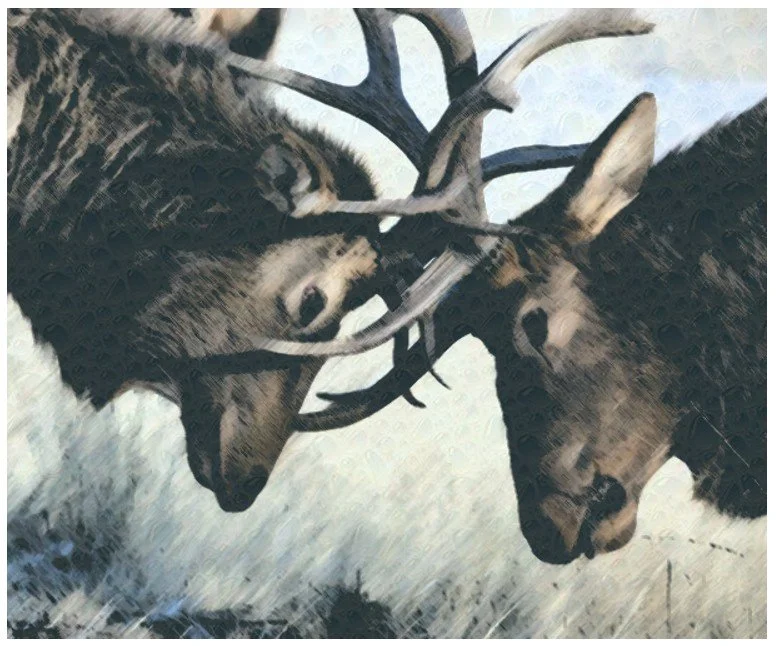
I scraped away more snow, making a crude window into the world below. Then I raised up, straight and tall, and beheld the truth of it. They were elk. Bull elk who’d locked antlers during their autumn rut and fought to exhaustion, tumbling into the water where they’d drowned. They were shut up like jewels in a crystal box. Bodies frozen in an attitude of eternal warfare, victor and vanquished never to be decided, their fates held fast and destined to remain so until the spring thaw released them from winter’s grip and the scavengers slunk away with their bones.
Images of Krebbs flooded my mind. How could they not? I’d kept them locked away for so many years they’d become a part of me. A part of my flesh and blood. My soul, if I had one. Yes. Yes, I’d seen death before. I’d witnessed it, smelled it. Heard its bone-chilling rattle in the backs of men’s throats. I’d even called down its misery upon other men, but never before had it made me feel so alone. So far removed from the grace of god.
My folks had raised me to believe that mercy had a human heart, pity a human face. But I could find neither in the sight before me. All I could see was death.
I untangled the jacket from the antlers. Furay’s name had been scribbled onto the label in the neck-seam, but I ignored it and stuffed the jacket inside my parka without a second look. I didn’t know how or why the lost garment had come to me unscathed. Or why the boy might have removed it in the first place. Nor did I wonder at the distance it might have traveled to find me. I only knew that it was mine, and that it was up to me to care for it.
§
Melissa had always insisted my war was different from hers. That I’d helped save humanity. But I hadn’t saved anyone. Ever. So now, I suppose, I was looking to save myself. I harbored no illusions I could escape the ghosts of my past—I knew all too well they’d be there to greet me the moment I set down my bags in my new apartment in Edmonton—but I did hope a change of scenery might soften their view of me. Allow me an opportunity to seek, and perhaps even find, absolution for my sins.
I was staring out the tavern window now, watching the snow come down. Thinking about the meeting I’d had with the Chateau’s management. They’d made it plain the job was mine if I wanted it, and that they looked forward to closing the deal, formally, when we met again tomorrow morning.
Melissa was staring into her drink. When she looked up, she said, I knew this day was coming, Joe. I knew it when we took up together, and I told myself it would be okay when it did. That we knew the price we’d have to pay. But now that we’re here and the deal’s all but done, and I can’t say I like it much.
I offered no reply. There was no need. She knew I felt the same way.
I worry about you, Joe, she said. You’re a loner, and people aren’t meant to be alone. I know there’s something you haven’t told me, and I get that it isn’t mine to hear, but you know what? I hope someday you find someone you can trust enough to share it with. For your own sake.
She sipped her drink and sighed. She was tired. I could hear it in the ragged edges of her voice. It had been a long three days what with the flight up, the tour of the resort. The long meetings with management and all the rest. We were both ready for it to be over, though we weren’t yet ready to say goodbye.
What do you suppose happened to our bartender? Melissa wondered aloud, draining the last of her scotch. But as she said this, he appeared from the back room. Or, rather, a newer younger version of him appeared from the back room. This one was handsome, though he didn’t appear to be particularly aware of it, and unlike the older gent who’d served us earlier, he was quietly efficient. He pointed, immediately, to our empty glasses. Raised his chin, ready to take our orders.
Scotch, I said. For two.
He acknowledged the order and immediately set about his work. I watched him take down the bottle and pour, wondering at the effort it must have cost Melissa to pretend she hadn’t noticed his outrageous good looks. He had piercing green eyes and a mane of long auburn hair. Shoulders like a lumberjack’s.
Melissa stared at the TV. Daydreaming. She spoke without looking my way. How far is it, she asked, from Lake Louise to Boulder?
Twelve hundred miles.
Twelve hundred, she mumbled. Miles. She peered into her glass. That’s what? Twenty-hours? By car?
Give or take.
She nodded. Turned to me. I like you, Joe, she said with a gallant smile. In fact, I like you an awful lot. But it’s a long-damned drive from here to there, and frankly, I’m not convinced you’re worth it.
I laughed.
She turned her attention back to the TV, and frowned. There isn’t a single honorable thing you can say about the conflict in southeast Asia, she said, positing the words with an air of absolute authority. It’s immoral and ugly. It’s cold-blooded imperialism.
I listened without disagreeing. What was there to say? I was a ski instructor, not a soldier. Hell, I wasn’t even a citizen anymore, except in name. Back when we’d first met, I told her I knew no more about this war than I did about the last. Or the one before that. Or the thousands that had come and gone, age in and age out, since the seas rose and the earth cooled. And I’d meant it. Every word of it. But she hadn’t believed me.
Canada’s lovely, she said, swinging her eyes to the window that looked out at the holiday storefronts. I’m going to recommend it to all of my draft-age upperclassmen. Are you good with that, Joe? she teased. Will you mind if I start an underground railroad?
I smiled.
She said, I’m serious, Joe. Are you good with that? With me hating this war so badly I’d break the law to help innocent boys escape it?
Escape? I raised my brow, ever so slightly.
Yes, escape.
The word gave me pause. It struck me as false, somehow, though I couldn’t explain why. I lowered my glass and considered. But I had nothing for her. The truth was, I couldn’t imagine how someone so whip-smart and good-hearted could believe in something so simplistic and ridiculous. Did she actually think you could escape one life and enter another just by walking through a door?
You’re the most decent person I’ve ever met, I said. Do you know that?
She scowled when I said this, as if I’d meant it as some sort of put-down.
Don’t patronize me, she said. I’m serious, I really want to know.
The black and white over the bar was still playing. It was the news hour. A foreign correspondent dressed in a tiger suit and bush hat was standing at the edge of a squalid village on the other side of the world. He was holding a microphone in one hand and offering vague gestures with the other as he talked, anxiously, about something called Operation Rolling Thunder.
Melissa looked up at the screen and shook her head, exhausted. For God’s sake, she said, it’s 1972. How is it we’re still mired in this insanity? She turned to me. What’s wrong with our country, Joe? I’m serious. What’s wrong with it? She lifted her drink and took a long swallow. I’m sick of it, she said. All of it. The war, the politics—the killing.
She finished the drink and put down the glass. Hey? she said with a taut smile, turning from me to the new bartender. She raised her chin. What’s your take on all of this? Are you as sick of the war as we are? As I am? She twisted the glass in her hand. Let me tell you something, she said. You’re lucky, fella. You’re lucky you live in a country where people still believe in civility.
The bartender flashed a polite glance then turned to me as if I were the one responsible for the unexpected interrogation. Or to blame for having encouraged it.
What if it was like that movie? Melissa said, turning back to me. What if they gave a war and nobody came?
She snatched my sleeve and shook it, playfully. Come on, Joe. I’m serious. What would you think about it? What if they gave a war and nobody came?
I tried to imagine it, the war she was talking about where nobody came. I tried to see it, but I couldn’t get there no matter how much effort I put forth. I couldn’t envision a world without conflict. I couldn’t imagine a time or place when men wouldn’t leap at the chance to slaughter one another in new and original ways. To me, the prospect of world peace seemed far more improbable than the likelihood of global annihilation. But of course I didn’t say this. I only thought it.
Melissa turned again to the bartender. He was rinsing glasses in the sink. She pushed her empty tumbler forward, and said, how about another round, Honey?
The bartender set aside the glass he was rinsing and tossed his bar towel over his shoulder. He wiped his hands and looked at us.
I feel like drinking to something, Melissa said. What about it? Do you know how to make a Moscow Mule? I hear they’re to die for. She laughed, acidly. If you’re going to die for something, she said, it might just as well be something that makes you happy, right?
The bartender looked from her to me. He asked if I’d like one as well, but I told him I’d be fine with another scotch.
Melissa closed her eyes and swayed on her stool as the bartender mixed her drink. She seemed to be listening to music in her own head.
I watched the kid work. There was something about him and the strange way he spoke that convinced me I’d seen him somewhere before. But where? I wasn’t a guy who got around much, and when I did it wasn’t in my makeup to spend time with strangers.
Melissa opened her eyes. She was leaning against the bar now, smiling vaguely.
What’s that you’re humming? I asked.
Oh, nothing, she said. Nothing you’d know, anyway.
It’s called “Rhymes of a Red Cross Man,” the bartender interrupted quietly. His back was to us. When he turned around, he laid out two paper napkins and set down our drinks.
You know about Robert Service? Melissa said in a mildly impressed voice, giving her hair a toss and following it up with a slinky sideways glance.
The young man offered a modest shrug. I’m Canadian.
Melissa grinned, and raised her drink. To Canada, then, she said. And Robert Service.
I glanced at my reflection in the gaudy backboard mirror. I was an old man—forty-six on a swift downhill run—so listening to Melissa talk to this handsome, long-haired, green-eyed boy reminded me, pointedly if not painfully, that we had no business carrying on as a couple. She was still young, still going places. Places I’d already been and never wanted to see again.
I could drink these all day, she said, raising the copper cup to her lips. She leaned across the bar, and held it out to the young man in offering. Wanna sip? I don’t mind sharing.
The boy glanced at the drink, but declined, politely, with a tepid shake of his head. Melissa sat back and allowed a whimsical expression to run away with her face. He doesn’t mind, she said, lilting her head at me. We’re Americans, but we’re broadminded. Aren’t we, Joe.
I lifted my glass.
My lover here is dumping me for a new job, she said. How do you like that?
The bartender glanced across his shoulder. Paused a moment, then turned and said, I’m just filling in here tonight. My shift’s over in a couple of hours. He was looking at both of us, but speaking to Melissa. I’m playing the Cellar Door this evening. My band and me. If you like live music, you ought to drop by. We put on a pretty good show.
Melissa touched her lip with her little finger. What kind of music?
The boy straightened. Your kind, I’m thinking.
§
Back in our hotel room, Melissa wandered here and there with dreamy eyes, running her fingers over the furniture. Moving stuff around, then moving it back.
He was nice, wasn’t he? I said.
The bartender?
I combed my hair with my fingers and adjusted the pillow behind my back. I was stretched out on the bed looking over the employment contract I’d signed. The one I’d bring to the meeting tomorrow morning. Yeah, I said. The bartender.
You know, she said, back in the States, he’d have been drafted already. Shipped off to a combat zone. Maybe even killed.
We looked at one another.
I can’t believe we’re never going to see one another again, Joe. I can’t believe I’m losing you.
I set the contract aside.
She looked out the window.
I’m here now, I said.
Yes. But you won’t be tomorrow. Will you?
Would you like to see him play?
The bartender?
Yes.
She turned and blinked, surprised. Why? Would you?
I would, I said, but I can’t. I have the early meeting at the resort tomorrow, remember? But you can go. You should go.
She demurred, pretending she didn’t want to be without me. But I knew better, so I insisted. Go on, I said. It’s our last night here. Go on and enjoy yourself. Go put on something nice, and I’ll call the concierge and arrange a cab.
Will you wait up for me?
If you want me to.
§
When she left, I laid back and let my head fall against the pillow. Then I closed my eyes, unable to bear the weight of the day any longer. Something went out of me, and something new replaced it. Something I didn’t yet understand, and perhaps never would.
I couldn’t say for certain whether the bartender had a mole on his left cheek—his beard prevented my knowing—but at that moment, the moment I’d wished for longer than I could remember—I was willing to believe he did. I was willing to believe that after all these years I’d finally found Colin Furay.
Would a seventeen-year-old boy have turned his back on his old life without a second thought? Been clever enough to join the ROTC so no one would guess at the inner workings of his secret plan? Who could say? Who could possibly know? Could his folks—simple ranch people with nothing to their name—have been in on the deception, too? Could they have known all along that when their son set out on that cross-country trek ten years ago, his intent was to abandon them? Them, and the country of his birth? All to avoid the bloody chalice of Vietnam?
I pictured him on stage in the spotlight, holding his guitar. Tilting the microphone to his mouth. Closing his eyes against the lights and throwing back his head. Belting out a ballad of road-dust blues.
Then I thought about Melissa.
The rest was easy.
Robert McGuill’s work has appeared in Narrative, the Southwest Review, Louisiana Literature, American Fiction, the Saturday Evening Post and other publications. His stories have been nominated for the Pushcart Prize on five occasions, and short-listed for awards by, among others, Glimmer Train, the New Guard, Sequestrum Art & Literature, and Narrative. McGuill’s short story collection, The Outskirts of Nowhere, is due for release in March 2028 by Cornerstone Press.