Review, “Crux: A Play,” by Jesi Bender.
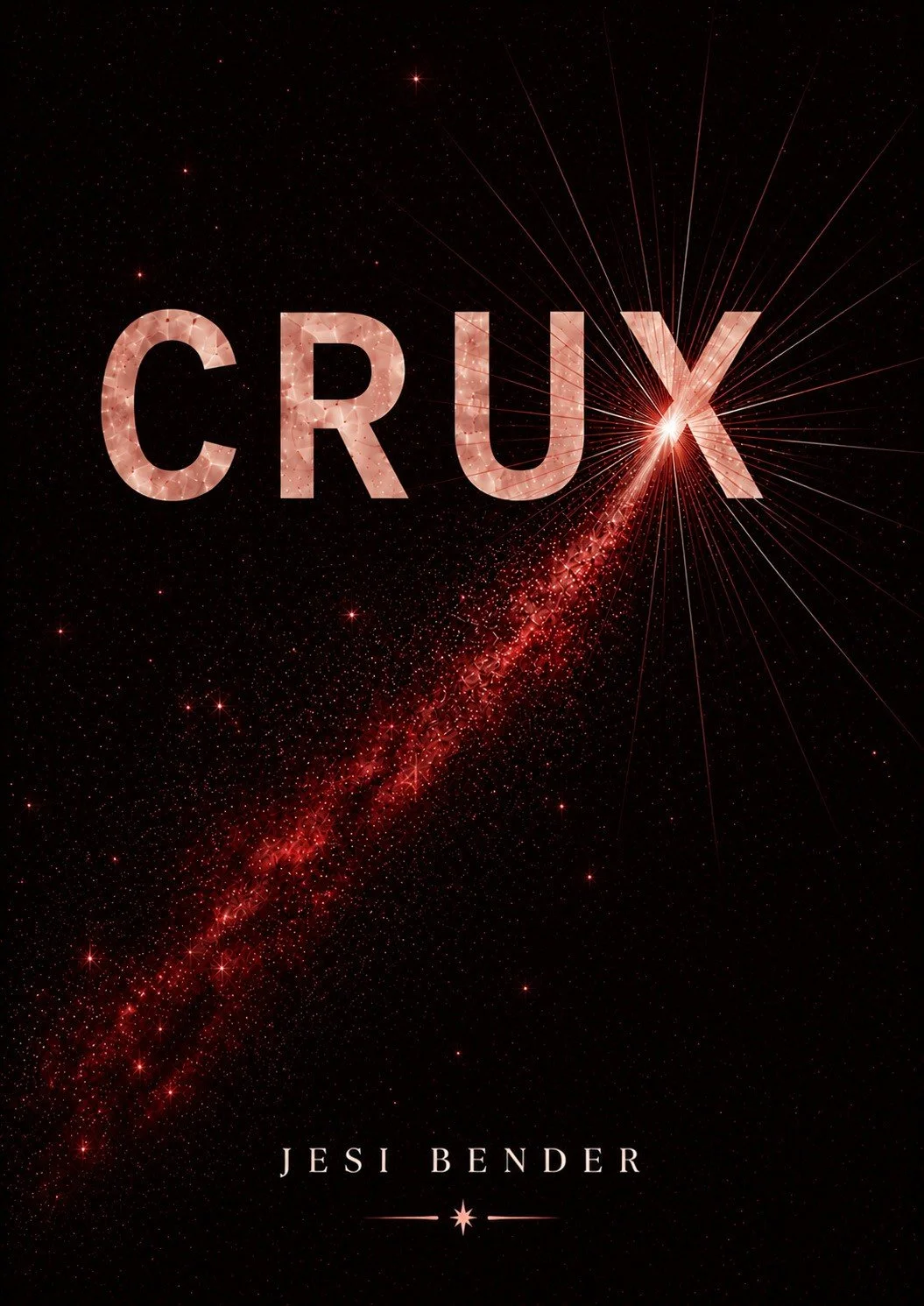
Jesi Bender. Crux. New York: Sagging Meniscus Press, 2026.
Jesi Bender grounds her new play, Crux, in the prison cell of Irish revolutionary Bobby Sands during his 1981 hunger strike. Yet much of the play unfolds in an imaginary space where Sands engages in intellectual debate with political revolutionaries from across history, including Romanian communist Haia Lifșiț and American political activist Bayard Rustin. Much of this discussion revolves around the utility of self-sacrifice on the political stage and, more broadly, whether violence or nonviolence offers the most practical means to an ideal end, whether that violence is directed toward others or toward oneself.
Structurally, Crux is fragmentary and abstract, a postmodern dreamscape that attempts to wed George Bernard Shaw’s “play of ideas” with some of the early work of Suzan-Lori Parks, with a bit of Symbolism thrown in for good measure. The play begins with a lengthy prologue, essentially a scientific lecture delivered by Irish physicist John Stewart Bell, before transporting the audience to a prison cell somehow capable of “emitting a flow of faces” belonging to dozens of significant political radicals. Bender embraces an avant-garde polyvocality that at times evokes Antonin Artaud and at others Caryl Churchill.
These disparate influences are intriguing, but their combination make the play’s stylistic identity feel diffuse. Bender’s considerable ambitions both enrich the piece, but occasionally pull the drama in competing theatrical directions, and Crux does not always succeed in bringing those impulses into a fully cohesive dramatic whole.
Yet the greatest strengths of Crux lie in its ideas and in Bender’s ability to transform historical and political questions into something approaching a Socratic dialogue. The most compelling moments are therefore often the contentious debates between Sands and his fellow radicals, particularly when Bender allows competing philosophies of political action to collide without reducing them to easy answers. The writing literate and politically engaged writer with a keen interest in history, and the play demonstrates an impressive willingness to take seriously the moral and philosophical dilemmas that accompany political resistance.
One challenge with Crux is that its considerable intellectual ambitions sometimes take precedence over more conventional dramatic development. Its characters occasionally function less as fully realized theatrical personalities than as vehicles for historical positions and philosophical arguments. As a result, the play can feel at times more literary than theatrical, more concerned with exploring ideas about political action than with rendering those ideas through the embodied experience of performance. The fragmentary structure, historical allusions, and intellectual debates produce moments of genuine power, even if they do not always settle into a sustained dramatic rhythm.
This tension between literary ambition and theatrical form ultimately makes Crux a fascinating but uneven stage work. Bender has constructed a provocative intellectual encounter among figures who represent radically different approaches to resistance, sacrifice, and political change. Yet the play's ideas sometimes overwhelm its dramaturgy. One is left wondering whether these arguments might find a more natural home in the compressed intensity of a short story or poem, or perhaps in the deliberately literary form of a closet drama. Crux is worth engaging for the seriousness and ambition of its questions; its greater challenge is finding a theatrical form equal to them.
Dr. Michael Boynton is Professor of Performance, Directing, and Playwriting at Jacksonville State University, Alabama.