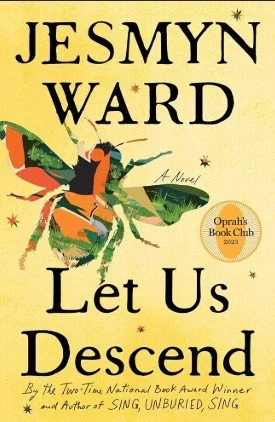
Jesmyn Ward. Let Us Descend. New York: Scribner, 2023.
Reviewed by Zijian Liu
A Light that Consumes Itself
Near the opening of Jesmyn Ward's Let Us Descend, Annis, enslaved on a Carolina rice plantation, describes her mother as a woman who “burns like a sulfur lantern” and “leads me through the world's darkness” (4). The image is easy to read as simple comfort, a warm light in a cruel place. But a lantern burns its own fuel to give that light, and the novel makes the cost of the comparison clear soon after, when Annis's mother is sold away and Annis learns, for the first time, what it is “to be alone” (26). Ward's fourth novel is built on this exchange. In a world arranged to strip enslaved people of every attachment, love survives, but only by consuming the person who gives it.
The plot is a descent in the literal sense. After her mother is sold south, Annis is marched to the slave market in New Orleans and then to a sugarcane plantation in Louisiana, where she is accompanied by Aza, a spirit who has taken the name of Annis's grandmother. Ward takes her title from Dante, “Let us descend, and enter this blind world,” and the borrowing is apt: each stage of Annis's journey takes her further south and further into the dark, and the novel asks what can still give light at the bottom. Its answer is a chain of people who burn for one another.
The chain is clearest in Annis's love for Safi, another young woman on the march. When Safi rests a hand over her heart, Annis says her heart “blazes like a fire” (31). The figure echoes the mother's lantern but changes it. The lantern was a contained flame, carried to guide someone else; Annis's fire has no frame and spreads outward. When Safi is taken from her, sorrow “sinks at the heart,” but Annis insists “there is love, too” (48). Love here is less a cure for grief than what is left burning after it, and Ward lets the two coexist rather than resolving one into the other.
That refusal to simplify is the novel's strength. Ward gives Annis a mother, a lover and, eventually, a sense of her own worth, and she shows how each grows out of the one before. Annis can believe that “there are others in this terrible world who will touch me with kindness” (33) because she was once loved without condition. When she finally escapes by river, her mother's voice returns to her, saying “Float, my baby. Float,” and she feels that love “stronger than ... the drag of the river” (266). The novel reaches its turn when Annis says, “I will be free” (267). The line lands because the reader has watched every source of that conviction being built.
The same quality is also the book's main limitation. Ward writes in an intensely lyrical first person, and her register rarely varies. Scenes of brutality, of tenderness and of spiritual vision are rendered in the same heightened prose, so that the language, at moments, flattens differences the story depends on. Readers who come to the novel through the realism of Salvage the Bones may find the pace of its middle chapters slow. Yet the sustained voice is also what makes the descent feel continuous, a single consciousness holding itself together under pressure.
Let Us Descend is not an easy book, and it does not offer the consolation its lyricism might seem to promise. The novel’s argument is harder and more honest than that: love does not rescue Annis from slavery, but love is what she carries through the ordeal, and love’s cost is paid by the people who give it. The image of the mother as a lantern, burning herself to light her daughter's way, is the book in miniature.
Zijian Liu