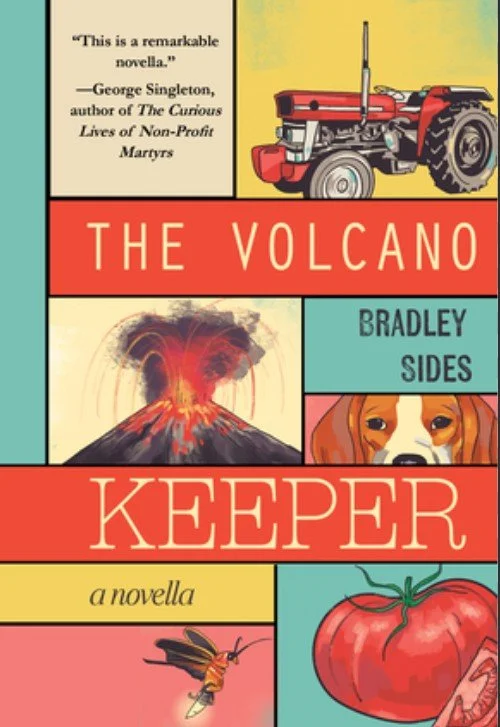
Bradley Sides. The Volcano Keeper: A Novella. North Carolina: Regal House Publishing, 2026.
Reviewed by Tim Lockette
My grandparents were aliens to me. My mother’s parents lived right next door, and my father’s parents lived just ten minutes away from the place I grew up, and maybe five minutes from the place I live today. Yet they seemed like immigrants from a completely different country.
I spent all but a year of my childhood in air-conditioned houses. I played with plastic spaceships and looked forward to a future in which I could live on the Moon or Mars. I didn’t want to live in Alabama, so I didn’t: the woods outside were Endor or the jungles of some Johnny Quest adventure – here was anywhere but here.
My grandparents did, in fact, live in Alabama. One grandfather hitchhiked to work at a brass foundry in Anniston. The other grandfather worked in a different pipe shop, which provided a stable paycheck and health care that allowed him to continue farming a couple dozen head of cattle. They were not simple country people. My father’s father was neurotic in a way that would be normal for, say, a lawyer in Manhattan: he hid his first failed marriage from everyone, even his own kids; he was afraid of driving; he added a pointless “e” to the end of his surname to spite his father in some obscure dispute. My mother’s father was whip-smart and could have had a brilliant college career, if war and the death of his own father had not kept him down on the farm. He was quick to anger, and he once hit a man in the head with a baseball bat. I feared him, and I was impressed by him. Shortly after he died, someone asked me if we had been close. I just blinked in confusion. Had closeness even been an option?
I’ll admit I’m probably not the target audience for The Volcano Keeper by Bradley Sides, a work of magical realism that is built on the love between a grandfather and grandson in a lyrical rural Alabama. Still, the odd minimalism and strange elisions of this speculative-fiction novella won me over by the end. Sides is an Alabama writer – he teaches at Calhoun Community College – and he’s very much of the Big Fish school, pulling us in with a circus of tall tales and hoping we’ll stay for a supper of genuine local Southern color.
The Volcano Keeper opens in September 1962 with elementary-age Charley and his grandfather Clarence enjoying some late-summer watermelon and throwing the rinds into the pasture of the family’s 200-acre farm. It reads like an old man’s memory of his grandfather: the two are close, the sweetness of watermelon is a foretaste of heaven, Charlie views his grandfather as his hero and Clarence is as loving and tender as any television granddad. If you find this stuff hard to believe, hang on. There is more to the bond between them than we see here, but the reasons for this tenderness don’t surface until later in the book.
Over watermelon, Clarence tells Charley that he – Clarence – is sick and will die soon. He also says that something magical will emerge on this land after he is gone, and he says that Charley must take care of this new thing. By Page 15, Clarence’s death is an accomplished fact, and soon the earth begins to shake. A volcano rises from the pasture like a very old man with enormous wings.
One can imagine where this situation would go, and one can’t imagine where this situation could go. This is almost always the tension at the heart of magical realism. What does the volcano mean, assuming volcanoes have to mean anything? Will Charley successfully fulfil his vaguely-defined duty, or will he fail the volcano? If he does do his duty, will he be rewarded in the end, or will he end up like Linus van Pelt sitting very sincerely in the pumpkin patch? A volcano implies an eventual eruption, but Charley doesn’t live in geological time, and he may not live to hear the other shoe drop. The only clear clue we’re given is the fact that the volcano grows bigger with every death in the community.
What Sides doesn’t do with this metaphor is perhaps more important than what he does with it. No one even thinks of turning Clarence’s property into Volcano Park and selling tickets. Charley doesn’t wind up feeding his neighbors to the caldera as if it were some sort of carnivorous plant. Charley and his relatives and neighbors are simple, unassuming Alabama country people. After a lifetime in Alabama, I can assure you that such people really do exist, though I haven’t the slightest clue what makes them tick.
Charley’s volcano can’t be all that tall, measuring only 200 acres at its base, yet it blots out our view of much of the outside world. Years slide by and that other Alabama volcano – race – rarely rumbles, aside from a scene in which Charley’s family watches television coverage of the stand in the schoolhouse door and concludes that George Wallace is mean as a damn snake. The Cuban Missile Crisis means little to people on the slopes of Vesuvius. Charlie never worries about his draft number, and as we slide toward 1973, we become confident that he’ll never be called. In 1969, Charley shuts down moon-landing skeptics by noting that the volcano is real, though a lot of people who hadn’t seen it wouldn’t believe it.
In fact, we, the readers, don’t actually see the volcano that much. It’s often mentioned, rarely described, a less-is-more mountain in a less-is-more book. It’s a fact in the background, an odd exotic thing we struggle to imagine, looming over an Alabama farmhouse.
Perhaps it is here simply to frame and call attention to a dreamlike sequence of small rural Alabama memories. In late summer, whole families rush into the fields to put the hay away before it gets wet. The characters cut open a persimmon to predict the winter weather. They get muddy and bloody helping deliver a newborn calf. All my life, I’ve heard older people talk about the joy of tying a string to a junebug: the description in this book is the first I’ve seen that explains why such an activity would be fun.
The overall effect is rural Alabama as it might appear in a Terrence Malick film: a collection of scenes, spare and factual, in which we’re not told what to think, not given anyone’s inner thoughts and not led down some easy-to-see path of plot. The book’s cover tells us that Charley must wrestle with the meaning of the volcano, but in truth this is our job, as readers. Charley seems to know a meaning, but his love language consists of actions, not words. He goes on tending the volcano, which makes the family farm less profitable by the day.
The book jacket also hints that the volcano is a metaphor for grief, but I do wonder if there is not a different Southern theme emerging here. The volcano is a landform. It is what the family land has become. If Sides said nothing at all about Charley’s motives, we could assume that he’s just another land-bound Southerner, clutching his fistful of dirt like Scarlett O’Hara.
Sides makes it clear, though, that love is what makes Charley stay – love and a hope that something eventually will happen that will make his wait worthwhile, something that will turn his loss into, well, anything but loss.
The Volcano Keeper is very much a book about staying put, a thing that most rural Alabamians do not in fact do, which is why rural Alabama goes on being rural. It’s a book about sticking with a family plot that is becoming more a burden than a boon. . It’s a book about saying goodbye because you’ve chosen to stay, instead of saying goodbye because you’ve chosen to leave. It’s a book about the fact that staying is indeed a choice, just like leaving is a choice. This book posits the idea that if you stay, you get to go on being simple and pure, if you were simple and pure to begin with. It suggests a way to preserve whatever is left in you that is indeed still simple and pure.
You keep it by staying put with the ones you love.
Tim Lockette is a writer, English teacher, and former journalist who lives in Jacksonville, Alabama. He’s the author of three YA novels, Atty at Law, Atty in Love, and Tell It True. His website is timlockette.com.