Review, “Magic Can’t Save Us: Eighteen Tales of Likely Failure,” by Josh Denslow.
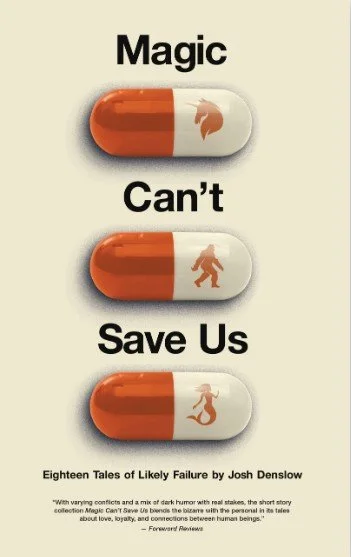
Josh Denslow. Magic Can’t Save Us: Eighteen Tales of Likely Failure. New Orleans: University of New Orleans Press, 2025. Reviewed by Tim Lockette
One night, as I was working my way through Josh Denslow’s Magic Can’t Save Us, I had an odd dream.
My wife and I were living in one of the old Victorian hilltop houses in Anniston, a city fifteen miles from where we actually live. Most of the house was in good repair and livable, but much of the square footage of the house was wasted on a gorgeous and decrepit wooden staircase that went up to a cupola or bell tower or some such no-longer-useful structure. When I say decrepit, I want you to picture the movie Crimson Peak. One might step out onto the staircase to see if it’s raining or snowing.
My wife was busy trying to fix up the staircase. She told me there was no need to hire someone because all we needed was to board up the holes. The staircase didn’t have to be up to code, but it needed some repairs because she had contracted with the Calhoun County Jail to house the jail’s overflow of inmates. I was stunned that my wife, a vegetarian and women’s studies major, would contract with Alabama’s notorious criminal justice system to do anything at all, much less to house people in a drafty staircase with no plumbing. I was seriously asking myself whether I could remain married to this person when my wife told me we were housing only ghosts. A weird belfry-like structure was perfect for ghosts, and we could give a home to the spirits of all the folks who’d died in the jail.
I woke thinking I’d created a new genre of fiction: an urban fantasy in which a couple struggles with their own personal issues while uncovering the injustices of the past by talking to the South’s ghosts. I thought I was a genius.
But I didn’t invent a new subgenre of fantasy. Josh Denslow did, and I only dreamed about it. The 18 stories in Magic Can’t Save Us give us a new approach to speculative fiction that blends urban fantasy with workshop fiction.
You know workshop fiction, even if you’ve never been in a creative writing class or writer’s retreat. It’s the contemporary realism that literary writers have been turning out for more than half a century: stories of fraying relationships, woven through with telling details of modern life, related by unreliable narrators who struggle to get along with partners who are quirky and sphinxlike. It all feels so real because there are never any clear endings, and because no one really understands their partners or themselves. Just like in real life.
Take that struggle and place a mythical creature in the center of each story, and you have the central conceit of all eighteen stories in Magic Can’t Save Us. By mixing light fantasy with suburban discontent, one could easily create something charming and silly and pleasant to read. Think Harry and the Hendersons. Denslow finds something much more significant in this territory. His stories are whimsical and witty as the model demands, but fortunately, he’s willing to be cruel, to bend his characters to the breaking point and take them to depths one can stand to look at only for one brief moment of horrified realization. There is, in fact, a sasquatch story in Magic Can’t Save Us – “Tale #7: Remnants” -- and it goes to a place Harry and the Hendersons would never go, a place that maybe your mind wandered to once while watching the film, a place you felt ashamed for going.
To tell you more would be to offer spoilers. The wonder of these stories is in discovering exactly how Denslow is going to work a leprechaun, a mermaid or a banshee into a story about modern relationships. It’s a pleasure to watch him stick the landing nearly every time, turning the magical creature into a perfect metaphor for a certain kind of relationship dysfunction. Occasionally, there is a metaphor that doesn’t quite click – I mean, what would you do with a water sprite in a story about a dying relationship? – but even when the magic seems a little crammed in, it’s crammed into an intriguing marital dilemma. In “Tale #9: The Lie,” a couple are unable to conceive: the man gets a sperm count and passes with flying colors, but he decides to lie and take the “blame” for the couple’s fertility problems because “I’d rather she felt disappointed in me.” One doesn’t need a water sprite or any other magical intervention to see a tension driving the story to a conclusion.
Some of these stories will change the way you see relationships, and others will change the way you read fantasy or mythology. After all, what is in fact the biggest source of distress for “damsels?” Doesn’t it make sense that dragons are creatures that are hired by women, to protect them from “suitors?” Denslow gives us a suburban landscape (“Tale #12; The Court of Common Pleas”) in which a fire-breathing lizard perches over perhaps every third house, guarding against the return of a cheating husband. This changes, fundamentally, how you see the image of the man in armor, fighting a dragon. He’s no hero, but he’s also no longer a tired trope.
All the narrators in these first-person stories are men struggling in relationships with women, but we’re two-thirds of the way into the book before a cheater appears. Denslow finds plenty of other ways men can fail to be part of a couple. Maybe the guy doesn’t fight for what he wants. Maybe he doesn’t know what he wants. Maybe she doesn’t know or do these things. And maybe, well, there are some relationships – and some families – that one simply needs to walk away from, without anger or judgment. In telling us all this, Denslow manages to deftly avoid the sexism at the heart of some of the best-known creature myths. There is, for instance, a medusa story (“Tale #4 Silence”) but we see no medusa. Instead, we confront the riddle of why a man turns to stone – a common-enough fate as men age – and we’re left to speculate about why.
The male narrators represent a wide variety of male dysfunction, from cheaters to cowards to guys who mean well but just don’t seem to light a fire in a partner. Most of these men have some respectable degree of self-awareness, and some of them have a gift for finding a telling detail. The women in the collection seem a little less varied – all of them decent and distant and smart and hard to completely make out, all of them capable of producing at least one deep, mysterious quote that lets the reader know they have hidden depths. If this is a fault, it’s a fault of the genre – workshop fiction – in which less is more, showing beats telling, and showing too little beats showing too much. One doesn’t come to modern short fiction looking for closure, or an ending, or answers. The stories in Magic Can’t Save Us are best read over a long time, perhaps one tale per day, but this is true of almost every short story collection.
When they’re read in one or two sittings, the stories in this book give the impression of a single narrator, reincarnated again and again into dysfunctional relationships. Every life produces a flash of enlightenment. (“Instead of unspoken rules, we could have had real rules,” realizes the narrator of “Tale #1: Keening.”) Over many of these lives, one realizes that perhaps the message is that there aren’t dysfunctional or functional relationships, but simply relationships, each of them hopeless in its own way. One can walk away or one can stay, and sometimes either choice involves some pretty grim math.
I suppose nobody promised us a fairy tale -- and yet, somehow, everyone promised us a fairy tale. Growing up means realizing that even a fairytale world wouldn’t resolve this struggle at the heart of living together. Magic can’t save us, but in the wreckage of Denslow’s narrators, a reader might find a glimpse of other things that can.
Tim Lockette is a writer, English teacher, and former journalist who lives in Jacksonville, Alabama. He’s the author of three YA novels, Atty at Law, Atty in Love, and Tell It True. His website is timlockette.com.