“maybe hope lies there,” Interview, Benjamin Gucciardi and RS Deeren.
In his second collection of poetry, Arguments: Poems, Benjamin Gucciardi brings his readers into a beautiful tug of war between action and inaction, impact and intent, and hope and grief. The book is partly a response to this moment in history, a time of piling environmental disasters and compiling social and political strife. It is also a meditation on an individual’s place at the infinite crossroads of these turmoils. With a command for scope, Gucciardi allows his readers to see the micro—a mother forced to pretend for her family, a note scribbled at the bottom of a diagram detailing a mining operation— while simultaneously connecting them to the macro—the fate of the world and humanity’s place in it is the culmination of our treatment of each other and the planet. In the interview below, Gucciardi explains how poetry is a great entryway into the complexities and contradictions that make up not only a single person’s life, but of the lives of all of us. He talks about the need for hope and the scale at which we can care for each other, even as more storms begin to stir.
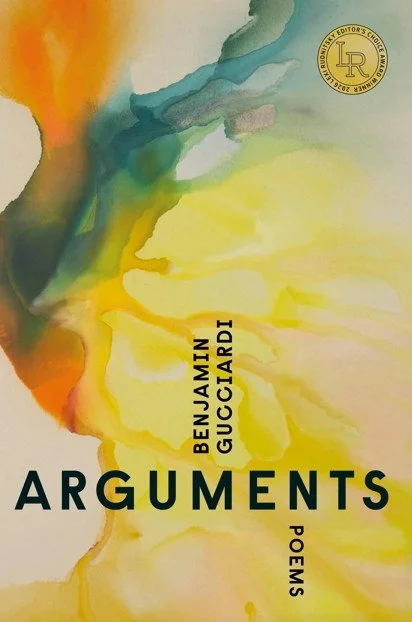
RS Deeren: Many of these poems juxtapose toil with comfort but rarely—if ever—separate the two. Like in “Thread Count,” where the speaker can’t help but think of the human and environmental toll it costs for soft bed linens. When writing, where do you find inroads like these, to challenge the state of comfort with the work that goes into making it?
Benjamin Gucciardi: About twenty years ago, I read the Buddhist philosopher and poet Thich Nhat Hanh’s “A Cloud Never Dies.” In that text he says, “When I drink my tea, I drink my cloud,” pointing toward the whole web of relationships that existed to make that cup of tea: rain, soil, seed, plant, tea leaves, labor, distribution systems, money to buy the tea, the care involved in making it, and the time to enjoy it.
I’m interested in poems that reveal the connections between things—how they form and how they are made. And when I say things, I don’t just mean objects or material things (like the sheets in “Thread Count”), but emotions, histories, relationships between the seen and the unseen. So often I’m surprised by the insights that come from exploring process, causality, and connection. That is an essential element of what poetry is for me: an attempt to uncover what becomes visible when we trace the processes of made things, feelings, histories, and memories.
RSD: Arguments does what great poetry needs to do: it makes the reader see the broader world by looking at its smallest parts. A pinto bean becomes a tool for climate liberation. Hot oatmeal wafts over conversations of unknown futures. When writing, how often do you start small and grow from there and how often is the process reversed?
BG: I like thinking about the different ways poems move. I was talking the other day with a friend about centrifugal and centripetal poems. Centrifugal poems start small and open, and centripetal poems want to call everything back into one central image, where the poem bends back toward a central image. I find those terms to be really useful, but of course not all poems fit neatly into either category.
When I’m writing, I don’t usually start out saying, this will be a centripetal poem. Instead, sometime in revision, I see where the image system takes me and what form of motion feels most aligned with the poem’s core insight. I might realize that a poem wants to bend toward one image or idea and edit toward that end. I think there is a fairly equal balance between those types of poems in the collection. For example, the two ars poeticas “A Poem Wants You to Be Broken” and “A Poem Wants You to Be Whole” offer a nice juxtaposition. I think part of why they work against each other is that “Broken” is centripetal, everything moves inward toward that one image of the feather, and “Whole” is centrifugal, moving outward and expanding to bring in more and more of the world. The poems move against each other not only in their thesis but in their use of rhyme, their length, and their direction of motion, and I think that formal contrast contributes to their meaning.
RSD: The extended “Argument” series takes the speaker to a climate activist camp where they, like the reader, are wedged between nature and capitalism’s impact on it. The speaker also highlights how they too will leave an impact on the planet simply by existing. An unfair question: is this series a call to action or a meditation on the actions an individual has already taken?
BG: That’s a great question. I think it’s probably both, and I’m wary of separating those things too neatly. Hannah Arendt makes a distinction between the active and contemplative lives, and talks about action as something we initiate in the world without being able to control its consequences. The speaker in “Argument” has already taken action; he’s protested, taught, organized, tried to live according to his convictions, and part of what brings him to the camp is his frustration that those actions seem to have had so little effect. He begins to wonder whether action must become more forceful in order to matter.
But the forceful action never comes. The sabotage never happens. The camp disbands, and the speaker goes home. What does happen is that he enters a temporary community, takes on risks and responsibilities, learns new ways of seeing, and becomes more conscious of the relationship between his own life and the world he wants to protect. The poem inhabits the difficulty in reckoning with the limits of what we can do with our actions.
The book is concerned with the limits of care. How do we keep caring in a world where our care and our actions are not enough? How do we keep trying, even knowing that our efforts won’t have the desired effect? At what scale, and toward what, should we direct our time and attention and action? I think the book documents some of my wrestling with those questions, and importantly, it resists offering answers in favor of remaining inside the pressure between positions.
RSD: I loved nestling into the moral ambiguities found in these poems. Of note is one section in “Argument,” “A note beneath a diagram…” The speaker studies how to sabotage mining operations but admits that a part of them would covet the commodities these companies might make. Humans hold contradictions. How do you work through these when writing?
BG: Poetry seems to be the art form most willing to admit that contradiction is fundamental to human experience. Poems don’t need to solve anything. I think the best poems may even actively resist easy resolution or arrival. Writing a poem forces me to look closely at what I feel about complex questions, and of course not just what I feel, but how to articulate that feeling or knowing. The choice of how to say a thing is laden with all kinds of traditions, expectations, histories, and that choice also clarifies what I really think. I’m often so surprised by the way the syntax reveals the thought in a way my mind can’t or won’t or is afraid to.
RSD: The speaker is told that “to let go of fear is to make room for hope.” Later, they lament that “mostly action, too, went nowhere… the pipelines were built.” It’s a gutting description of environmental and humanitarian movements, especially in the United States. Where does the hope come from, both when writing these poems and for your readers?
BG: In the aftermath of Trump’s reelection, my friend the beloved writer Rebecca Solnit wrote, “The fact that we cannot save everything does not mean we cannot save anything and everything we can save is worth saving.” That insight helps me focus on a smaller scale, where hope feels more available. At the scale of the poem or the garden or the family or the neighborhood, we can break down action into manageable concrete steps and show up to them with care more easily.
RSD: Adding to that, grief is a theme throughout this collection. Loss comes from a family member who has passed, the songs of extinct birds played on a smartphone, a mother forced to mask as someone/thing else. What do you see is the relationship between hope and grief?
BG: I think hope is inherent in grief because grief is an expression of attachment, or as Wordsworth puts it in Elegiac Stanzas, “Not without hope we suffer and we mourn.” When we feel that pain deeply, it is an admission of how much we love what we have lost, whether that loss is human or nonhuman. And maybe hope lies there, not in believing that we can undo the loss, but in remaining close to the love that made us grieve in the first place.
RSD: The book balances themes of inheritance and legacy. “Photograph” blurs the roles of fatherhood and childhood. A throughline in “Argument” is the speaker’s daughter and what her future might look like. “In Defense of Sadness” wonders if “sadness is hereditary.” As a species, we shoulder so much of the past and present. As a poet, what helps you put that weight onto the page?
BG: I never studied poetry formally in school, but I had the good fortune of finding the critic Helen Vendler’s work, which has been important to me. One of the things Vendler says she first asks of a poem is what “piece of life” it is connected to and where and when that life is being lived. The idea of leaving a piece or trace of a life on the page feels to me like an invitation to be vulnerable, to not shy away from letting others see the speaker’s humanity. The page can hold traces of all kinds. And there’s a kind of permission in knowing it’s ok to make your mark and let it be your footprint, your line through the forest.
RSD: From the opening poem, “Catania,” you position readers between images of nature and of humanity’s encroachment and violence on the land and on each other. One section of “Argument” lists classic activists and texts. What other texts and authors should your readers move to after Arguments?
BG: For people interested in some of the philosophical questions around action and its limits and possibilities, Hannah Arendt’s The Human Condition has pushed me to think about those concepts in new ways.
For poets thinking about the relationship between the human and the more-than-human world, I’d point toward Aracelis Girmay, Robert Hass, Arthur Sze, and W. S. Merwin, all of whom have been important to me. A few recent books I’ve loved are David Baker’s Whale Fall and Katie Peterson’s Fog and Smoke. Robert Macfarlane’s Is a River Alive? is also a book I’ve been thinking about a lot; it explores the possibility of extending legal rights and protections to rivers, forests, and other parts of the living world.
And my partner Lauren Markham’s Immemorial is a speculative essay about language in the face of climate catastrophe, thinking about what has been lost and what soon might be, while also pushing the imagination toward other possibilities. We’re working through some of the same questions and concerns through very different sensibilities and genres, and I’ve learned a lot from watching her do that.
RSD: Finally, can you speak a little on the collection title and the extend series that anchors it?
BG: I don't understand argument only as a disagreement between two positions. I'm interested in argument as a form of pressure, one thing pushing against another, a person arguing with themselves, a poem arguing with its own assumptions, the past arguing with the present. In that sense, I think the book is full of arguments that don't necessarily get resolved, and the final poem in the book, “Harbors,” is a kind of a landing place. The speaker in that poem strips away his responsibilities and reduces his life to its most basic conditions, and even there he’s left with the mind’s dissatisfaction. How can we live with that mind? How can we make peace with that questioning and desire for something better? Something more? That feels like the work of lifetimes.