Review, “The Bad Child: A Maria Janion Reader,” Edited and translated by Marta Figlerowicz.
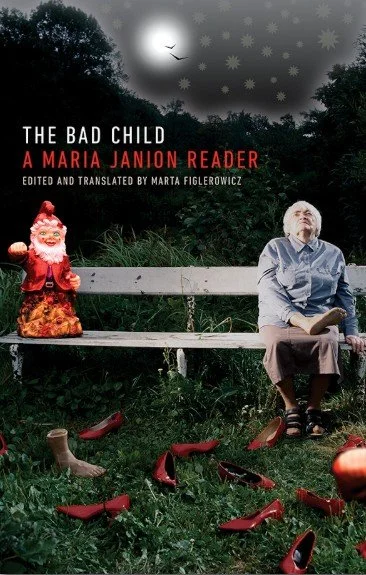
Maria Janion. The Bad Child: A Maria Janion Reader. Edited and translated by Marta Figlerowicz. Minneapolis: University of Minnesota Press, 2025. Reviewed by Anita Rescia.
Maria Janion (1926-2020) was a transgressive Polish scholar, educator, and translator whose prolific and multifaceted work has unfortunately been unavailable to an anglophone audience until now. Over her career, Janion’s writing explored vast topics ranging from (Polish) Romanticism, fascism, literary criticism, reflections on literary theory in general, cultural history, popular culture, folklore, and more, with a depth that revealed her insatiability as a reader and thinker. The Bad Child, with selections of Janion’s oeuvre edited and translated by Marta Figlerowicz, is a perfect introduction for scholars of related fields, especially 18th and 19th century Central/Eastern European history, colonialism, historical Marxism, and comparative literature. It will also be of interest for educators teaching under the contemporary resurgence of reactionary politics. Figlerowicz notes the wide applicability of Janion’s work in her introduction, writing that the author is “well aware of the generalizability of her insights and effortlessly links them to these broader intellectual networks” (ix).
The essays take on questions such as: How can one be a culturally rooted socialist without becoming a national socialist? What can madness reveal? Is there a primacy of ideas over literature? Due to the wide net that Janion’s work casts, I believe a slightly more robust introduction by the editor might be useful to help the readers situate themselves with the diverse readings that follow. Despite this, the array of themes that were selected for this book’s eleven chapters do serve to reach Figlerowicz’s goal of revealing the astounding breadth and depth of Maria Janion’s research to those unfamiliar with it, making this a useful introductory book.
The selected essays in the first part, “A Theory of Eastern Europe”, trace the history of the Polish condition not only back to the 18th century when the partitioning began, but even further back in time to the Middle Ages, when the Slavic people were forced to convert to Christianity. Janion argues that this loss left a hole in Slavic cultural memory, particularly due to the erasure of local folklore and pagan mythology that left lacunae in the archives. Over time, this historical and cultural loss led to an identity crisis that played a role in the birth of the Polish myth of the “Borderland” and the development of Poland’s double identity as both a colonizing and a colonized people. Poland’s perceived superiority to Eastern states was however tempered by their perceived inferiority to the West. Ultimately, this bred an unhealthy nationalism that can be linked to the rise of fascism throughout the 20th century. Figlerowicz decided to close the theory set forth in the first two chapters of this section with a third chapter that showcases Janion as a critic of art and literature. While this selection does mark a shift in style, it is nonetheless an interesting one. It focuses on the art of Jacek Malczewski and explores an element of indigenous mythology that has persisted: the rusałki, or Slavic female water demons. The analysis contained here sets the stage for following sections of the collection.
Part II begins with “The Patriot-as-Madman”, a fascinating reflection on figures who have been affected by a “madness” brought about by their love for Poland. Drawing heavily from Polish Romantic writers and poets—her primary area of scholarly investigation—Janion explores how the Polish condition in the 18th and 19th centuries can be considered a “national mental disorder” (93). This illness, while debilitating, is also revealing, as “psychosis lets one see reality for what it is” (98). Janion posits that the mad patriots that protagonize stories (like Rejtan in Adam Mickiewicz’s work) embody what many of their fellow citizens were thinking and feeling but could not express. These heroes' dramatic moral opposition to Poland’s partitioning offers an opportunity for citizens to collectively recognize themselves in their “patriotic despair”, especially when political resistance was not an option (87). This ties in well with the fifth chapter, “Socialism as Prometheism”, which refers to the idea that “human beings need to be their own creators and saviors” (110). This is an idea that comes up repeatedly in Romantic literature, such as Mickiewicz’s Dziady, a text to which Janion often returns. As a Marxist, Janion also draws connections between Prometheism and Marxism. Janion cites Polish thinker Leszek Kołakowski, who believes that for Marx, salvation is the work of “a collective Prometheus who, in principle, is capable of achieving absolute command over the world he lives in” (113). Here Janion emphasizes the importance of standing with the marginalized and suffering.
Part III showcases more of Janion’s work in criticism and literary theory, and her talent for bringing together Western and Eastern European thought. First, she explores the psychoanalytic concept of the phantasm drawing from Freud, which can take the form of daydreams (linked with Romanticism), as well as hallucinations (which connect with the previous section’s “madman”). Romantics who suffered from these forms of madness began to use their psychic visions to fracture the reality that the Enlightenment depicted as singular and instead “probe its multiplicities” (121). The next chapter shifts its focus onto the history of literature (and art) alongside and against the history of ideas. Janion proposes a sharp difference between the two, founded on their incomparable timelines as well as the origins of ideas themselves. Janion criticizes literary theory that results in the primacy of ideas over artwork and the subordination of literature to ideology or to special topics in history. In the final chapter selected for this section, the editor brings us back to the phantasm, but this time as seen in the specific genres of melodrama and horror. Like madness and phantasms, horror is dangerous, threatening destabilization and transgression because its monsters, vampires and other beings deconstruct norms and reality and open a space for “absolute freedom—freedom from humanity itself” (171).
Part IV is the most eclectic of the book’s sections, taking on the theme of “The Authority of the Other” in different contexts. In the first, Janion explores the marginalized Jewish community and, specifically, the hopes to build a Jewish legion within the Polish army to achieve Polish emancipation following the partitioning, particularly through the lens of the poet Adam Mickiewicz. In the second, Janion, a privately queer woman herself, engages with then-recent lesbian fiction by author Nicole Müller, while also offering reflections on the marginalization of homosexuality and conventions of intimacy. The book’s final chapter is composed of fragments of an interview between Maria Janion and Kazimiera Szczuka, a Polish historian and one of Janion’s students. These excerpts reveal memories of Janion’s adolescence in the occupied Vilnius ghetto, her experience as an academic who was often viewed as a transgressive outsider, and her educational philosophy.
Having learned about and read Janion for the first time only now, it is a shame that she isn’t better known outside of Poland and Eastern Europe. Overall, this book does an excellent job bringing an understudied scholar’s ideas to a new readership. With it, it is my hope that Janion will become more accessible and receive more attention from an English-speaking audience in the future.
Anita Rescia is a PhD candidate in the Department of Hispanic Languages and Literature at Stony Brook University (SUNY). Her dissertation project focuses on childhood political awareness and agency in 20th century fascist Spain and Italy.