“‘To Whom This May Concern’ Travelers and Travel Papers in the Early Modern Mediterranean,” Essay, Lama Elsharif.
I was twelve when I first sailed across the Mediterranean. We traveled this way every summer for several years, crossing between North Africa and Europe. Sometimes we set out from Benghazi on the Libyan coast, heading to Izmir or Athens, with an occasional stop at the port of Alexandria, Egypt. Other times we sailed from Tripoli to Valletta, Malta. The ports of those cities were old, all of them, their stone quays worn and darkened by centuries of use, the brick edges covered with seaweed, and the harbor walls rough where waves battered them.
The travel process was simple. The port officials would check our tickets and stamp our passports, and the next thing we knew we were onboard. As soon as the ship’s horn sounded and we began to move, I remember running with my brother to the outer deck to look back as we drifted away from land. The port, the people on the dock, everything shrinking. Then we would race to the other side of the ship to watch the open sea spread before us, stretching in every direction with no end.
I remember the smell of salt and seaweed and the wind cold against my face. I remember the steady sound of small waves breaking against the hull as we moved through them. And I remember the dolphins. A few hours after we set out, on almost every trip, a pod of dolphins would appear alongside us, swimming in the same direction, as if leading the way or simply keeping us company.
I knew nothing then about the centuries of people who had made this same crossing before me, carrying papers, hoping to arrive. I had no idea that the right to cross had always been a bureaucratic achievement, a matter of who would vouch for the traveler and who would believe them.
Years later I became a historian and ended up working in archives on both shores of this sea. While rummaging through the documents, I found older travel permits that had moved across these same waters in the hands of merchants, diplomats, and sea raiders. The documents taught me to see these crossings differently. They reveal a Mediterranean in which a travel pass did not yet identify a person so much as establish a relationship: between traveler and vessel, merchant and sovereign, corsair and consul, paper and the power willing to enforce it.
Protection and predation had always traveled on the same paper, and the stories of those who crossed were far more unequal and stranger than I had ever imagined when I stood on my toes and leaned over the ship’s railing to watch the dolphins.
The Travel Pass
The word passport is older than the nation-state. Its roots lie in the French passeport, from passer which means to pass, and port, a harbor entry point.[1] Travel passes or travel permits, as they were known, had existed for centuries. During the expansion of sea-borne empires into the Mediterranean from the late sixteenth century onward, the flourishing trade routes they brought also drew increased sea raiding, and travel documents multiplied as a result.[2] Issued by local authorities or consulates, they became a routine instrument of movement carried by anyone who hoped to cross the sea without hindrance.
Long before the modern border existed, rulers and diplomats issued letters, petitioning other powers to allow their subjects safe passage across contested waters, through ports and into foreign territories. These early documents rarely described the travelers. What mattered was who stood behind them, the sovereign or the consulate whose signature vouched for the bearer.
Despite their political weight, these early travel passes functioned more like modern-day tickets than like the passports we carry today. While today’s passport lasts up to ten years and covers countless trips, state representatives in the early modern period issued the old passes for a specific voyage, however long it took, and each expired when that voyage ended. A new journey required a new pass before departure. Among the records of the French archives is a clearance certificate for French vessels, issued by Louis-Jean-Marie de Bourbon, Admiral of France, for a voyage from the port of Toulon. It has a large X crossed through it, marking, in all likelihood, the end of the voyage.[3]
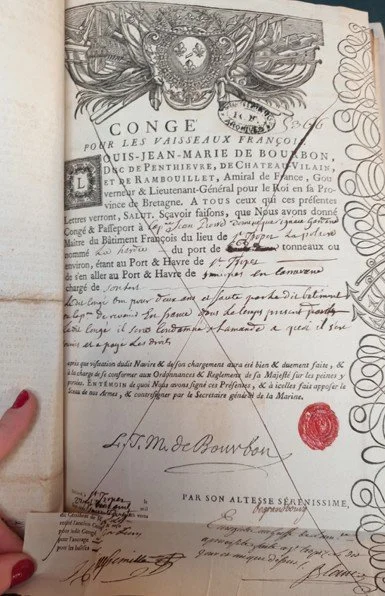
French naval clearance certificate (congé pour les vaisseaux français) for a voyage from the port of Toulon, cancelled upon the captain’s return with a large X. Archives Nationales, France.
Crossing the Mediterranean during that time meant navigating multiple dangers. Storms could sink a ship, disease could spread through a vessel from a single sick passenger. But the threat travelers feared most was from the sea raiders who prowled these waters, North African corsairs and European privateers alike. Unlike pirates, corsairs and privateers operated within a recognized, if often contested, legal framework from the sixteenth to the early nineteenth century. They held commissions from their governments to attack enemy vessels, and treaties bound them to spare ships that belonged to friendly states.[4] For this reason, both passengers and sea captains carried travel passes as proof of safe conduct. When corsairs approached, it was these documents they demanded to see first before they decided the ship’s fate.
Verifying a document at sea, however, was never simple. While North African corsairs spoke multiple languages, there were encounters where neither party shared a common tongue, making the inspection of papers uncertain and tense. As a result, some states changed the physical design of the travel passes. In 1797, for instance, President John Adams signed a Mediterranean passport for the Ship Commerce of Newport, authorizing its captain to sail to the Mediterranean with his cargo and crew “without any hindrance, seizure, or molestation.”[5]
The document has creases where the captain once folded it, the paper yellowed with age, the top edge cut in an irregular scalloped pattern. Its counterpart went to Algerian corsair captains under the terms of a treaty with the Algerian ruler. When a corsair approached an American vessel, the two parts fit together like a puzzle, confirming its legitimacy at sea. Other governments adopted the same solution, the Swedish and Danish among them.[6] On the back, near the top, a brief surrender note, written years later in a smaller script, records the end of the voyage, “surrendered at the port of Newport, June 1805, for a new passport,” much like the French clearance pass mentioned earlier, though marked here with words instead of an X.[7]
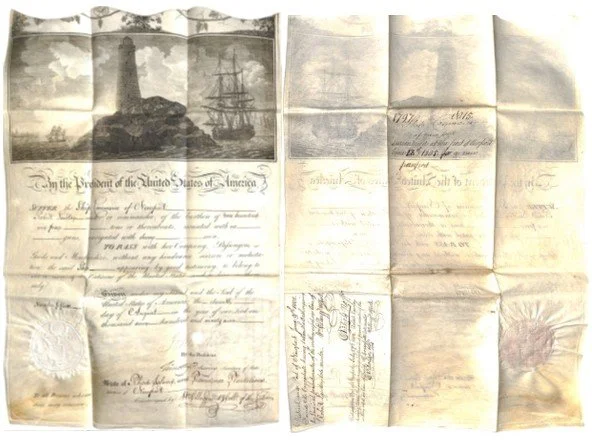
Mediterranean passport for the Ship Commerce of Newport, issued by President John Adams, 1797, cut along an irregular scalloped edge at the top to prevent forgery. National Archives at Boston, Massachusetts, United States, NAID 73982111 (Source).
Throughout the early modern period, people crossed the sea for trade, pilgrimage, scholarly exchange, and diplomatic missions, each carrying papers and dependent on the protection those papers promised. For merchants, that protection was a matter of survival. Without a pass, a vessel was fair game. Any raider could seize it and its cargo. With it, the merchant sailed under the protection of a sovereign power.
The French system shows how far that protection could extend. French merchant vessels in the Mediterranean were part of a continuously numbered, carefully administered series, tracked by number, route, tonnage, and captain.[8] A merchant’s travel pass connected him to an administrative apparatus extending from the vessel all the way to Versailles. Attacking a properly documented French vessel meant attacking France itself. The French Admiral could dispatch warships to retaliate when needed.[9] The British, Dutch, and Venetian Admirals operated by the same logic.[10] North African merchants understood this well. Many chartered European vessels to move their goods, drawn by the protection those flags conferred.[11] Pilgrims traveling to Alexandria often did the same, booking passage on French and Venetian ships.[12]
To keep peace treaties with European powers intact, Ottoman authorities held North African corsairs accountable when they broke them. The North African regencies of Tripoli, Tunis, and Algiers were nominally under Ottoman suzerainty, and the Ottoman government periodically sent sultanic decrees to their rulers, expressing displeasure when their corsairs seized ships that belonged to Ottoman allies, in violation of existing treaties.[13] The regencies, in turn, passed these instructions down to their own corsair captains. A correspondence signed in September 1766 by Tripoli’s ruler, Ali al-Qaramanli Pasha, reveals his orders to his corsair captains that an agreement had been reached with Venice, and his corsairs were to avoid Venetian waters and leave Venetian vessels untouched. Any violation would result in severe punishment, he warned.[14] But instructions and passes could only do so much. Such exchanges between the Ottoman authorities and their North African regencies were a recurring feature of the system, since no party in the Mediterranean, whether European or North African, complied all the time.
War created a different kind of violation. States at war dispatched warships and privateers to seize enemy vessels, but they often ended up plundering ships that had nothing to do with the conflict. During the Seven Years War, fought between Britain and France (1756–1763), neutral merchants caught between warring naval powers had little recourse. At the end of 1758, a British captain, Andrew Wilkinson, seized a French vessel bound for Malta. The cargo on that ship belonged to a Tripolitanian merchant.[15] It consisted of wool, dates, and butter, and 178 sequins he had gathered to ransom his son from captivity in Malta, which Wilkinson refused to return. Tripoli, like every other Mediterranean power, treated its subjects as an extension of the state itself. Whoever harmed them had to reckon with Tripoli’s authorities directly, which is why Ali al-Qaramanli Pasha filed an official complaint with the British Royal Court. British records document similar seizures affecting merchants from other regencies as well. Abdulsalam, a Tunisian merchant, lost his cargo of wheat to a British captain in August 1762.[16]
Diplomats crossed the Mediterranean with more institutional backing than pilgrims or merchants, yet they too needed papers. Like many diplomats of his time, Abdulrahman Agha served as Ambassador of the Ottoman regency of Tripoli while also running his own trading business. In 1757, during the Seven Years War, a British cruiser seized a French vessel carrying his cargo under a British consular pass. His papers were in order, the goods documented and protected by the very pass the British consul in Tripoli had issued. Ali al-Qaramanli Pasha filed a formal complaint on behalf of his ambassador.[17] A year of negotiations followed. What happened next, the documents do not say.[18]
Decades later, in 1779, Abdulrahman Agha wrote a letter in Arabic to a senior French official.[19] He wished to travel to Lyon, by way of either Marseille or Livorno, a port city located in what is now Italy, and he requested that the French minister send him a باصبرته — bassbarta, a transliteration of the word passport written in Arabic script, “according to custom and law,” as he put it.[20] He signed himself انباشدور — anbashador, a transliteration of the word ambassador written in the same way.[21] Abdulrahman Agha knew the language this system required, and his letter shows that it worked in Arabic just as well as it did in French.
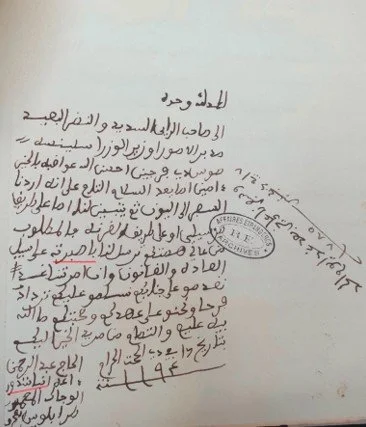
Letter in Arabic from Abdulrahman Agha, Ambassador of Tripoli, to a senior French official requesting a passport (باصبرته) to travel to Lyon, 1779. Archives du Ministère des Affaires Étrangères, France.
European diplomats also sought protection for themselves and their subjects, and over the decades, the system’s logic gradually shifted from filing complaints to taking preventive measures. In 1763, the Swedish ambassador filed a detailed complaint documenting the seizure of Swedish vessels by Tunisian corsairs and listing the crews and cargo held in Tunis.[22] But that was the kind of case that could drag on for months if not years through courts and negotiations for compensation, if it came at all. By the 1780s, European diplomats had learned to secure protection before their ships set sail through multiple channels, such as imperial decrees from Constantinople and peace treaties negotiated directly with the North African regencies. Between 1780 and 1783, for instance, the ambassador of the Habsburg Empire (present-day Austria) requested imperial decrees from the Ottoman authorities to protect Habsburg merchants.[23] The Ottoman government issued the requested decrees in both cases. Protection flowed through every available means: consular offices, imperial courts, diplomatic letters in French and Arabic and Ottoman Turkish, on behalf of merchants who had connections that vouched for them.
Not every traveler had that level of protection. North African pilgrims sailing to Alexandria en route to Mecca may have carried passes of their own, but their protection rarely matched what merchants received. Merchants had diplomats who advocated for them and royal courts with a direct stake in their cargo. Such connections gave a merchant’s pass real weight when trouble came. Pilgrims, on the other hand, had no comparable network behind them. Whatever protection they had, came through general Ottoman correspondence, not the kind of individual backing a merchant’s pass carried. In one such report, the Ottoman Admiral wrote to the Sultan that corsairs had been stopping travelers with legal travel documents, seizing their cargo, taking them captive, and stripping their papers directly from their hands. The Admiral proposed an imperial decree forbidding this under any pretext.[24]
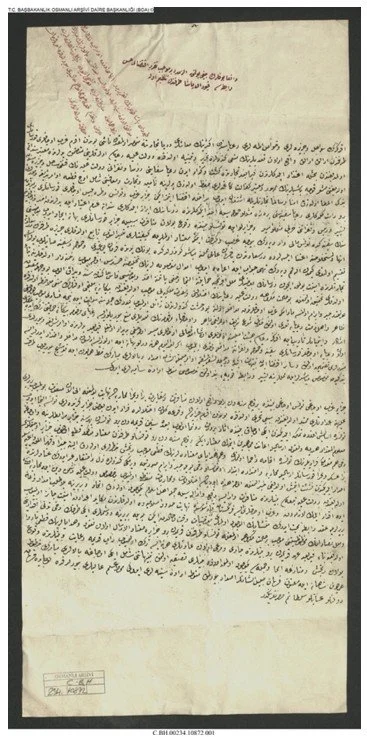
Report from the Ottoman Admiral (Kapudan Pasha) to the Sultan on the protection of Mediterranean travelers, recommending an imperial decree to prevent corsairs from seizing travel documents from their bearers. Cumhurbaşkanlığı Devlet Arşivleri, Türkiye.
Even corsairs needed passports.
Corsair captains on all shores operated within this documentary world. European consulates in North African ports routinely issued travel passes to corsair captains.[25] For the consulates, these passes were as much about control as protection, a way to monitor corsair captains and hold them accountable to treaty terms. For the corsairs themselves, a pass from consulates or governments offered protection against warships that might otherwise seize their vessels and take them into captivity.[26]
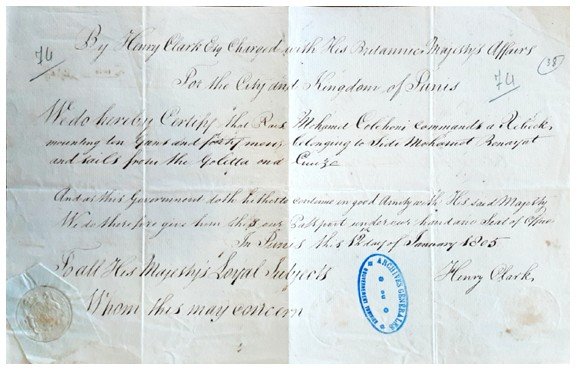
Rais Mohamed, a Tunisian corsair captain, commanded a xebec, a fast, nimble vessel most common to the southern Mediterranean, built for speed and coastal maneuver. On the twelfth of January 1805, Rais Mohamed sailed out through the channel carrying a passport issued by Henry Clark, His Britannic Majesty’s representative in Tunis.[27] The document certified Rais Mohamed’s command of his vessel and attested to the friendship and goodwill between the Tunisian government and the British Crown. Clark addressed it “To all His Majesty’s Loyal Subjects, Whom this may concern,” a phrase for any British naval officer who might one day stop Rais Mohamed at sea and need to know he sailed under British protection.[28]
Passport issued to Edward Deering Preble by the American Legation in London, June 4, 1828, its Signalement column left entirely blank. Library of Congress.
On the fifth of February 1805, less than a month after Clark signed this travel permit, a British naval officer aboard a Royal Navy vessel encountered Rais Mohamed at sea in company with a Ragusan vessel he had plundered and seized as a prize.[29] According to the naval officer, Ragusa (present-day Dubrovnik) was at peace with Tunis, its ships among those his treaty obligations bound him to spare. The Ragusans, the officer noted, had been “treated in a most infamous manner.”[30] He released the Ragusan prisoners and detained Rais Mohamed “for his improper conduct on the high seas.”[31] Although many North African corsairs operated within this legal framework, carefully honoring the treaty protections their passes guaranteed, violations did occur, and Rais Mohamed’s case illustrates what happened when they did.
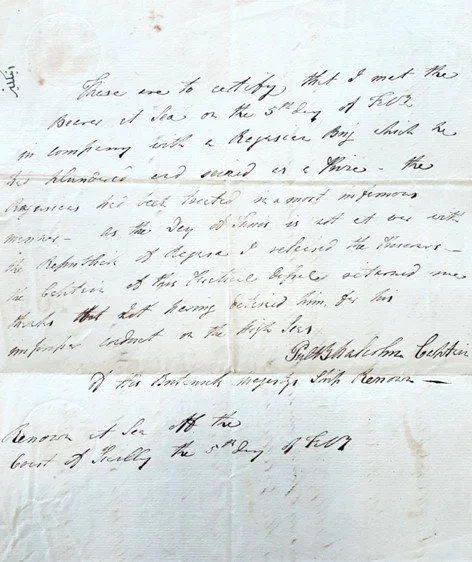
The back of the same travel permit, written vertically, endorsed by a British naval officer recording the seizure of a Ragusan vessel by Rais Mohamed, February 1805. Archives Nationales de Tunisie, Tunisia.
Rais Mohamed was one of many North African corsair captains who carried European passes, and Tunis was only part of a much larger system. The British consular register for Tunis alone records dozens more passes issued to Tunisian corsairs in a single year.[32] Similar documents moved through British and French consular offices in the rest of the regencies. The French consulate, for example, had issued around 239 passes to Algerian corsairs by the end of the eighteenth century, in addition to passes it issued to Tunisian and Tripolitanian corsairs.[33] Each register preserves only one consulate’s traffic with one regency, a fraction of a system that ran through every port on the coast, every consulate, and every regency. Taken together, the registers point to a much broader system than either archive can capture on its own.
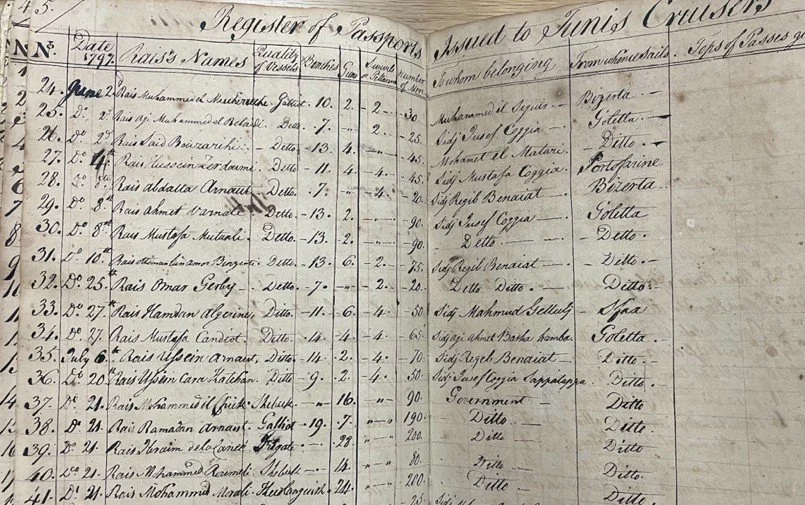
Register of Passports Issued to Tunis Cruisers, 1797. The National Archives (Kew), United Kingdom.
The Body
Sometime in the 1820s, Mediterranean passports began to take new form. A Sardinian passport template preserved in the British archives shows what that change looked like. At the top, the royal arms of Sardinia, issued in the name of the king. The main text still carried the old formula, “allow freely to pass, without molestation or impediment.” But the form asked for more than a name. Along the left margin, the form asked, in sequence, for Età (age), Statura (height), Capelli (hair), Fronte (forehead), Sopracciglia (eyebrows), Occhi (eyes), Naso (nose), Bocca (mouth), Barba (beard), Mento (chin), Faccia (face), Carnagione (complexion), and, at the very end, Segni particolari (distinguishing marks).
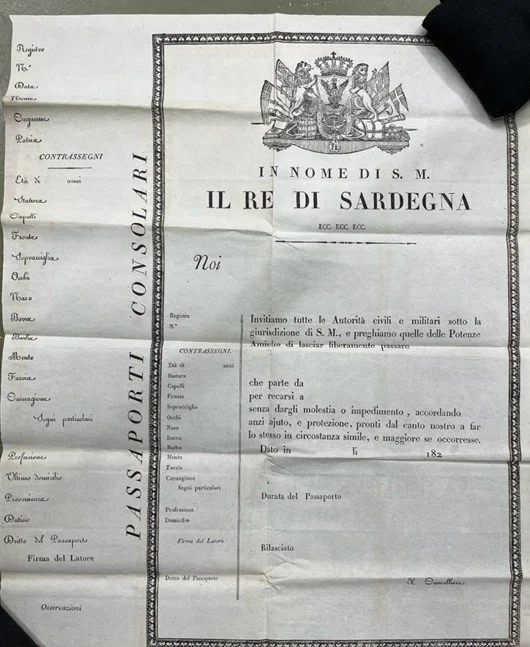
Blank printed passport template (Passaporto Consolare) issued in the name of the King of Sardinia, 1820s. The left margin lists thirteen physical distinguishing marks required to identify the bearer. The National Archives (Kew), United Kingdom.
British consul Henry Clark’s travel pass for Rais Mohamed described its bearer entirely through relationships and capacities. He commands this vessel. He serves this owner. This government stands in good relations with His Majesty. The document, however, said nothing about his body. The Sardinian template, on the other hand, asked for thirteen physical categories designed to fix a specific human being to a specific piece of paper.[34] By the early nineteenth century, travel passes began to take the form of the passport we carry today. Who vouched for you was still important, but so was your face.
An American passport issued that same decade carried a similar list along its left margin.[35] Yet officials did not apply the new practice consistently. In 1828, the American Legation issued a passport to Edward Deering Preble, son of the prominent American naval commodore Edward Preble. The document bore a signature, date, and seal, but its Signalement, or physical-description section, remained entirely blank. Over the following year, police and consular officials in Hamburg, Dresden, Vienna, Munich, Stuttgart, and Linz stamped and endorsed the passport for further travel. None filled in the empty Signalement column.
It is tempting to read that blank as a mark of privilege: perhaps the father’s name and rank made the physical-description section unnecessary. But the omission may also suggest that officials were still finding their footing with this new documentary practice and therefore applied it unevenly in the 1820s. Either way, the passport captures a transition in progress. The state had begun to expect the body to appear on the page, even when, in practice, officials sometimes chose not to.
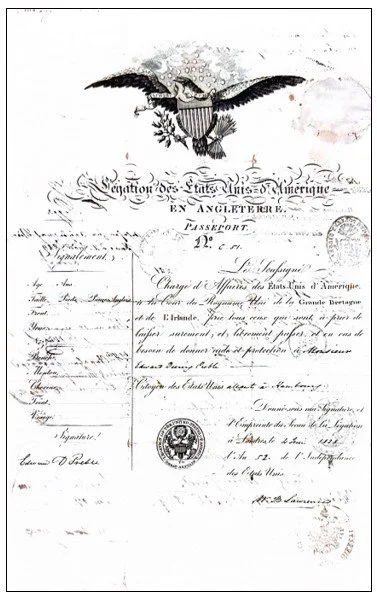
Passport issued to Edward Deering Preble by the American Legation in London, 4 June 1828, its Signalement column left entirely blank. Library of Congress.
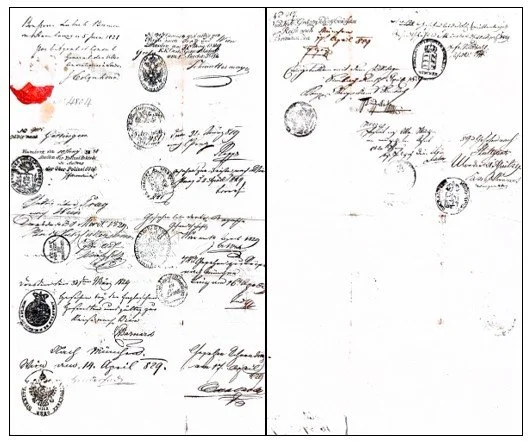
Additional pages of Preble’s passport, showing the accumulated visa stamps and endorsements of police and consular officials in Hamburg, Dresden, Vienna, Munich, Stuttgart, and Linz, June 1828–1829. Library of Congress.
The Sea
I was twelve when I first sailed across the Mediterranean. For days we sailed through open sky and sea, two shades of blue with us floating between them. To a child like me, the excitement of departure faded with sameness, and after a while the trip felt endless because at sea, day and night collapse into one another and time loses its meaning. While the ship neared Izmir’s port, passengers flocked to the decks to see it. My brother and I rushed upstairs to the outer deck and squeezed our small bodies through the crowd to reach the railing. A faint landscape of the city slowly came into view, sharpening as we drew closer. Buildings emerged from the haze and behind them a chain of mountains embracing the coastal city, like a backdrop in a painting.
By the time the ship sounded its final horn and stopped, everyone’s patience had worn out. We were all already lined up, luggage in hand, ready to disembark. My brother and I hopped onto the dock, stood next to our mother and watched our father hand over our passports to the official to check and stamp them. Then we walked away.
Deep in the archives, I finally understood what I had been part of. Abdulsalam, Abdulrahman Agha, and Rais Mohamed had all crossed this sea before me, and so had countless others from both shores whose names the sea never recorded, each one of them folding a document against their body, hoping it would be enough.
Lama Elsharif is a historian of the Middle East and North Africa whose work rethinks Mediterranean history by centering Ottoman North Africa. Her book project, tentatively titled “Small Wars of Scarcity: North African Corsairing Between Crises and Empires,” draws on North African, Ottoman, European, and American sources to examine corsairing as a state strategy for survival amid environmental crises, political instability, and imperial transformations. Based on her dissertation, this work received the 2024 College of Liberal Arts Distinguished Dissertation Award and an honorable mention for the 2024 Malcolm H. Kerr Dissertation Award from the Middle East Studies Association. After earning her PhD from Purdue University, Elsharif held an Andrew W. Mellon postdoctoral fellowship at the Wolf Humanities Center at the University of Pennsylvania. She then joined the Mahindra Humanities Center at Harvard as a postdoctoral fellow, where she is currently an associate scholar. She has a chapter on Tunisian corsairing in an edited volume published by Amsterdam University Press. Her work has also appeared in The Markaz Review and Gibraltar Magazine.
Works Cited
[1] For the definition of “Passport,” see: https://www.etymonline.com/word/passport
[2] Judith E. Tucker, “Piracy of the Eighteenth-Century Mediterranean: Navigating Laws and Legal Practices,” in The Making of the Modern Mediterranean: Views from the South, ed. Judith E. Tucker (Oakland, California: The University of California, 2019), 125–33.
[3] Archives Nationales de Paris (National Archives of Paris, ANP), AE/BI/1107, congé pour les vaisseaux français, issued by the Duc de Penthièvre, Admiral of France, for a voyage from the port of Toulon, [c. April–May 1777].
[4] Tucker, “Piracy of the Eighteenth-Century Mediterranean,” 132.
[5] Commerce [Ship], August 11, 1797; Series: Mediterranean Passports; Record Group 26: Records of the U.S. Coast Guard, National Archives at Boston (Waltham, Massachusetts); National Archives Catalog, https://catalog.archives.gov/id/73982111, accessed [April 08, 2026].
[6] For an image of a Swedish passport and a register of their issuance, see Müller, Consuls, Corsairs, and Commerce, 145–6. See also, Eric Gobel, “The Danish ‘Algerian Sea Passes,’ 1747–1838: An Example of Extraterritorial Production of ‘Human Security,’” Historical Social Research 35, no. 4, issue 134 (2010), 176–8.
[7] Ibid.
[8] Archives Nationales de Paris (National Archives of Paris, ANP), AE/BI/1107, congé pour les vaisseaux français, issued by the Duc de Penthièvre, Admiral of France, for a voyage from the port of Toulon, [c. April–May 1777].
[9] Muḥammad al-Hādī ʻAbd Allāh Abū ʻUjaylah, Al-Nashāṭ al-Lībī Fī al-Baḥr al-Mutawassiṭ Fī ʻahd al-Usrah al-Qarmānlīyah, 1711 M–1835 M Wa-Atharuhu ʻalá ʻalāqātihā Bi-al-Duwal al-Ajnabīyah (Banghāzī: Jāmiʻat Qāryūnis, 1997), 180.
[10] Rodolfo Micacchi, Ṭarābulus Al-Gharb Taḥta Ḥukm Usrat al-Qaramānlī (Jāmiʻat al-Duwal al-ʻArabīyah, Maʻhad al-Dirāsāt al-ʻArabīyah al-ʻĀliyah, 1961), 96; Eugène Plantet, Correspondance des beys de Tunis et des consuls de France avec la cour, 1577–1830; publiée sous les auspices du Ministre des affaires étrangères, avec une introduction et des notes par Eugène Plantet, vol. 2 (France: F. Alcan, 1899), 588; Giorgio Cappovin, ‘Abd al-Salām Muṣṭafá Bāsh Imām, ʻUmar Bārūnī, Ṭarāblus wa-al-Bunduqīyah fī al-qarn al-thāmin ʻashar (Ṭarāblus, al-Jamāhīrīyah al-Lībīyah al-Shaʻbīyah al-Ishtirākīyah al-ʻUẓmá: Manshūrāt Markaz Dirāsāt Jihād al-Lībīyīn ḍid al-ghazw al-Īṭālī, 1988), 81.
[11] Lucette Valensi, On the Eve of Colonialism: North Africa before the French Conquest (New York: Africana Pub. Co., 1977), 47–9.
[12] F. Moussaoui el-Kachai, “Wabāʾ Al-Ṭāʿūn Ti al-Ǧazāʾer al-ʿOṯmānīyah Dawrātah Wa Selm Ḥiddatah Wa Ṭoroq Intiqālah,” Dirasāt Fi Al-ʿOlūm al-Insānīyah Wa al-Iǧtimāʿīyah 1, no. 1 (June 2001), 140–2.
[13] Başbakanlık Osmanlı Arşivi (Republic of Türkiye Prime Ministry Ottoman Archives, BOA), C.BH Dosya no. 214 Gömlek no. 9965, 10 Zilkade 1201 [c. 23 August, 1787].
[14] This document is appended in Giorgio Cappovin, ‘Abd al-Salām Muṣṭafá Bāsh Imām, and ʻUmar Bārūnī, Ṭarāblus Wa-al-Bunduqīyah Fī al-Qarn al-Thāmin ʻashar (Ṭarāblus, al-Jamāhīrīyah al-Lībīyah al-Shaʻbīyah al-Ishtirākīyah al-ʻUẓmá: Manshūrāt Markaz Dirāsāt Jihād al-Lībīyīn ḍid al-ghazw al-Īṭālī, 1998), 260.
[15] The National Archives of the UK (TNA), FO 76/1 Consul Robert White (1756–1765), 31–3.
[16] Başbakanlık Osmanlı Arşivi (Republic of Türkiye Prime Ministry Ottoman Archives, BOA), AE.SMST.III Dosya no. 97 Gömlek no. 7302, 1176 Receb 26 [c. February 1763].
[17] The National Archives of the UK (TNA), FO 76/1 Consul Robert White (1756–1765), 31–3.
[18] The National Archives of the UK (TNA), FO 76/1 Consul Robert White (1756–1765), 54–6.
[19] Archives Nationales de Paris (French National Archives, ANP), AE/BI/1105, Abdulrahman Agha to Charles Gravier, Comte de Vergennes, French Foreign Minister (referred to in the original as “prime minister”), 19 Ramadan 1193 AH [c. October 1779].
[20] Ibid.
[21] Ibid.
[22] Başbakanlık Osmanlı Arşivi (Republic of Türkiye Prime Ministry Ottoman Archives, BOA), AE.SMST.III Dosya no. 231 Gömlek no. 18269, 21 Safer 1177 [c. late August 1763].
[23] Başbakanlık Osmanlı Arşivi (Republic of Türkiye Prime Ministry Ottoman Archives, BOA), C.HR. Dosya No: 169 Gömlek: 8434 (1194 C 01) [c. May 1780]; See also (BOA), C.HR. Dosya No: 114 Gömlek: 56811 (1195 Ca 02) [c. May 1781]; (BOA), C.HR. Dosya No: 79 Gömlek: 3946 (1196 N 29) [c. September 1782]; and (BOA), C.HR. Dosya No: 118 Gömlek: 5884 (1197 Ra 20) [c. February 1783].
[24] Başbakanlık Osmanlı Arşivi (Republic of Türkiye Prime Ministry Ottoman Archives, BOA), C.BH Dosya no. 234 Gömlek no. 10872, 29 Zilkade 1205 [c. 1790–91] (catalogued elsewhere as 1255 AH, likely a transcription error; the content, active Algerian-Tunisian corsair rivalry, fits the 1790s, not the 1840s).
[25] Christian Windler, “Representing a State in a Segmentary Society: French Consuls in Tunis from the Ancien Régime to the Restoration,” The Journal of Modern History 73, no. 2 (June 2001): 271.
[26] Ibid.
[27] Archives Nationales de Tunisie (Tunisian National Archives, ANT), FA-1881-H-0224-0407-0001, passport issued to Rais Mohamed, Tunisian corsair, signed by Henry Clark, 12 January 1805.
[28] Ibid.
[29] Ibid.
[30] Ibid.
[31] Ibid.
[32] The National Archives of the UK (TNA), FO 339/25. For data from the French register of Tunisian corsairing expeditions, see Pierre Grandchamp, Documents Relatifs Aux Corsaires Tunisiens (2 Octobre 1777–4 Mai 1824) (Imprimerie Générale, J. Barlier & C , 1925).
[33] Daniel Panzac, Les Corsaires Barbaresques: La Fin d'une Épopée, 1800–1820 (Paris: CNRS Éditions, 1999), 52. Panzac’s figure of 239 passes refers specifically to Algerian corsair captains; the extension to Tunisian and Tripolitanian captains is my own inference based on the broader pattern of consular pass issuance.
[34] The National Archives (TNA), Kew, United Kingdom, FO 335/101/6, Passaporto Consolare, blank printed passport template issued in the name of the King of Sardinia, 1820s.
[35] Library of Congress, Edward Preble Correspondence, 1779–1805, Box 58, File 4, passport issued to Edward Deering Preble by M.B. Lawrence, U.S. Chargé d'Affaires in London, 4 June 1828.