“Ahab’s Head: American Vengeance,” Interview, Heidi Whitman and Wesley R. Bishop
In January 2026, editor Wesley R. Bishop sat down with artist Heidi Whitman to discuss her installation, Ahab’s Head: American Vengeance, then on display at the New Bedford Whaling Museum in Massachusetts. The installation explores themes of violence, vengeance, obsession, and the human condition through the lens of Herman Melville’s Moby-Dick. The following interview has been edited for clarity and length.
Wesley R. Bishop: To start, could you tell us a little about your background? Your work often explores invented terrains and mental maps. How did you first become interested in these themes, and what draws you to them?
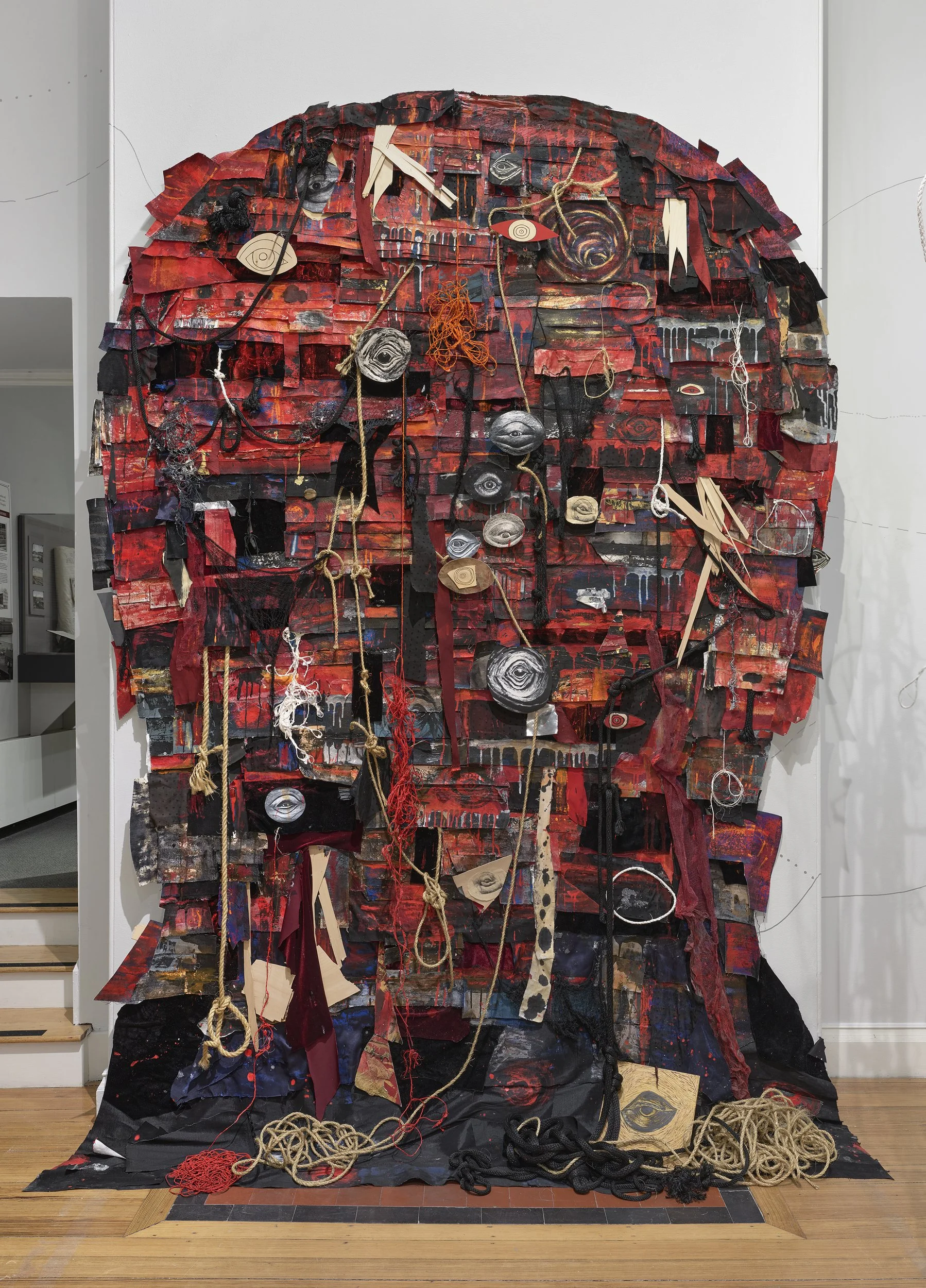
Heidi Whitman: I've been making art for a long time, and one thing tends to lead to another. I can't remember exactly how I started drawing heads, but I did. I began seeing these heads, which I was drawing about 25 years ago, as vessels of experience. There's the world outside, and then there's the world inside your head as you process things.
I did a zillion drawings and paintings of heads. Sometimes there would be landscapes, cars, or other things I was thinking about outside the head. Inside the head, there would be eyes and other sensory elements. That's kind of how it started.
After the heads, I decided to try drawing brains. I did a whole series called Brain Terrain. The brains led me to look at brain maps, then neurological maps, and so on. That led me to maps in general, and I fell completely in love with maps.
I've done a lot of work since then, over the last 20 years, using maps in one way or another. This installation uses charts, but it's really the same thing. It's a way of seeing the world. It's a landscape, in a sense.
WRB: You studied at UC Berkeley and the School of the Museum of Fine Arts in Boston, and you taught at Tufts for many years. How did that academic experience shape your art?
HW: I think everything you do in life goes into your artwork. It's there somewhere in what you're doing. And being in an academic setting gives you a lot of stimulation, whether you're studying yourself or teaching, from the other students, the teachers, and so on. So I think that's kind of where it's at for me.
WRB: Much of your work explores the relationship between interior states and external landscapes. How do you think about that relationship? Are they extensions of each other, or do you see them as separate?
HW: When I first started drawing these heads, there was a very strong skull happening. Over time, the skull kind of disappeared, and what was inside the head shape and what was outside became blurred, as if the skull were a permeable membrane, or the brain was. I think there’s a very mysterious relationship that goes on in consciousness, for sure, between the outside and the inside.
WRB: How does your approach change when you're creating work for a specific space, like the New Bedford Whaling Museum?
HW: Actually, I did a lot of the work on Moby-Dick before I knew I was going to show it at the Whaling Museum. I started it during the pandemic, and I've been working on it for five years.
My studio was empty, so I decided I would make another installation. During the pandemic, of course, everything was so fraught and horrible, and we didn't know what we'd be doing. I wasn't thinking about showing it exactly, but then it kept getting bigger and bigger, and I thought I should really try to show it someplace.
I reached out to the New Bedford Whaling Museum, and they wanted it, but they couldn't put it in the room where it eventually went because they only had two shows a year, and each show gets five months or something. Then there's the installation time in between. That was a long time to wait, but I decided this was a good opportunity, and it was.
WRB: What first sparked the idea for the Moby-Dick installation?
HW: I had done an installation at the Addison Gallery of American Art in Andover, Massachusetts, called New World. It was a large installation like this one, using many of the same materials. That installation explored the idea of American empire, including the violence, greed, and environmental devastation that have happened since Europeans crossed the Atlantic. It had a kind of narrative element and involved colonization. I used maps from the Addison Gallery, which has an incredible map collection, and I was looking at colonial maps.
Then, during the pandemic, I was sitting at home and decided to reread Moby-Dick. I had read it in high school, probably grudgingly, because it's so huge and you have so much other work to do. But this time I thought, "I'm just at home. I'm just going to read one little bit a day." Sometimes I read a chapter a day, depending on the length. Some chapters are huge and some are tiny, so sometimes I could read three chapters or whatever.
It became a great little project that I gave myself. The Addison installation involved a sea voyage, so I was thinking about sea voyages. At some point, that also led me to think about making something about Moby-Dick.
It seemed like a grandiose idea for me to do, but I thought, "Well, why not?" So I went back into my studio and started working on it, and it got bigger and bigger. And there it's been.
WRB: How did rereading Moby-Dick shape the direction of the installation? What stood out to you when you read it again as an adult?
HW: I think reading it during the pandemic was particularly difficult. There was so much dread, and there was a kind of obsessive quality to everything. We were washing our groceries because we didn't know where the virus was coming from or anything.
I think I became most interested in the whole idea of vengeance and violence in Moby-Dick. Certainly obsession is huge, as is dread, but those were the two things I was really leaning toward as I worked on the installation.
WRB: How do you see Ahab? Is he someone we should fear, or should we sympathize with him?
HW: I think that even though this installation is very much about his violence and vengeance, it's also about the human condition. We all have so many different emotions and so much inside us. Violence comes out, all kinds of bad things, revenge, the seven deadly sins, greed, and so on. Ahab is a human being, and with all of that, he's also kind of tragic. I mean, he's Shakespearean. There are times when he seems so mystical and mysterious, profound and tragic, that he had to go down this path.
But he was also evil. There was an evil quality to him in the sense that he was very willing to send everyone to their doom. I'm not that sympathetic to him ultimately. That's the sort of direction I wanted to take with the installation, by connecting him to contemporary America.
He's a megalomaniac, a narcissist in a sense. And we have one big narcissist, megalomaniac in charge of a government right now. There are others in the world, too. If I wanted to bring it outside of America, we've got Putin and Orban and many, many other authoritarian rulers.
WRB: As you read Moby-Dick and think about visualizing Ahab in three dimensions, what aspects of his character do you recognize in yourself or in other people? And what aspects are harder to understand?
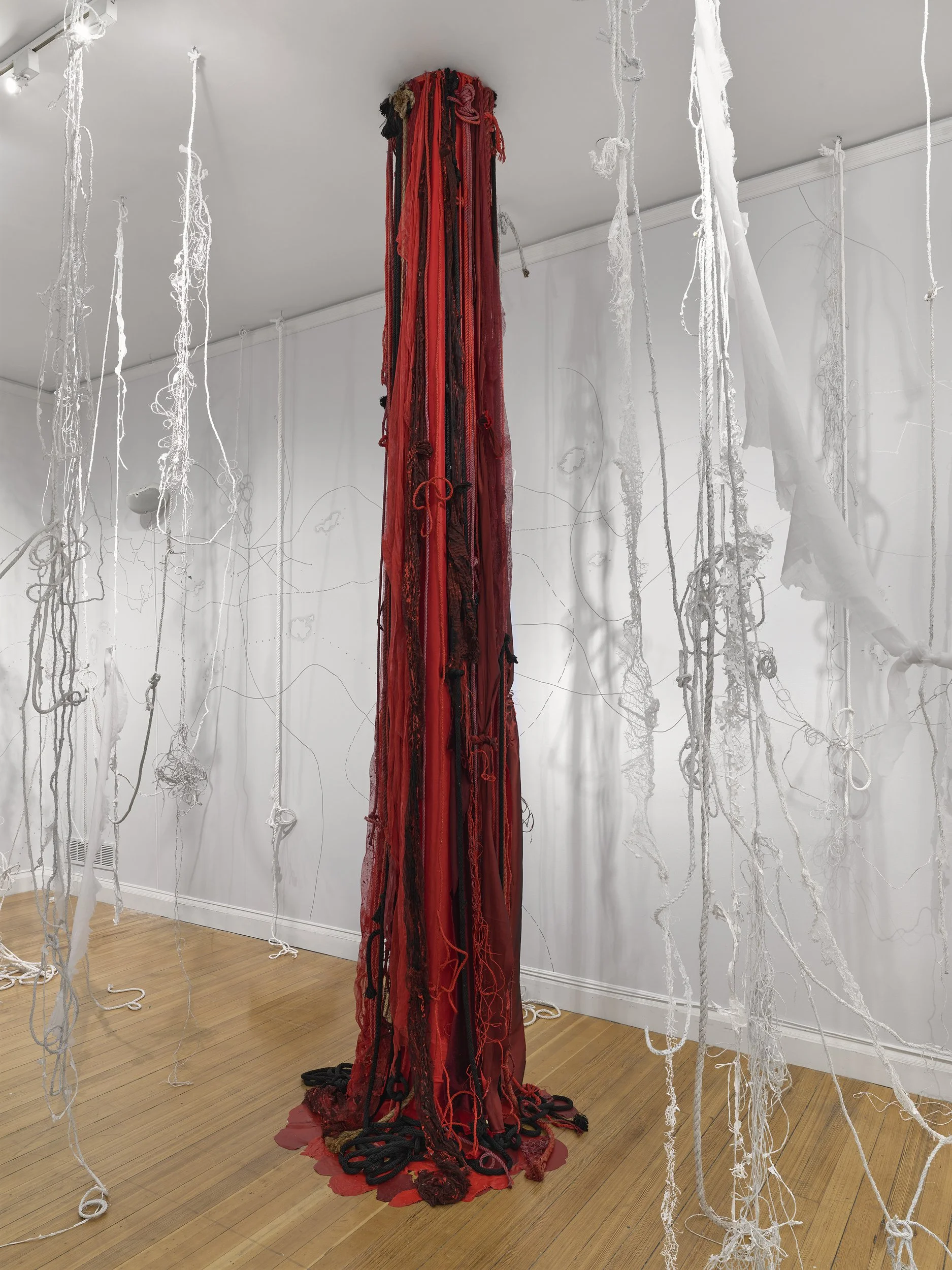
HW: Right, yes. I think perhaps if you're not a megalomaniac, it's hard for us to understand them. I have a lot of trouble understanding a lot of these crazed billionaires. Why do they need more money? Why aren't they giving their money to worthwhile things?
There's so much need in the world, so much poverty, and they could do such good with all this money they've got. But they simply have to make more and have more power, which I don't get at all.
WRB: By the end of the installation, does Ahab become more familiar to you, or does he become more alien?
HW: [laughing] You mean this megalomaniac?
WRB: [laughing] Yeah, I guess. This megalomania you are describing, or maybe a better term is this 'Ahab Impulse.'
HW: I don't know. Maybe the same... I am not sure how to answer that...
WRB: No, I get that. For me, that's sometimes what's really fascinating. You can do a deep dive into a historical figure or a historical moment and come away with a deeper understanding. But at the same time, you realize you're never going to fully understand it. That loss of understanding can actually be profound. You realize, "I'm not going to be able to get there and understand what's happening."
HW: Yes. Well, this, of course, is a great work of fiction that is so mysterious and profound, and there are all kinds of strange characters in there, strange happenings all the time, mysterious. And that adds to the whole business as well.
WRB: What role does narrative play in this work? Is the story of Moby-Dick a structure, a metaphor, or something else?
HW: I think, as a visual artist, I was aware of this room. I mean, I have my studio, which is a kind of rectangle, and this room where I currently have the show is also a rectangle. So I was thinking of that as a kind of structure, for sure.
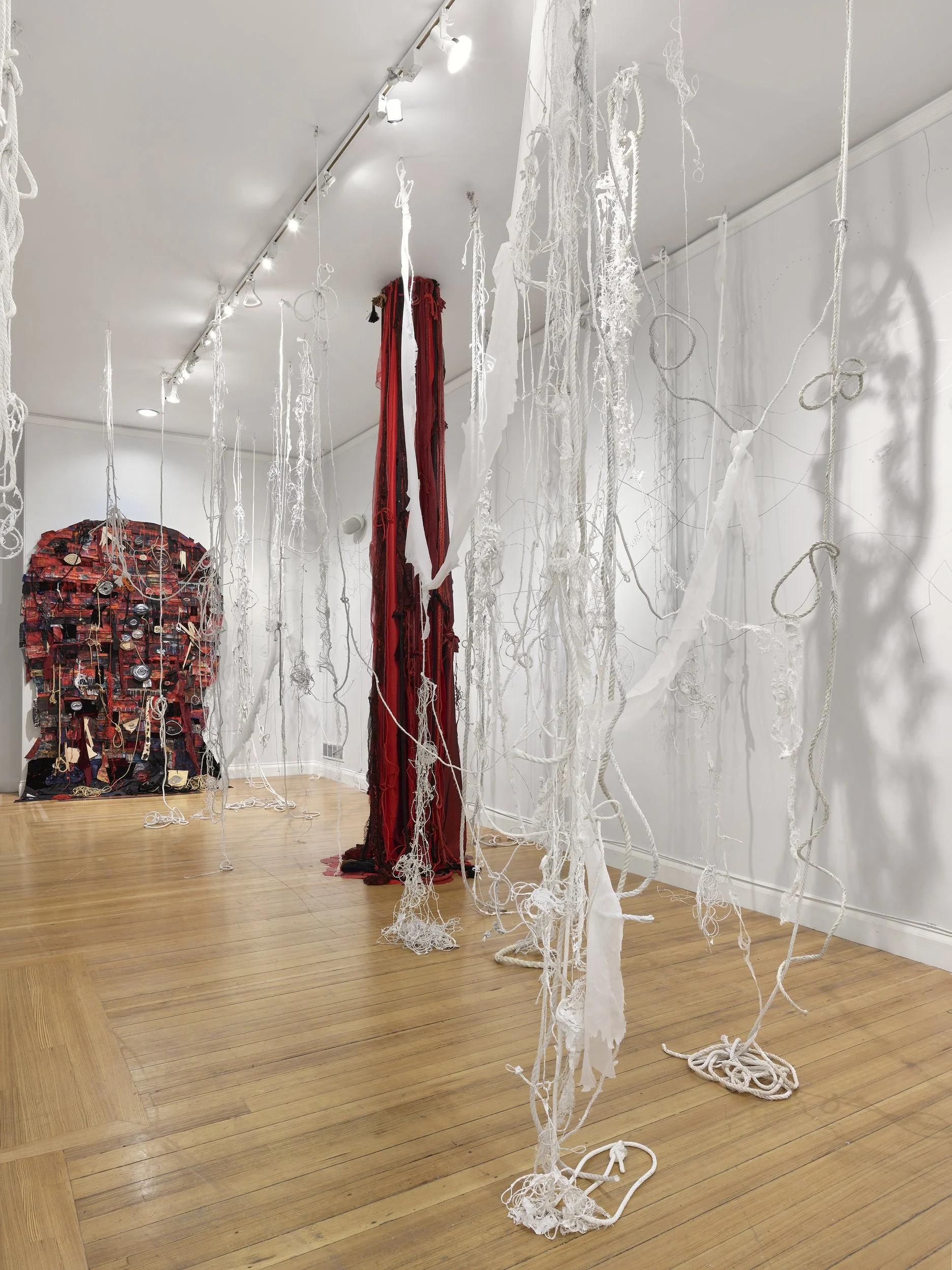
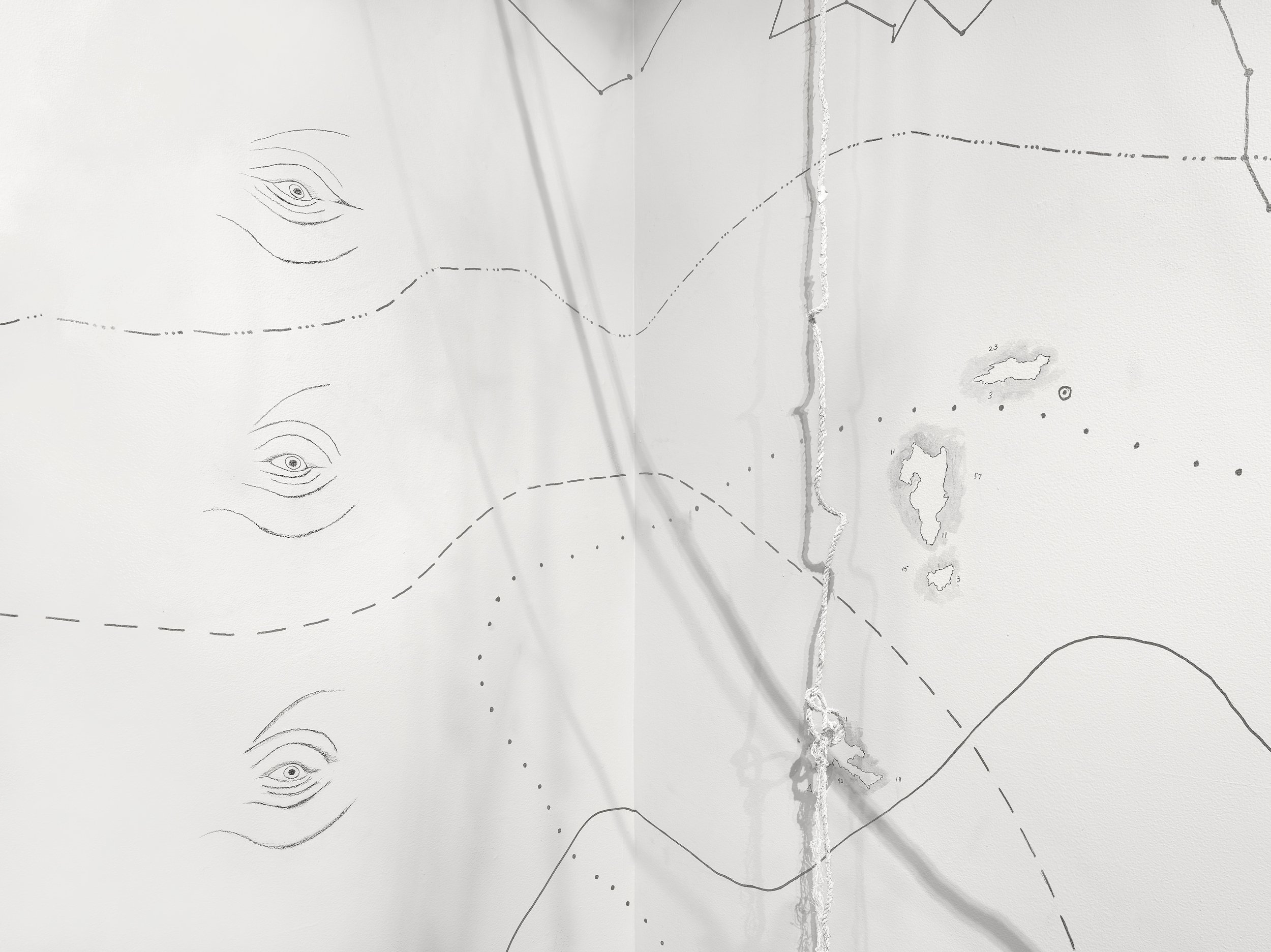
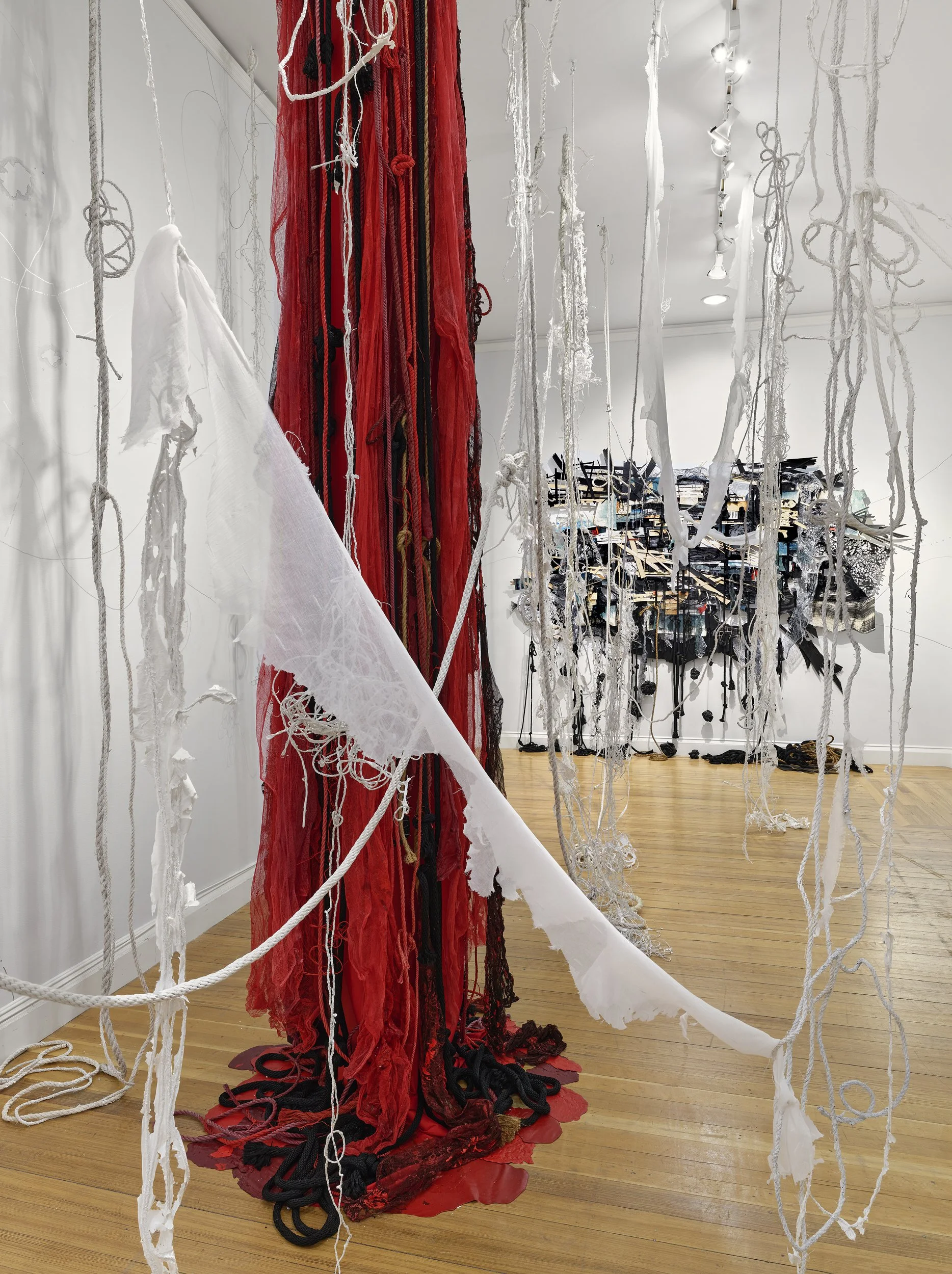
I wanted to have my fictitious charts going around the room that I drew. I had also used a number of black ropes in the Addison Gallery New World installation. But this one led me to white ropes because of the great chapter, of course, about the white whale, The Whiteness of the Whale, which is a famous chapter in Moby-Dick that brings up all the possible evils of whiteness. And we're not talking about race. We're talking about things like polar bears and sharks and other things in nature that can be totally terrifying.
So I thought the white ropes would fit right in with that idea. I also wanted the white ropes to cast shadows on the walls, which would add a kind of ominousness. I've been using shadows for some time in my work, and they're fantastic. I think shadows fit right in there with Moby-Dick.
WRB: Your work blends abstraction with meaning rooted in place, history, and story. How do you balance those impulses? How much do you want visitors to understand, and how much do you want to leave open to exploration?
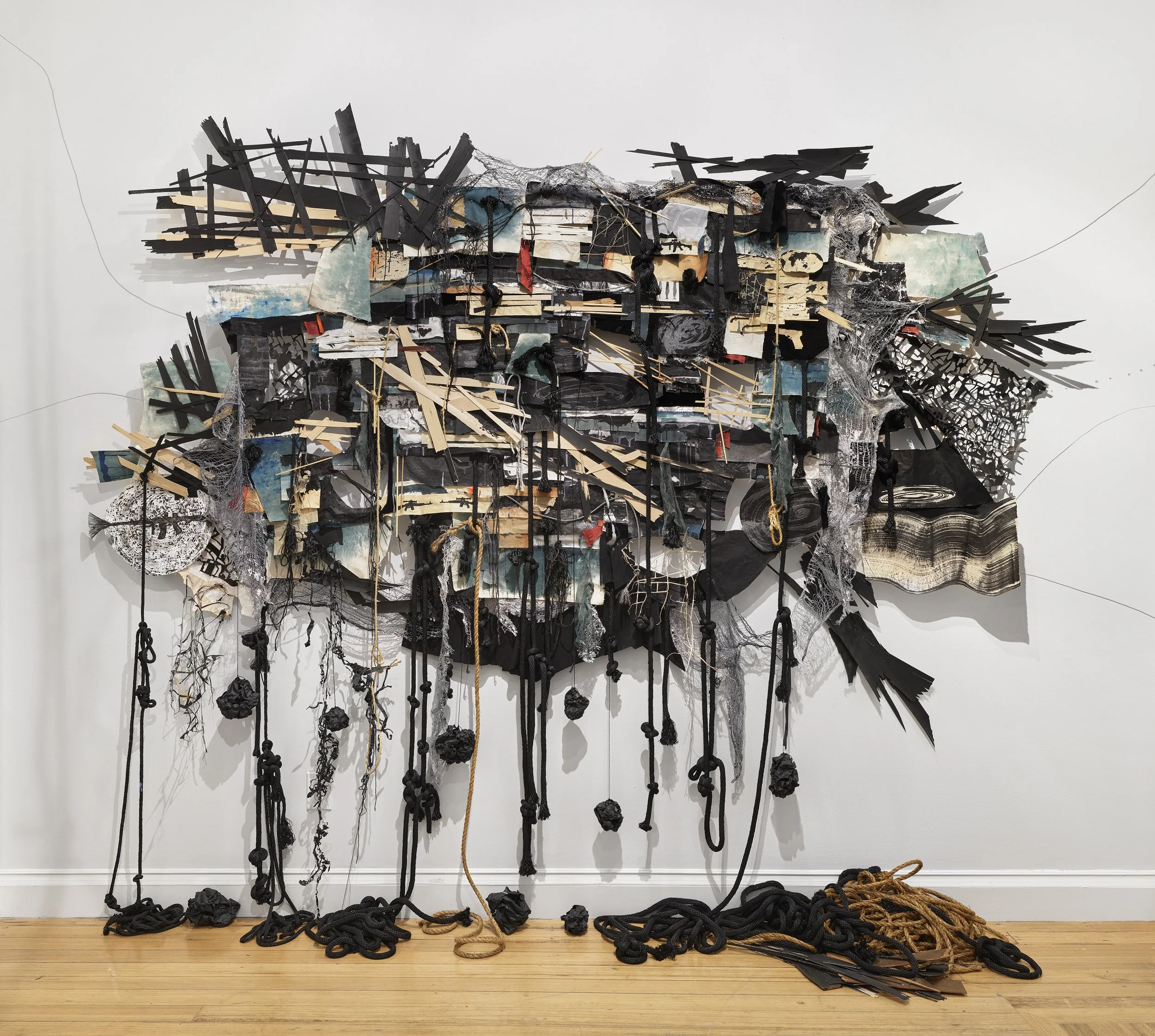
HW: Another hard question, but I sort of come to a balance of things. I mean, there are definitely things in this installation that are easily graspable as something that you could understand. For instance, the eyes are depicted, or there's some charting. But then there are these elements like the ropes or parts of the big black installation, the assemblage. That could be very abstract as well.
So I'm hoping that people could spend just a little time and listen to the soundscape, which is also very ominous, and sort of understand the mood of the whole business. And there's some wall text and other things that could also help them move toward understanding what on earth they're looking at.
WRB: When I visited, I got the sense of walking around inside a mine, with dendrites or neurons, but also fishnets and fish. Some of the elements spilling out even reminded me of blood or the material removed from whales. It was very interesting, and I was really moved by it.
HW: Thank you. I'm happy to hear that.
WRB: Have you heard any reactions to the installation yet?
HW: I've gotten two really wonderful reviews. It's hard to say. I had two sort of openings, one on December 12th, and then during the Moby-Dick Marathon, a lot of people came, and I did a little talking here and there. But people have generally responded really positively to this. That's what I hear.
So that's been great. It's been great to show there in a place where there really are a lot of people who know Moby-Dick and love it. So that's pretty great.
WRB: What do you hope people take away from Ahab's Head, especially given that it was conceived during COVID?
HW: Well, it's not a political activist piece in that sense of what I created there. So my hope is that it sort of penetrates deeply into people's hearts and minds, and that it will influence how they're thinking in general about the world, the government, their communities.
I have a certain amount of gun violence portrayed in my installation, which is important to me in terms of contemporary America. I've got assault rifles and Glocks depicted in drawings as part of the assemblage. And then, of course, there are the harpoons and muskets that I had from the Whaling Museum's collection. I picked them, and they installed them in the hallway.
That was important to me, to bring up the weaponry aspect of this whole thing. So that's kind of my hope, that it will sit there with people, that people will think, and maybe take some sort of action.
WRB: Thank you so much for taking the time to talk with us.
HW: Thank you!