“Who Gets Left Out of Fashion?: An Insider’s Look at Clothing’s Size Inclusive Problem,” Interview, Megan Ixim and Wesley R. Bishop.
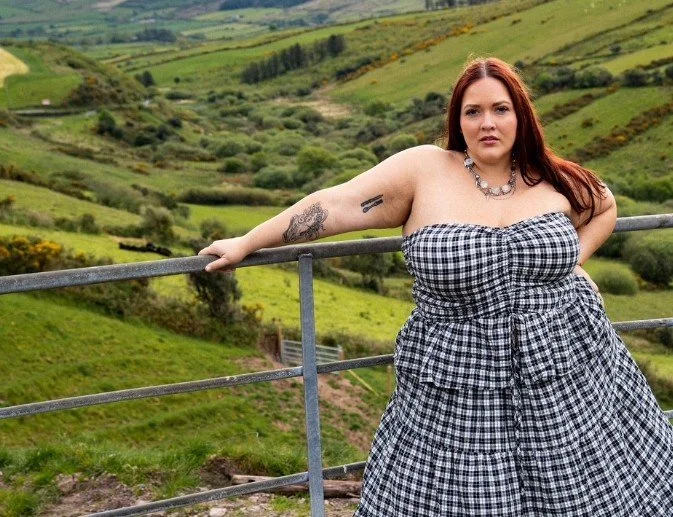
In summer 2026 model, creative director, and fat activist content creatorMegan Iximsat down with managing editor Wesley R. Bishop to discuss size-inclusive fashion, the uneven availability of plus-size clothing in mainstream retail, and the tension between marketing claims of inclusivity and lived consumer experience. Ixim, who has worked in fashion and marketing for over a decade as both a creative director and consultant in plus-size fashion, is widely known for her commentary on body acceptance and the cultural pressures shaping contemporary beauty standards. The conversation also addresses her recent public critique of a celebrity-branded Walmart collaboration, which sparked widespread media discussion about representation and accessibility in fashion. The following interview has been edited for clarity and length.
Wesley R. Bishop: Thank you for taking the time to speak with us.
Megan Ixim: Thank you!
WRB: To begin, could you tell us a little about yourself and how you became involved in modeling, content creation, and body size activism?
MI: I've been what I like to call a “fat activist content creator” for more than a decade. I came to it pretty organically. I graduated with a degree in marketing, always felt drawn to creative work, and had interests in photography, writing, and fashion. At the same time, I was struggling with an eating disorder. My platform really grew out of trying to find joy within myself and within my body, and finding ways to celebrate both. Funny enough, I found success when I wasn't looking for it. I never woke up wanting to be an influencer. That was never the goal. What people responded to was content that felt unapologetic. I would wear these fun, extravagant outfits and eat beautiful, decadent food on camera. It wasn't me eating a salad or trying to prove that I was a "good" fat person or an exceptionally healthy fat person. It was me enjoying delicious food while looking fabulous and staring straight into the camera without apology. At the time, that was something very few people were doing. It was almost seen as a faux pas for a fat woman to eat, look fabulous, and act as though her body wasn't merely acceptable, but something worth celebrating.
WRB: And about what year was that?
MI: Sometime in the twenty-teens. 2015? 2017?
WRB: And what platform were you primarily using?
MI: Instagram. Yeah, I was mostly on Instagram.
WRB: You also said you majored in and eventually moved into marketing?
MI: Yes. Professionally, I've worked as a creative director and social strategist for the past ten years. That's my day job. During that time, I've also worked in fashion, particularly plus-size fashion, as a marketing consultant while modeling on the front end as well.
WRB: So you are somebody who is very much familiar with the issues that fat people face in finding accessible clothing, not just from the fact that you are a consumer, but you actually work in the marketing end as well.
MI: Yes, exactly.
WRB: From your experience working in marketing and fashion, how has the industry handled clothing accessibility across different sizes, particularly plus-size fashion? Has it improved, declined, or shifted over time?
MI: I would say it has shifted a lot over time. I’ve grown up plus size, and I was raised by a plus-size woman, so this is something I’ve lived with my whole life. There was a time when we thought there was no accessibility at all, but looking back, we did have some options. There were stores like Dressbarn and Fashion Bug, and more in-person places where you could actually go in and try things on. When I was a teenager, you could still expect places like Walmart and Target to have fairly solid plus-size sections. Over time, that changed. Then around 2018 to 2023, we saw a real expansion again, when a lot of mainstream brands started introducing extended sizing for the first time. But over the past couple of years, it feels like that progress has started to stall or even reverse. Some brands have scaled back their plus-size offerings, limited what’s available, or moved those lines entirely online, if they exist at all.
WRB: So just to clarify, your sense is that plus-size availability has shifted over time, with earlier in-person accessibility, a decline in the early 2000s, renewed expansion in the late 2010s, and then a recent contraction again. Is that accurate?
MI: Yeah, exactly. Like anything in trend forecasting, it moves in waves. Right now we’re seeing a pullback in plus-size accessibility, especially in-store, with more pressure pushed onto online shopping. That shift creates its own “fat tax” in practice. You end up spending more on shipping and returns, and often wasting money because fit hasn’t been properly considered. A lot of brands expand into plus sizes without real experience, and the issue usually comes down to fit. Fit is different on fat bodies than on straight sizes, and it requires more work, more testing, and more attention to get right.
WRB: Can you explain why that is?
MI: Because we come in a much wider range of body shapes and proportions. People carry weight differently, whether that’s in the bust, hips, stomach, or elsewhere, and that variation matters a lot for fit. Hiring fit models and actually testing garments on real bodies becomes essential if a company cares about doing this well. The brands that succeed when they expand into plus sizes are usually the ones that invest in that process. The ones that struggle tend to just scale up straight sizes, adding inches without really reworking the garment for different body proportions. Then they wonder why those clothes do not sell.
WRB: Why do you think access to plus-size clothing has followed that cycle of expansion and contraction over time?
MI: The late 2000s into the mid-2010s, especially around 2004 to 2015, felt like a period where many mainstream stores capped out around a size 12. The dominant trend at the time was a very narrow, model-like body ideal, and if you did not fit into that, it often felt like you were meant to be grateful for whatever was available at all. Personally, I remember places like Kohl’s and Sears being some of the only reliable options. As someone who was into fashion, it was frustrating not being able to shop in stores like Hollister or PacSun the way my peers could. What we have seen since then also repeats a pattern. Brands enter the plus-size market, but instead of truly investing in it, they either scale straight sizes up without much research, or they create entirely separate lines. That separation often fails. A lot of companies design plus-size clothing in ways that reflect bias or a lack of understanding of fat bodies, so the clothes do not actually match what plus-size consumers want to wear. There are studies and industry discussions that have pointed this out, including critiques of brands like Ann Taylor when they introduced plus-size lines that were essentially disconnected from their main collections. When the design is segregated like that, it often misses the mark entirely. In most cases, the solution is not complicated. If brands simply extended their existing design language into inclusive sizing, rather than treating plus-size clothing as an afterthought, they would likely see much more success.
WRB: Can you give an example of what that looks like in practice? What changes between the straight-size designs and the plus-size versions?
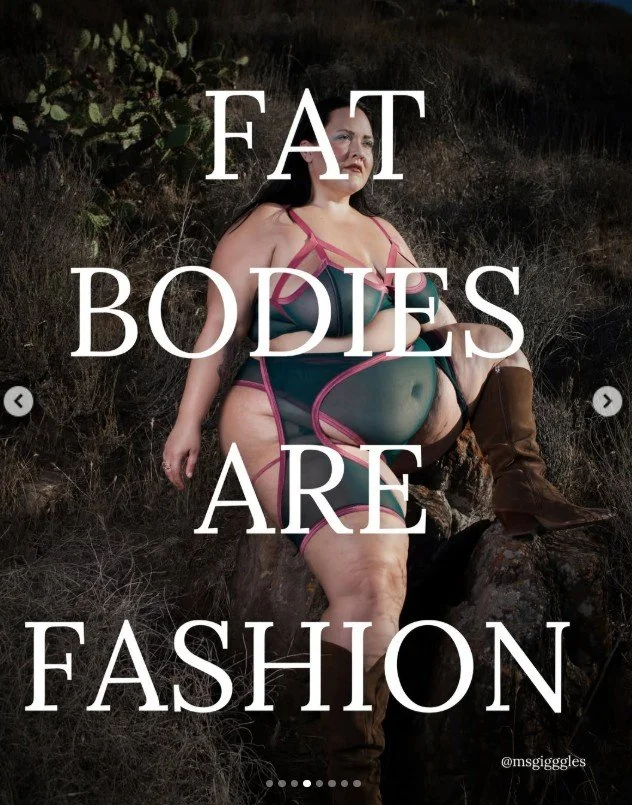
MI: For example, say a brand is making a jacket in a colorful tweed. Instead of offering that same design in plus sizes, they will often switch it out for a basic black jacket. So the plus-size version is no longer the same garment. It is stripped down, simplified, and loses the design details that made the original interesting in the first place.
WRB: That makes sense. I relate to that a bit myself. As a fat person, I get comments sometimes from colleagues about wearing hoodies and jeans so often, and the truth is I would love to dress up more and wear a suit and look put together. But in practice, this is what feels comfortable and workable for me day to day, especially when I am teaching.
MI: Yeah, absolutely. I think the state of plus-size expansion in menswear and gender-fluid fashion is also pretty poor. I have male friends who exist in larger bodies, and I will try to help them find things they actually feel good in, but the options are still very limited and often frustrating. What can be difficult in those conversations is hearing, “Well, I already have to shop at big and tall stores, so why are you complaining?” But that misses the point. When we talk about inclusivity, it has to include everyone. We all deserve more accessibility, more options, and better design.
WRB: I am less familiar with how these issues show up in gender-fluid or gender-queer fashion spaces, so can you explain that a bit more?
MI: Finding androgynous or gender-fluid clothing in plus sizes is extremely difficult, especially pieces that are not coded as overly masculine or overly feminine, but are more about design and silhouette. There are some brands doing it well. Big Bud Press, for example, does a good job of creating clothing that exists in that in-between space and feels more genuinely inclusive in its design approach.
WRB: From your experience in marketing and fashion, is there a comparable baseline of availability for women’s plus-size clothing in stores, or is the issue more fundamental than fit and aesthetics, where the options simply are not there in the same way?
MI: I think there’s a commonality here that I notice with a lot of my plus-size influencer friends. We joke that if I find something I like, chances are they will be wearing the same thing too, because the options are so limited. There’s just not a lot of variety, especially in-store. Styling options are limited, and once you get past a size 22, it becomes even more restricted. It makes developing a personal sense of style really difficult. A lot of plus-size people end up looking like they are wearing variations of the same outfits, not because we want to, but because that is what is available. Being a fashionable plus-size person can feel like a full-time job. You have to really love it and commit to it to make it work.
WRB: So why do you think that is? If these products clearly have demand, why aren’t more brands making them at scale?
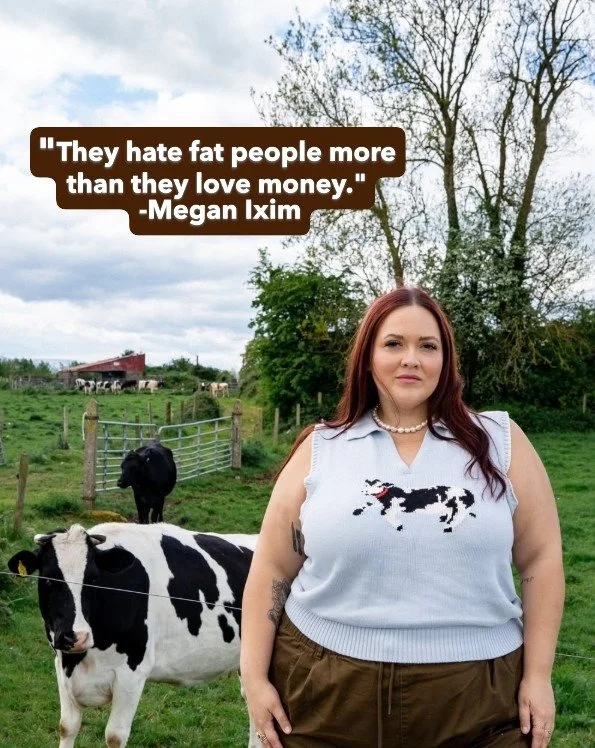
MI: They hate fat people more than they love money. If you look at the numbers, the plus-size clothing market is already valued in the hundreds of billions and is projected to grow significantly over the next decade. So when people talk about profitability or say it is too expensive to expand sizing, that does not really hold up. This is a growing market. What we are actually seeing is companies choosing not to invest, and I think that comes down to fatphobia. There is still a perception that expanding into plus sizes somehow diminishes a brand’s value or image, and that perception is what drives the decision-making.
WRB: I think that probably gets at it. There is still a real discomfort with different body types, to the point where some designers seem to worry that if a fat person wears their clothing, it will change how the brand is perceived or who it is associated with.
MI: Yeah, and we also want options. Right now, casual wear dominates plus-size fashion because that is what consumers are asking for, things they can wear every day that feel good and look good. But a lot of brands are still operating from the idea that plus-size consumers only need basics, or clothing that is meant to minimize or hide the body rather than celebrate it.
WRB: That brings us to your recent campaign. Can you walk us through what has been happening and what you want people to understand about it?
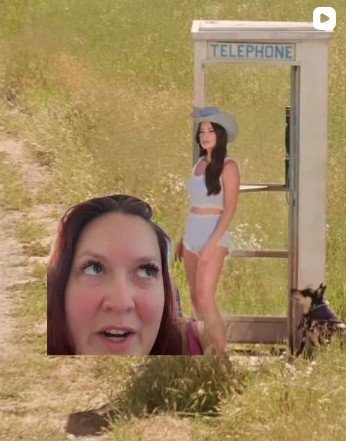
MI: So I’m a fat activist and content creator who talks about a wide range of topics, not just fashion. I speak a lot about body acceptance, the current pressures around things like Ozempic, and how fat acceptance actually benefits everyone. Fashion is just one part of what I cover. To give a bit of context, I was actually a Kacey Musgraves fan before this. As a Latina, I really connected with her recent album. I loved the use of Mexican cultural references and the way she blended that into a country sound, especially with that small-town Texas aesthetic. I also genuinely loved the fashion around it. I’m into that kind of “slutty cowgirl” vibe, tight jeans, rhinestones, all of it. It is something I enjoy wearing myself. I first heard about the collection through her page and did not think too much of it at first. I only saw the pre-release. Then the release happened, and the same day a friend of mine, who is a big Kacey Musgraves fan, messaged me. She knows I talk about fashion and told me she had just gone into Walmart and there was nothing there. She had spent a couple of hours going in to check the collection and left disappointed because there was nothing available in store. That made me go and look myself. I checked her page, then looked at what was actually being presented. The messaging suggested this was an inclusive collaboration with extended sizing, and that even if you did not find it in store, there were plenty of options online. So I went to the website to see what was actually available, partly out of curiosity. And what I found was that the options were very limited. There were a few swim pieces and maybe a shirt here and there. Some items went up to a 3X, but a lot of the line only went to an XXL, which is often presented as “inclusive,” but XXL in women’s sizing is not the same as a true 2X. That distinction matters. At that point I decided to make a video, which I often do when I see things like this. For me, especially with a line being sold through Walmart, I associate that with a place where plus-size shoppers should reasonably expect in-person availability and accessibility. Instead, what I saw was a very limited range, with key pieces missing from extended sizing.
WRB: Right, and with a retailer like Walmart, that is where a wide range of people shop. That is part of what makes accessibility expectations different in that context.
MI: Yes. And those are the places I always think of as baseline access. If you lose your suitcase and need essentials as a plus-size person, where are you going first? For basics like underwear, a white T-shirt, or jeans, it is usually Target or Walmart. Those are the first places that come to mind. So I felt like this should have been an opportunity to create real full-line availability in extended sizing. Instead, once again, it feels like we are an afterthought, or something used to signal inclusivity in marketing rather than something built into the actual product. I made a video about it. It was not viral or anything like that. And then, within about ten minutes, Kacey Musgraves commented. That was honestly surprising for me. I am not a large creator, I am not someone with a million followers or regular brand campaigns. I talk about fatness online, but in a pretty direct and independent way, so getting a response from a celebrity was unexpected. What came after was the response itself, and I was honestly taken aback by the wording. Given what I had said, and my background in marketing and PR, I would have expected something more along the lines of, “I am sorry, this was out of my control,” or “I will talk to my team and try to do better.” Even just a simple acknowledgment of the concern. Instead, what I saw came across as rude and dismissive at best.
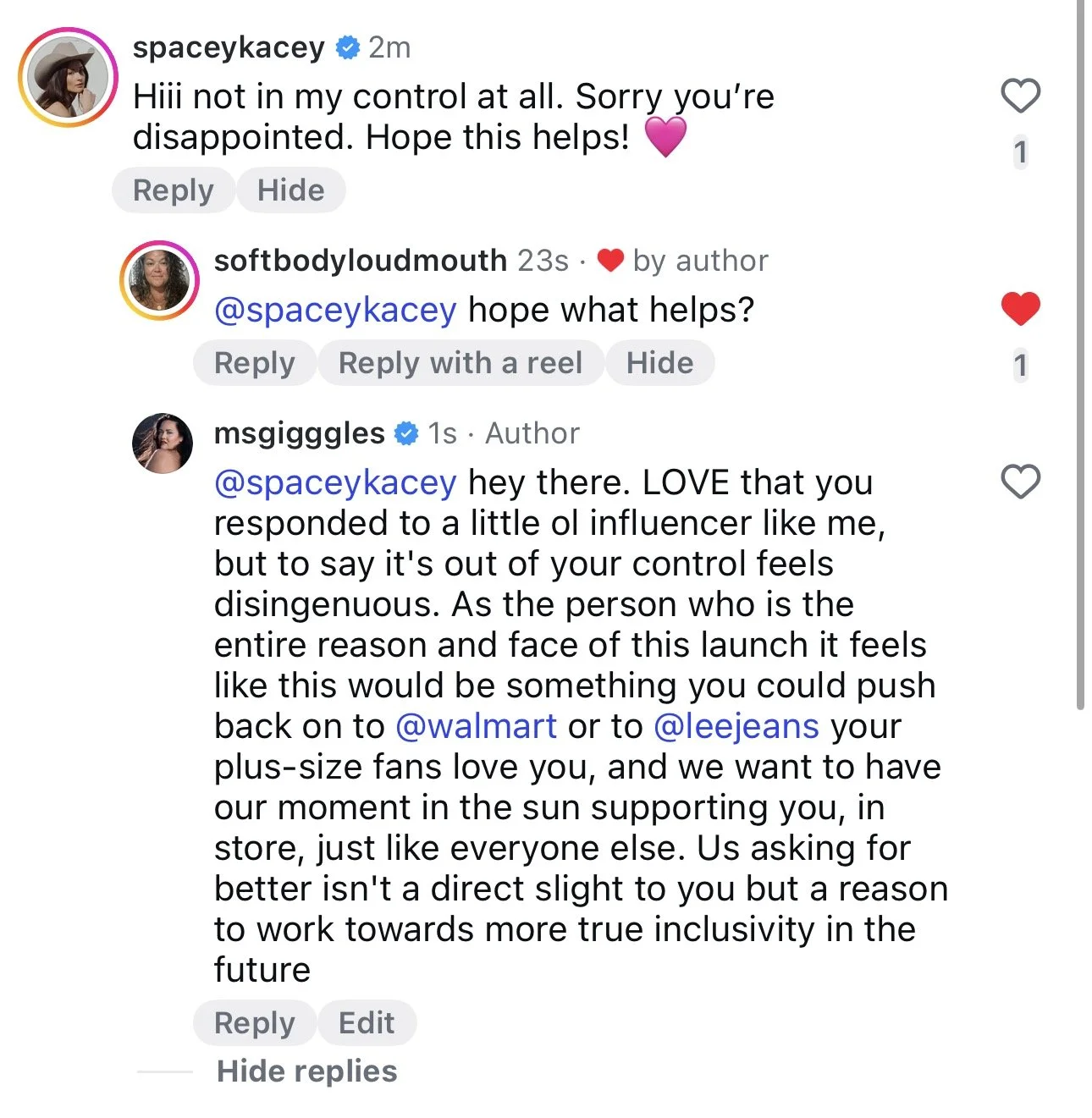
WRB: What exactly did she say in response?
MI: I can pull it up for you. I have my phone next to me. Okay. So the actual response was, “Hi,” hi with lots of “i’s. “Not in my control at all. Sorry you're disappointed. Hope that helps," exclamation point heart.
WRB: [laughs] Ok.
MI: And here's the thing is if you're just reading that, it sounds dismissive but not that bad unless you know and you're into internet culture where you know ‘hope that helps’ is the new ‘fuck you’ for Gen Z.
WRB: Right, it is rude and dismissive.
MI: It is the new, ‘Bless Your Heart!’
WRB: So, you make this video criticizing the false advertising and lack of inclusivity, and she responds, or at least someone in her PR does—
MI: I think it's her. Personally. I don't think a PR person would've responded like that.
WRB: Well, if that was a PR person, they're getting paid way too much, right? That’s the best you can come up with after being paid to respond to the public?
MI: If it was a PR person, I'd be livid if I was her.
WRB: So, her account, has this response. Then what happened?
MI: People really caught onto it. I actually did not have to do much explaining as to why it felt dismissive. Most of the time, when I post about these things as a plus-size creator, I get a lot of immediate pushback and dismissal. People question why I would criticize a favorite pop star or ask who I think I am to say something like that. But in this case, a lot of people actually agreed with me right away, which was surprising. That is not usually my experience. Of course, after some news coverage and circulation, I also started getting more harassment and hate as people found the content, but the initial response was very different from what I expected. Under her original comment, a lot of people were reacting with things like “yikes” or “this is wild.” I even saw people saying things like, “My wedding song was Golden Hour and now I do not feel the same way,” or talking about selling concert tickets. It was honestly pretty shocking, but it also confirmed for me that I was not alone in reading it that way. Other people were arriving at the same conclusion. And honestly, it is pretty telling when my comment has more engagement than the celebrity response itself.
WRB: So there was also a fair amount of support for your critique. I guess the broader question is whether it matters how a brand positions itself. If a brand or artist is not claiming inclusivity, that is one thing. But when they do position themselves that way and then fall short, and respond defensively when called out, that feels like a different kind of issue.
MI: Yes. And it feels very off brand. This is someone who has built a career on being seen as part of the more progressive side of country music, including moments like bringing attention to a mariachi band that had been in ICE custody and giving them a platform. But at the same time, it reads as dismissive toward a fat Latina who is raising concerns about inclusivity. I do not think you can really hold both of those positions without contradiction. That is where intersectionality and progressive politics get complicated. You can present as progressive in some areas, while still holding fatphobic views in others, even if that is not how the branding is framed.
WRB: You also raise a broader question about how public figures navigate progressive branding alongside criticism. In this case, there seems to be a tension between an artist’s public image and how they respond to critiques about inclusivity. How do you think that plays out in situations like this?
MI: Well, I actually started to get interest from larger media outlets. I get a text while I am literally on my phone dealing with all of this. It was already pretty emotionally demanding at that point. An acquaintance messages me saying, “Megan, you are about to be on Inside Edition.” And I am like, “What are you talking about?” She says she just saw the preview and it was me. Then I find out I am in a CBS news segment talking about my claim that Kacey Musgraves is not being fully inclusive, and it is framed in a way that makes it seem like I am just bothering a celebrity with nonsense. No one contacted me for a quote or my response. I just found out because someone happened to be watching TV at the right time.
WRB: Were they sympathetic or neutral?
MI: No. It was not sympathetic or neutral. It was, how do I put this, a masterclass in what I would call very “hard-hitting journalism.” Cough cough.
WRB: Not to make excuses, but its Inside Edition.
MI: Exactly. So I was like, "Oh great, this is going to go really well for me. " That was my thought process.
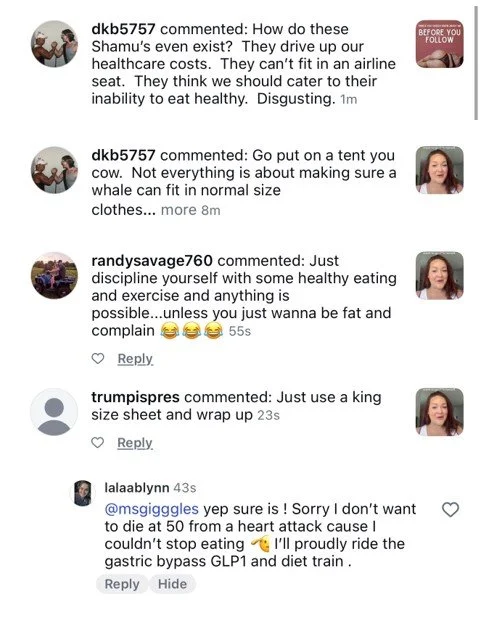
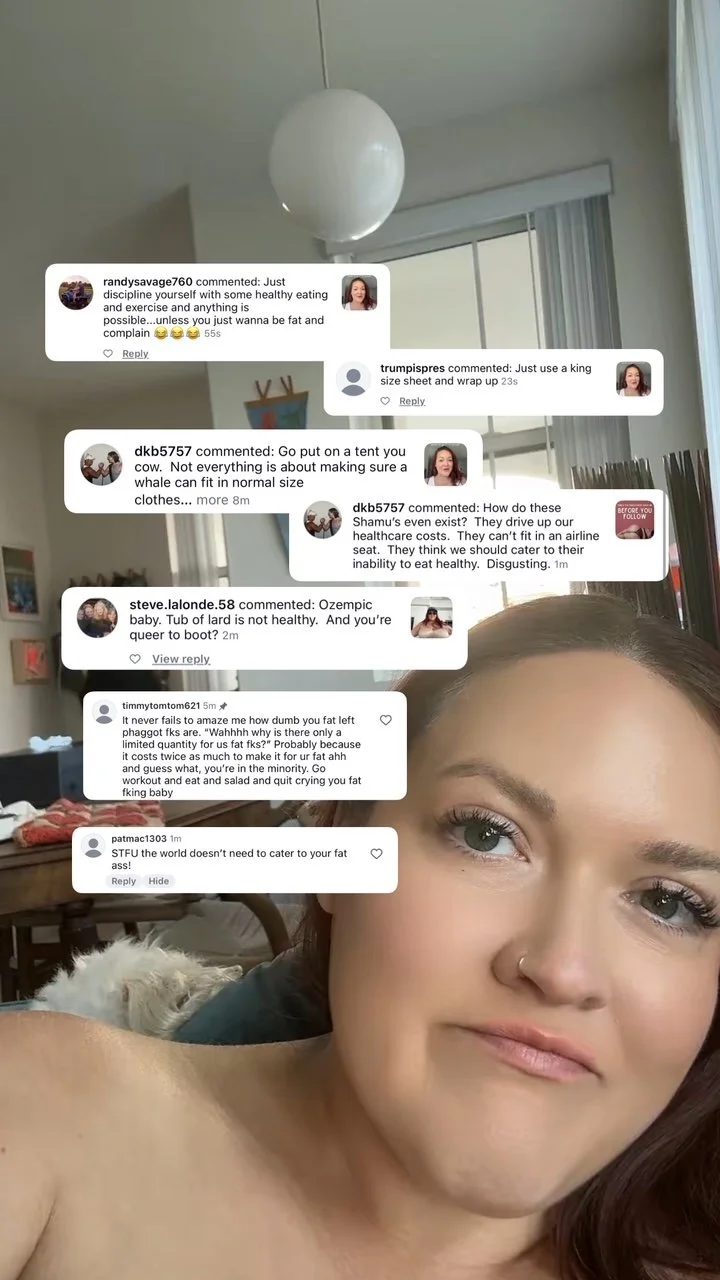
WRB: And is this when you saw the uptick of trolls and fat phobic comments?
MI: Yes. It was on CBS, and then it was also on BuzzFeed, which was very dismissive of me as well. But what surprised me was Reddit. Someone posted about it there, and a lot of the comments actually agreed with me. That was unexpected, especially because I have also had pretty negative experiences on Reddit in the past. In this case, people were saying things like, no, she is basically pointing out a lack of inclusivity, and I think that is an important distinction. Brands are not required to create plus-size inclusive lines. They are businesses, they can choose what they do. The issue here is claiming inclusivity as part of the marketing. That is where I think people get hung up. I am not going to Louis Vuitton or a straight-size brand and saying, “How dare you not make plus sizes.” That is a different conversation, and I would love to see more of it, but it is separate. The problem is when a collaboration or celebrity uses inclusivity as a selling point, and then the actual offering does not match that claim.
WRB: This is something I have been thinking about and occasionally ask in conversations around body size activism and fat liberation. There is an idea that circulates that if brands are going to sell to the public, they should be required to offer a baseline range of sizes, in the same way the ADA requires physical accessibility for public-facing spaces. What do you think of this idea?
MI: Let me just say we live in a capitalist society, country, and world. So I think that idea sounds great on paper, but in practice it is unlikely to become a structural reality. I would love it if companies were required to offer a certain size range in order to enter certain markets. For example, if a brand wanted access to a certain number of storefronts, they would need to include a baseline level of size inclusivity in what they produce. But I also try to stay grounded in what is realistically possible. You cannot easily force companies to do this in fashion, as much as I might want that to be true. So the only real way we see change is through demand. People do not always realize that consumers have power here. If you are a straight-size person, one of the most effective things you can do is ask brands why they are not inclusive, push them to expand their sizing, or choose not to spend money with brands that are not size inclusive. That is where actual pressure comes from.
WRB: Fair point.
MI: I also want to circle back to why not having an inclusive collaboration feels so frustrating, because from my research into this since everything has blown up, there are clear examples showing it is possible. Megan Thee Stallion released a Walmart collaboration, and the first version was not size inclusive. It received a lot of backlash, and she responded by making her next collaboration size inclusive and ensuring it was also available in-store. There are also other existing examples. Lee Jeans carries up to a size 26. Walmart already sells plus sizes. Jessica Simpson and Sofia Vergara both have size-inclusive lines available in Walmart stores. So this tells me it is not a question of possibility. It should have been the standard from the beginning. Either no one in those decision-making rooms cared, or there were no plus-size people included in the process at all.
WRB: I take your point. If this had never been done before, it would be easier to think it an oversight. But as you are saying, this is already being done in many cases, especially with major retailers. So the absence of it here reads less like an accident and more like a deliberate choice.
MI: Yeah, it is a conscious choice, or it has to be. If you say you are going to be inclusive and then you do not follow through, then what else can it be? It is not as if it was simply forgotten. It was presented as part of the offering. And when the response to criticism is immediate dismissal, especially from someone pointing out a lack of inclusivity, that signals to me that there is not real investment in it. It reads as though the commitment is not actually there.
WRB: Are there any closing thoughts you'd like to end on?
MI: Yeah, I would just say that asking for inclusivity should not be treated like a scandal. It should not be something that becomes a big story. It should be the standard, the norm. Giving people more access and more inclusivity does not take anything away from anyone else. It actually makes things better for all of us.
Megan Ixim is a creative director, social strategist, model, and fat activist content creator. She has worked in fashion and marketing for over a decade, with a focus on plus-size and inclusive design consulting alongside her work in front of the camera. Her public work explores body acceptance, fashion accessibility, and the cultural and economic forces shaping beauty standards in contemporary media.
Works Mentioned:
“Kacey Musgraves Responds to Fat Activist Furious She Can’t Fit New Walmart Clothing Line.” Fox News (OutKick Culture), accessed June 3, 2026. https://www.foxnews.com/outkick-culture/kacey-musgraves-responds-fat-activist-furious-cant-fit-new-walmart-clothing-line.
Ellen Durney. “Kacey Musgraves Walmart Clothing Line Inclusivity Backlash.” BuzzFeed, accessed June 3, 2026. https://www.buzzfeed.com/ellendurney/kacey-musgraves-walmart-clothing-line-inclusivity-backlash.
“Kacey Musgraves Responds to Criticism of Size-Inclusive Fashion Collaboration.” People, accessed June 3, 2026. https://people.com/kacey-musgraves-responds-criticism-size-inclusion-fashion-collaboration-11979273.
“Influencer Calls Out Kacey Musgraves for Insensitive Response to Complaints Over Lack of Plus-Size Options for Her New Clothing Line.” Whiskey Riff, May 21, 2026. https://www.whiskeyriff.com/2026/05/21/influencer-calls-out-kacey-musgraves-for-insensitive-response-to-complaints-over-lack-of-plus-size-options-for-her-new-clothing-line/.