“The Threat of a Good Example: The Cuban Revolution Still Faces United States Imperialism,” Essay, Harry Targ.
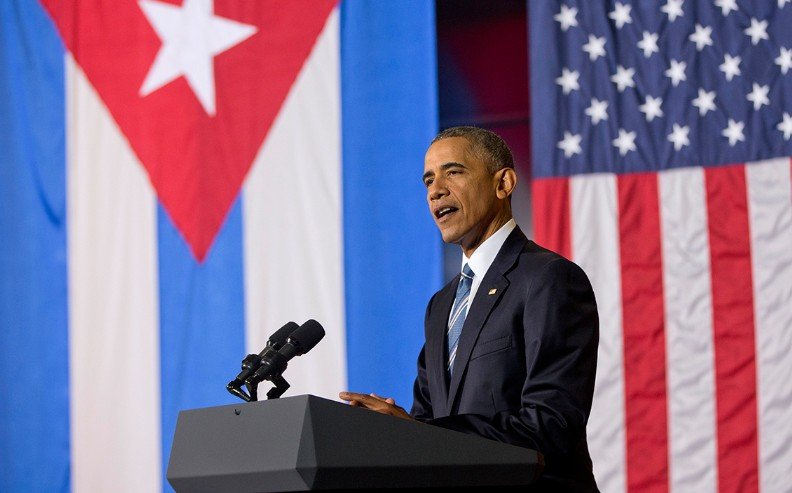
Obama Opens the Door and Trump Closes It
On December 17, 2014, President Raul Castro and Barack Obama announced that the U.S./Cuban relationship would change. The United States and Cuba, President Obama said, would begin negotiations to reestablish diplomatic relations, open embassies, and move to eliminate the U.S. economic blockade and restrictions on American travel to the island. This announcement was broadly celebrated by nations everywhere, the Pope who had lobbied Washington for the policy change, and Americans and Cubans alike. Of course, in both countries there were skeptics and the strong and vocal Cuban American lobby immediately condemned the announced policy changes.
Shortly after the announcement the United States and Cuba reestablished the normalization of relations and several steps were taken by both countries including:
·Freeing the last three of the Cuban Five by the United States and the release by Cuba of U.S. agents Roland Sarraff Trujillo and Alan Gross from Cuban prisons.
·Easing restrictions on remittances from Cuban/American families to relatives on the island.
·Using executive action in the United States to loosen restrictions on American travel to Cuba and reestablishing the capacity for banking connections with the island.
·Authorizing flights from the United States to Cuba by multiple airlines.
·Giving authority to some companies to invest in small businesses in Cuba and the increase in trade of selected U.S. commodities, primarily agricultural products and building materials.
·Taking Cuba off the State Department list of sponsors of terrorism
And President Obama deliberated with President Raul Castro at the April 2015 meeting of the Summit of the Americas in Panama, communicating the image of the return to normal diplomatic relations.
However, much needed to be done to complete the normalization of diplomatic relations. The U.S. economic embargo had not been lifted. The Helms-Burton Act, which prohibits foreign companies from having commercial relations with the island and then the United States, has not been repealed. And the House of Representatives passed a resolution that challenged President Obama’s executive authority to expand the categories of U.S. citizens who could travel to Cuba without applying for a license from the Treasury Department. In addition, many issues of relevance to the two countries such as those involving immigration, control of drug trafficking, and cooperation on disaster relief were not yet resolved.
Most Americans, including Cuban/Americans, supported the full normalization of relations. But a small number of politicians from both political parties who opposed normalization of relations were using their legislative and public political leverage to reverse the will of the American and Cuban people. One example was the misrepresentation of the case of Assata Shakur, who lived in Cuba for over thirty years. Shakur, a former member of the Black Panther Party was tried and convicted on dubious grounds of murdering a police officer in New Jersey and who fled to Cuba in 1984, was being used by anti-Cuban activists to resist the normalization of relations, claiming that Cuba is harboring “terrorists.”
However, the dramatic gestures by Presidents Obama and Castro set the stage for the normalization of diplomatic relations. But as Secretary of State John Kerry suggested more work needed to be done.
"The restoration of diplomatic ties will also make it easier for our governments to engage. After all, we are neighbors, and neighbors will always have much to discuss in such areas as civil aviation, migration policy, disaster preparedness, protecting marine environment, global climate change, and other tougher and more complicated issues. Having normal relations makes it easier for us to talk, and talk can deepen understanding even when we know full well we will not see eye to eye on everything."
-Secretary of State Kerry’s Remarks at Flag Raising Ceremony, 2015
Trump Reverses Modest Improvements in US-Cuban Relations
With God’s help, a free Cuba is what we will soon achieve… I am canceling the last administration’s completely one-sided deal with Cuba.
-President Donald Trump, New Cuba Policy in Speech in Miami’s Little Havana, 2017
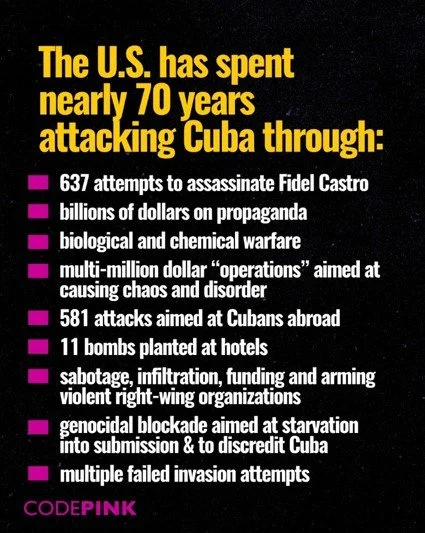
With these words, President Trump early in his first term announced the return to the almost 60-year Cold War against Cuba, a war that has cost the people on the island and their relatives in the United States dearly. He initiated efforts to resume travel restrictions, limit trade and investment on the island, and to punish US citizens who traveled to Cuba on their own. These policy changes were motivated primarily by Trump’s promises to a dwindling sector of Cuban Americans in the Republican Party (and a few Democratic politicians as well). Although economics, geopolitics, and white supremacist ideology have long shaped United States foreign policy, narrow and short-term political calculations seemed to have motivated the reversal of modest US openings to Cuba that had been put in place during the Obama Administration.
The influence of the Cuban American right-wing was blatantly obvious in the rhetoric and actions of Trump administration officials. They made the calculated decision to stop and reverse the process of dialogue with the Cuban government, which most US foreign policy experts viewed in a positive light. President Biden did not reverse Trump’s first term Cuba policies as he had promised The United States resumed a construction of the imagery of a Cuba that was a security threat and adversary.
In 2026 Trump escalated the economic blockade of Cuba, threatening to punish any country that continued to engage in commerce with the island. (He had already put Cuba back on the “state sponsor of terrorism” list in January, 2025). The most brutal part of the renewed policy now is the blockade of Cuba’s access to oil. The island now suffers blackouts, shortages in transportation, energy access to hospitals and schools and in the main the United States has enshrined the policy of starving Cuna, an approach to the island that was recommended to President Eisenhower in 1960 to create hunger and desperation among the Cuban people.
And during the spring of 2026 the Trump administration moved a battleship and troops to the Caribbean, threatening a US war on Cuba.
To compound this, US courts have issued an indictment of Raul Castro for his leadership of the island when a Cuban/American alleged humanitarian plane flew near the island and was shot down. In short, the Trump administration reversed the modest Obama policies toward Cuba in his first term (and Biden did not act to return to the Obama era) and escalated the brutal attacks on Cuba in his second term, including starving the Cuban people and making permanent the threat of war against them.
Where did the Revolution Come From: A Short History
Before Fidel Castro’s 26th of July Movement seized power in Cuba in January 1959, the United States had long controlled the island nation ninety miles from its shores. The country was ruled by dictator, Fulgencio Batista, a close ally of the United States, who, through repression and corruption, generated large-scale opposition in the countryside and the cities. In 1958 the State Department urged Batista to turn control over to a caretaker government, to forestall the victory of Fidel Castro, Che Guevara, Camillo Cienfuegos, Vilma Espin, and their growing guerrilla armies, who were on the verge of overthrowing the dictator. Batista rejected the pressure to flee. His U.S. backed armies and police were defeated. The revolutionaries were victorious.
Before the revolution, United States investors controlled 80 percent of Cuba’s utilities, 90 percent of its mines, 90 percent of its cattle ranches, its three oil refineries, half its railroads, and 40 percent of its sugar. In a land rich with human and natural resources and a modern infrastructure and a tourist sector second to none in the Hemisphere, 600,000 Cubans were unemployed, more than half the population lived in slums, and one-half the population had no access to electricity. Forty percent of the Cuban population was illiterate; most Cubans spent much of their income on rent, and among wealthy Cubans, 1.5 percent of landowners owned 46 percent of the land.
When the Castro-led revolutionaries assumed office, they began to develop a series of policies to alleviate the worst features of Cuban poverty. The revolutionary government invested in housing, schools, and public works. Salaries were raised, electrical rates were cut, and rents were reduced by half. On a visit to the United States in April, 1959, Castro, who had proposed a large-scale assistance program for the Western Hemisphere to the Eisenhower Administration, was ignored by the President.
“The problem of the land, the problem of industrialization, the problem of housing, the problem of unemployment, the problem of education and the problem of the people’s health: these are the six problems we would take immediate steps to solve, along with restoration of civil liberties and political democracy.”
-Fidel Castro, “History Will Absolve Me,” 1953.
Returning from a hostile visit to Washington, Castro announced a redistributive program of agrarian reform that generated opposition from conservative Cuban and American landowners. These policies involved transfers of land to the Cuban people from the huge estates owned by the wealthy. The Eisenhower administration responded by reducing the quantity of United States purchases of Cuban sugar. Cuba then nationalized the industry.
In February 1960 Cuba signed trade agreements with the former Soviet Union. The Soviets agreed to exchange their oil for sugar no longer purchased by the U.S. When the U.S. owned oil refineries refused to refine the Soviet oil, the Cuban government nationalized them. An aide to President Eisenhower recommended that the US launch an economic blockade of the island to starve the Cuban people. Then, the argument went, they would revolt against their new government.
In July, 1960, the U.S. cut all sugar purchases. Over the next several months the Cuban government nationalized U.S. owned corporations and banks on the island. Therefore, between the spring of 1960 and January 1961 U.S. and Cuban economic ties came to a halt and the island nation had established formal diplomatic relations with the Soviet Union. Shortly before Eisenhower left office, the break was made symbolically complete with the U.S. termination of formal diplomatic relations with Cuba.
As U.S./Cuban economic and diplomatic tensions were escalating, President Eisenhower made a decision that in the future would lead the world to the brink of nuclear war. In March,1960, he ordered the Central Intelligence Agency to create a Cuban exile force that would invade the island and depose Fidel Castro. Even the State Department knew at that time that Castro was enormously popular.
In April, 1961, the newly elected President Kennedy was presented with an invasion plan by the CIA. The agency claimed that the right-wing Cubans would be greeted as heroes when they landed at the Bay of Pigs. After the Castro regime was overthrown, all private assets would be returned, and a Batista-like government would be reestablished.
The Bay of Pigs invasion, April 17-19, 1961, was launched by fifteen hundred Cuban exiles. It was an immediate failure: close to 300 invaders were killed and the rest captured. No uprising against the revolutionary government occurred. Kennedy was criticized in the United States for not providing sufficient air support to protect the invading army. The critics ignored the fact that the revolutionary government had the support of workers and peasants who would fight to defend it.
After the invasion attempt failed, President Kennedy warned of the danger of the “menace of external Communist intervention and domination in Cuba.” He saw a need to respond to Communism, whether in Cuba or South Vietnam. In the face of perceived Communist danger to the Western Hemisphere, he reserved the right to intervene as needed. The lesson he drew from the Bay of Pigs was the need for escalated adventurism, not caution Every administration, with the exception of the opening of US/Cuban relations during the Obama presidency, has maintained the economic blockade and in other ways sought to undermine and/or overthrow the Cuban Revolution. And today the Trump Administration is continuing this tradition-placing Cuba on the list of terrorist nations, demanding that other countries withdraw their commercial ties with Cuba, and blocking Cuban access to oil, And now, the Trump Administration has indicted former Cuban President Raul Castro because the Cuban government shot down an anti-Cuban spy plane in 1996.
The Issue is U.S. Imperialism and Cuba as an Alternative for the Global South
As described by Stephen Kinzer in Overthrow (Times Books, 2006) the United States had been engaging in efforts to undermine and overthrow independent governments around the world, and particularly in the Western Hemisphere, ever since it took Hawaii in the 1890s. In fact, the Cuban revolution of 1898 against Spanish colonialism was usurped by U.S. forces followed by a full-scale occupation of the country, the institutionalization of a protectorate until 1934 and then indirect economic and political domination, lasting until 1959.
Further, as so many accounts of U.S./Cuban relations suggest, the interests of the Cuban people never figured in U.S. policy toward the island. The economic blockade and diplomatic embargo of the island amounted to a 66-year effort to strangle, not only the regime, but the Cuban people. A truism of US policy is and has been that others must be forced to sacrifice for the U.S. imperial agenda.
Also, the Bay of Pigs fiasco suggests that U.S. foreign policy decision-makers almost always misjudged the will of the people who would be subjected to military action. Ruling classes, by their very nature, are unable to understand the interests, passions, and visions of the great masses of people. The Director of the CIA in 1961 and other members of the President’s inner circle were incapable of understanding that the Cuban people supported their revolution, so they ignored State Department polling data.
Finally, as recent policies toward Venezuela; interventions in Iraq, Iran, Afghanistan and Ukraine; and the so-called Asian pivot all suggest is that the United States since the dawn of the twentieth century has pursued global hegemony. Any challenge to that hegemony, such as the Cuban Revolution, is defined as a security issue.
In fact, nations and peoples who seek their independence (as reflected in the idea of revolution) constitute a threat that must be undermined. And to this, American Imperialism marches forward.
Harry Targ is a Professor Emeritus of Political Science at Purdue University who specializes in United States foreign policy, international political economy, international relations, and peace studies. He is also a prominent progressive political activist, author, and socialist organizer. His book Strategy of an Empire in Decline is available at North Meridian Press.