“Poemas fibra: On Translation, Inhalation, and Inherited Breath,” Review, Valentina Concu.
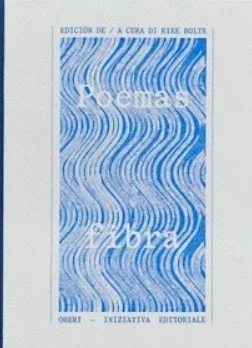
In a time when the right to breathe feels increasingly precarious, when U.S. regulators reconsider bans on asbestos, and invisible poisons still settle into walls, lungs, and legal loopholes, Poemas fibra arrives not as a document of the past, but as a breathing, bilingual act of resistance.
Poemas fibra was published by Orēri, a small independent press based in Cagliari, Sardinia, an island where the stones speak of Bronze Age time, of salt and empire, but also where asbestos — entombed in rooftops, schools, and breath — continues to mark bodies long after its promise turned to poison. But while the book saw its beginnings in Sardinia, it speaks unmistakably from Latin America, where the fiber never left, and poetry holds what justice refuses. Edited by German poet and translator Rike Bolte, and introduced with a poetic prologue by Arthur Rose, a British literary scholar whose work Asbestos: The Last Modernist Object[1] traces the cultural life of asbestos through literature, film, and environmental thought, Poemas fibra collects what it calls “poesías-respiro” — breath-poems — as a collective response to the long, slow violence of industrial toxicity. But it is also a declaration: that when other weapons have failed, regulation stutters, and the dead are buried without justice, poetry might still name what was erased, hold what was broken, and keep the breath moving across languages. And it does it between Spanish, marked by a colonial past but reclaimed here through Latin American grief and resistance, and Italian, the language of working lungs and buried fathers[2], now writing its own memory into the page.
Poemas fibra was born not from abstraction, but from proximity to contamination, to loss, to breath as both metaphor and material. As editor Rike Bolte writes in her powerful introduction, the book emerged from her collaboration with workers and activists resisting asbestos exposure in Buenos Aires own SUBTE metro system. These are people who learned to read their cities as “toxic ghosts”, who trained themselves to recognize and resist the nearly invisible fibers embedded in walls, air, and lungs. The book is dedicated to them — and to others, like Colombian journalist Ana Cecilia Niño, who died of mesothelioma in 2017 after growing up near an Eternit factory. She once described her childhood wonder at the "snowflakes" falling from the sky, unaware that they would not melt into water, but lodge deep in her lungs and unfold, over years, into an unstoppable choreography of multiplying cells.
The poems gathered in Poemas fibra come from Argentina, Colombia, Brazil, Peru, and Chile— voices that speak from and within the Global South, where asbestos has often been reterritorialized after being banned in the Global North, echoing a too well-known dynamic in which profit breathes freely while others suffocate slowly. The anthology becomes a form of poetic counter-mapping, tracing the long shadow of multinational industries, European export economies, and development models rooted in contamination. And it asks: What happens to a material once it is legally or socially condemned? Where does it go? And who still has to breathe it?
In this sense, Poemas fibra is not simply about asbestos, it’s about the afterlife of toxic matter and the asymmetric geographies of harm it maps. Its poetic forms are raw, sharp, elegiac, and experimental. Some offer documentary clarity, voices that name the substance, the law, the lobby, the factory. Others dream, unravel, gasp. Juan Salzano evokes a language of fragments and dissonance where “no orator” remains. Fede Llera confesses not knowing asbestos, and yet somehow always having breathed it. Isabella Trespalacios offers a surreal and fragmented vision: plastic like dried fog, silence guiding hands, thick clouds bubbling from pink caves. Ramona de Jesús turns to address Henriette Vogel in a litany of exposed organs and poetic abandon, naming amianto among her last breath and first love. Daniel Bencomo builds an archaeology of naming itself, reminding us that to name a material is to carve it into the world, and to ignore it is to let it kill slowly. And in Come se Pompei, Rike Bolte’s poetic voice lingers on stillness, on photography, on ash, on lungs that have not yet learned what history has already decided. As if we were living in a modern Pompeii, without the roar of the erupting Vesuvius, only its quiet, ongoing lethal aftermath. As if we were all Marcy Borders, dust-covered, breathing in what would take years to finish killing us.
Together, these voices refuse the erasure of slow death. They turn to poetry as archive, elegy, and insubordination, and to breath as a site of memory, labor, and political urgency. Poemas fibra does not just ask who profits from asbestos — it asks who names it, who ignores it, who breathes it, and who dares to write it down.
I came to Poemas fibra as a translator, and I left it as one of the poets in this anthology. Working on it felt closer to inhaling, or perhaps to breathing in someone else’s pain, memory, and rage. Slowly. Carefully. With responsibility. And at some point, I realized I was also breathing in my own. I didn’t know this pain was mine, too. In that moment, translation was no longer a bridge between languages — it was a return. A return to something I had forgotten, or maybe never dared to name. To my father saying Eternit, like it was just another material, part of the roof above his workshop, part of summer. I can still hear it in his voice, mixed with the smell of rubber and oil, with the heat rising off Sardinian concrete, with the silence of things we didn’t know yet could kill us. It lives in me like that, as word, as scent, as breath held too long.
Several poems I translated still stay with me — in my lungs, not just on the page. Amianto questions whether the word itself hides the violence it names. In Fede Llera’s poem, snow becomes neve di calce, lime dust falling softly over a childhood that doesn’t yet know how death arrives. Translating this anthology felt like birthing asbestos twice — once in the language of my Colombian years, and again in the language of my Sardinian parents. Spanish and Italian: two lungs of memory, both holding something I can’t exhale. To translate was to breathe with it, and to realize I already had.
Translating these poems was never just a technical act. It meant breathing with the fiber, knowing it had passed through other lungs before mine — and my father’s. It meant holding in what others had already exhaled. Carrying these lines into Italian meant navigating multiple forms of invisibility: the silence of the fiber, the erasures left by industry, and the metaphors poets reach for when breath itself has been taken. It also meant choosing how to carry someone else’s air into a different language, with all the weight, care, and responsibility that breath carries.
These are not easy poems. They resist simplification. But they invite listening, self-discovering, self-undoing, and they demand it. In Translation Changes Everything[3], Lawrence Venuti writes that poetry translation occupies a marginal space in the publishing world, often viewed as commercially insignificant. But it is precisely this marginality that gives poetry translation its ethical and political force. It becomes a space for experimentation, for resistance, for solidarity. And also a place where my Sardinian summers and my father’s workshop take on a different meaning, one too brutal to name, but impossible now to unsee.
Translating Poemas fibra was not about smoothing over cultural difference or decorating the page. It was about listening across borders — and acknowledging that these poems come from places where extractive violence is not history, but present continuous, — a tense that slips from the third person plural into something harder to escape. Something first person. Something plural.
From Argentina, Brazil, Colombia, Chile, and Perú, the voices in Poemas fibra speak of slow violence, invisible illness, and the ways industrial contamination inscribes itself into the bodies of the living. Venuti reminds us that translation can be a form of resistance, even when its change is symbolic or intimate. In this sense, Poemas fibra, and the work of translating and responding to it, becomes part of a larger poetic intervention: a way of challenging dominant narratives that frame asbestos as a “solved” issue; a way of remembering that the Global South continues to breathe in what the North has banned; a way of affirming that poetry is not an escape from harm, but a mode of surviving it, naming it, and refusing to let it disappear.
And more personally, it became a way to return to my own small Sardinian tragedy: the fiber in the roof above my father’s workshop, the word Eternit spoken like any other, and the breath we didn’t know we were already sharing.
Valentina Concu is an Italian linguist and academic who grew up in a small village in south Sardinia and holds a Ph.D. in linguistics from Purdue University in the United States. She is the Italian Program Coordinator at Leuphana University in Lüneburg, Germany, and her research spans historical linguistics, pragmatics, corpus linguistics, and second language acquisition, with previous teaching experience in Colombia.
Works Cited
[1] Arthur Rose, Asbestos: The Last Modernist Object (Edinburgh: Edinburgh University Press, 2022)
[2] Alberto Prunetti Amianto (Edizioni Alegre, 2021)
[3] Lawrence Venuti, Translation Changes Everything: Theory and Practice (London: Routledge, 2013)