“Presidential Fitness and the Creation of the Twenty-Fifth Amendment,” Interview, John Feerick and Wesley R. Bishop.
In the summer of 2026, North Meridian Review managing editor Wesley R. Bishop corresponded by email with John D. Feerick, professor emeritus and former dean of Fordham Law School, about the history and meaning of the Twenty-Fifth Amendment. Feerick was an important legal scholar and participant in the amendment's development. His 1963 Fordham Law Review article, “Presidential Succession and Inability,” helped bring renewed attention to the constitutional problem of presidential inability, and he subsequently worked with Senator Birch Bayh and others during the amendment's development. The Twenty-Fifth Amendment, ratified in 1967, addresses presidential succession, vacancies in the vice presidency, and the temporary transfer of presidential powers and duties when a president is unable to discharge them. In this interview, Feerick discusses the amendment's origins, the concerns that shaped its drafting, and the ways its provisions have been understood and misunderstood over the decades. The interview has been edited for clarity and length.
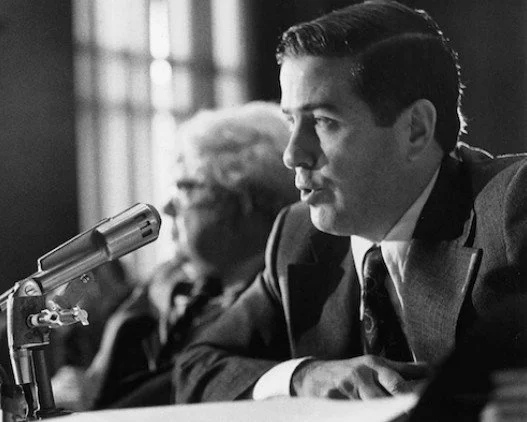
John Feerick testifying before Congress. (Source).
Wesley R. Bishop: Thank you Professor Feerick for taking the time to answer these questions. To begin, for readers who may not be familiar, could you walk us through how you first became involved in the effort that led to the Twenty-Fifth Amendment?
John Feerick: I became involved in the effort that led to the Twenty-Fifth Amendment because of an article I wrote on presidential inability after graduating from Fordham Law School in 1961. The article was published in the Fordham Law Review in October 1963 and was commented on favorably by the New York Times on November 24, 1963, in a column by Arthur Krock on the assassination of President Kennedy. Upon its publication and mention in the New York Times, I was drawn into this area by the American Bar Association. My interest in transitions in leadership and the role of inability has roots in my time, while a Fordham college senior, as Vice President of the student body, with responsibility for elections, having to deal with an inability of a candidate for office. My interest also was fostered by my learning from a college classmate of the disabilities suffered by President Eisenhower in office in the period from 1956—1958.
WRB: At the time, what problem felt most urgent to solve in terms of presidential succession and incapacity?
JF: The urgent problem that I saw in the area of presidential inability was that there was no clear process in the Constitution to ensure continuity of government leadership at times when the President may be “unable” to fulfill the obligations of the office, especially at times when the question of ability was not especially clear. There also emerged at the time the issue of how to fill a vacancy in the Vice Presidency, as occurred when President Kennedy was assassinated and his Vice President, Lyndon Johnson, became President, leaving a vacancy in the office of Vice President for the rest of the term.
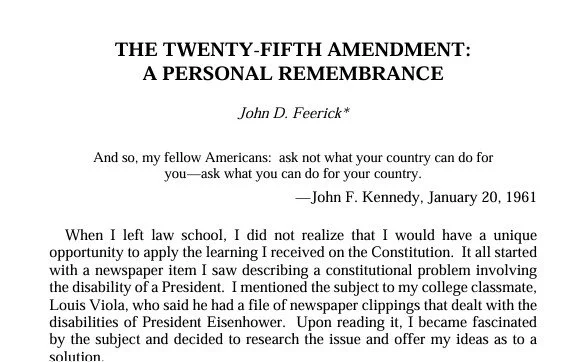
A 2017 article by Feerick reflecting on the Twenty-Fifth Amendment. (Source).
WRB: Before the amendment, what were the biggest ambiguities or risks in the Constitution that concerned you and your colleagues?
JF: The ambiguities on which I focused involved questions asked by a Framer of the Constitution in 1787 as to what constitutes an “inability” of a President, and who determines when such an inability exists.
WRB: You were a relatively young legal scholar when you began working on this. What was it like to move from academic analysis into something as consequential as shaping a constitutional amendment?
JF: I did not consider myself at the time as a young legal scholar because I was an associate in a small law firm at the time, engaged in labor and employment law practice, with a strong interest in writing an article on presidential inability in my spare time. The research for my writing was helped along by my beloved wife, Emalie, whom I acknowledged in my Fordham article.
WRB: Did your training as a lawyer and scholar change the way you approached what is, in many ways, a political process?
JF: I learned as a law student the importance of being factually correct, precise, concise, thorough, and not redundant.
WRB: Was there a specific moment when it struck you just how historically significant this work might become?
JF: I do not believe I did so until after my article was first published in October 1963. I wanted a small group to know of my article and recommendations, including President Kennedy and his brothers, former Vice Presidents Henry Wallace and Richard Nixon, and others who had written on the subject. My intention in sending the article to this group was driven more by my interest in sharing my thinking with individuals in a position to possibly act, without specific thought given to the potential significance of the outreach. I sent them all a reprint of the article and their responses are now in a presidential succession file in the law library at Fordham University law school. I found their responses of historical significance.
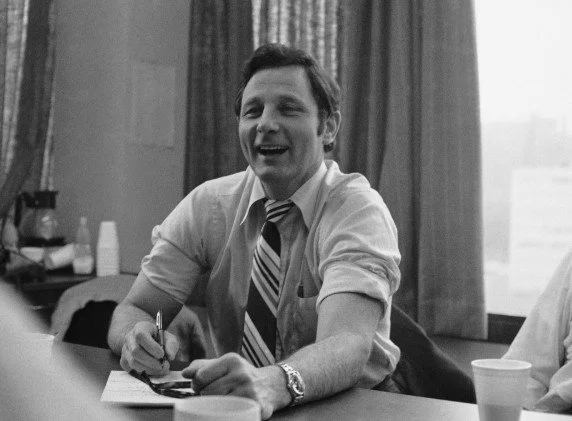
Senator Birch Bayh of Indiana. He achieved historic status as the only person since the Founding Fathers to author two ratified amendments to the United States Constitution.
WRB: Could you describe your working relationship with Senator Birch Bayh during the drafting process?
JF: [For those interested] I describe my working relationship with Senator Birch Bayh in a memoir I wrote, That Further Shore: A Memoir of Irish Roots and American Promise. When Arthur Krock’s column was brought to the attention of the staff of the American Bar Association, I was invited to attend a two day conference of the ABA in January 1964 on the subject of presidential inability and filling a vacancy in the Vice Presidency. I met Senator Bayh at that Conference and sat next to him on the first day. I became heavily engaged in the subject after the Conference, testifying before his committee in Congress in support of the ABA’s recommendations and thereafter relating to him and his staff, principally Larry Conrad, counsel to the Subcommittee on Constitutional Amendments, with respect to these recommendations. Senator Bayh generously describes my role in a foreword he wrote for the first edition of my book on the Twenty-Fifth Amendment in 1976, with editions in 1992 and 2014.
WRB: How did the collaboration between legal experts and legislators actually function in practice day to day?
JF: The Senate Subcommittee on Constitutional Amendments of the Senate Judiciary Committee played a major role in its crafting in the Senate as did the Judiciary Committee in the House of Representatives. The differences between the legislation passed by each House of Congress necessitated a Conference Committee chaired by Senator Bayh, with Representative Richard Poff as Vice Chairman, in order to resolve the differences.
With reference to collaboration with lawmakers, the ABA Conference of 1964 brought together in one room Senator Bayh with lawyers who had served in government positions, professors from academic institutions, and practicing lawyers. Their input and recommendations assisted Senator Bayh and others in Congress in formulating an amendment to the Constitution on presidential inability. As one such volunteer lawyer, I spent time communicating with both Senator Bayh and his counsel, by letters, telephone, and through the leaders of the ABA’s office in Washington, D.C. I also engaged in communications with a counterpart Framer in the House of Representatives.
WRB: In your opinion, what made Bayh an effective partner in moving the amendment forward?
JF: Senator Bayh was an extremely effective partner in moving the amendment forward because he listened to his staff and colleagues in Congress, as well as to respected groups like the American Bar Association, and he made changes in and additions to his original draft proposal of December 1963 on the subject of presidential inability.
WRB: At the time, were there concerns from lawmakers or the public that the Twenty-Fifth Amendment could be used to improperly remove a President?
JF: Concerns were expressed at the time that an amendment could be used improperly to remove a President from his powers and duties. Hence, the design of the amendment included a specified process and important safeguards to protect against abuse. The concerns and the process developed to address them are more fully discussed in my book, From Failing Hands: The Story of Presidential Succession, which was published in early 1965.
WRB: How did you and others respond to fears that provisions like Section 4 might enable something resembling a political coup?
JF: The design of Section 4 of the amendment that deals with declaring presidential inability included a number of steps before a President could be removed from the powers and duties of office: A declaration of inability by the Vice President plus a majority of the heads of the executive departments, or of such other body as Congress may provide by law (subject to a President’s veto), at which point the Vice President becomes Acting President; upon such a declaration of inability a President has 4 days to respond; and if the declaration by the Vice President and department heads (or such other body) is kept in place, Congress must resolve the difference. See also my response to question 35 concerning the role of Congress.
WRB: Were there specific debates or objections that significantly shaped the final language of the amendment?
JF: In response to specific debates or objections that shaped the final language, I suggest a reading of the Conference Committee report of June 1964 and of the discussions and debates in the Senate, on June 30 and July 6, 1965, in adopting the Conference Committee report. See also generally “The Twenty-Fifth Amendment in the Words of Birch Bayh, Its Principal Author, 89 Fordham L. Rev. 31, (2020).”
WRB: Looking back, do you think those early concerns were fully resolved, or do they still linger in how people understand the amendment today?
JF: I believe the concerns expressed were resolved in the text and by the legislative history surrounding the Conference Committee report.
WRB: When you think back on that period now, what stands out most: the legal challenge, the political negotiation, or the sense of historical responsibility?
JF: What stands out most for me in looking back is the sense of historical responsibility to the Constitution by those involved in the effort of formulating an amendment regarding the Presidency.
WRB: There’s an argument that mid-20th century fiction helped shape how Americans think about presidential fitness, especially mental fitness. From your perspective, is that a fair assessment?
JF: I [would] call your attention to chapter sixteen and page 261 of the third edition of my book on the Twenty-Fifth Amendment, entitled “Representation of the Twenty-Fifth Amendment in Popular Culture” … In a concluding note I said that, “the Twenty-Fifth Amendment, as with respect to the impeaching article and other provisions of the Constitution, is ripe for misunderstandings, rampant speculations, conspiracy theories, even when carefully and properly applied by the people with constitutional power. All of this makes important the media’s fascination with Twenty-Fifth Amendment plots, since at their root they educate, inform, and focus on outcomes in a wide range of contingencies that could happen, even in a country anchored on the rule of law.”
WRB: To what extent were lawmakers and legal thinkers at the time influenced by broader cultural narratives, rather than just constitutional theory and recent events?
JF: Depictions like Caine Mutiny, for example, present a case for a Twenty-Fifth Amendment, and I noted the depiction’s influence [in the] book I published in 1965 before the amendment was proposed by Congress in July 1965… Caine Mutiny was also mentioned in the response to a survey conducted by the House Judiciary Committee in 1955-56 of handling a presidential inability. Interestingly, many years later in a conversation I had with a journalist seeking an example of a Twenty-Fifth Amendment case, I suggested a reading of the book Caine Mutiny. A few days later, the Washington Post placed on its first page by that journalist an article with the title: “Caine Mutiny and the Disability of a President.”
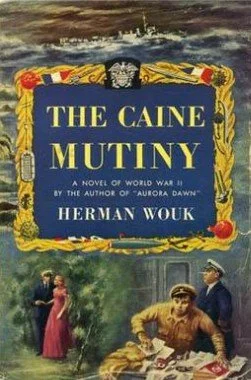
The Caine Mutiny, a 1951 novel by Herman Wouk, explores how a naval crew responds when its captain’s increasingly erratic behavior raises doubts about his ability to command. The book became part of the larger discussion on presidential disability because it raised the question of when a leader is incapable of performing the duties of office and who has the authority to intervene.
WRB: One of the challenges seems to be distinguishing between unpopular leadership, controversial decisions, and actual incapacity. How did you and others think about that line at the time?
JF: I decided, after the Watergate scandals, to write a book about the amendment to explain it for future generations. That book in 1976 contained a chapter (12 in the original edition now chapter 8 in its third edition) entitled “An analysis of Sections 1, 2, 3, and 4 of the Amendment.” It addresses unpopularity and other circumstances not qualifying as “inabilities,” and also what qualifies as an “inability.” My views of actual incapacity were shaped by my research of past inabilities of Presidents, messages to Congress by President Arthur and the proposals introduced in Congress during the Eisenhower years and in the testimony given at hearings, and the provisions placed by Presidents Eisenhower and Kennedy in their letter agreements with their Vice Presidents concerning a presidential inability.
WRB: Did the amendment’s framers consciously try to avoid turning questions of “fitness” into political weapons?
JF: The crafters of the Twenty-Fifth Amendment wanted to address vacancies in the Vice Presidency, the questions left open by the Framers of the Constitution as to the meaning of inability and who determines its existence, and codify the John Tyler precedent of succession to the office of President in cases of death, resignation and removal of a President.
WRB: More broadly, then, do you think popular culture plays a constructive role in helping the public grapple with the constitutional questions like presidential fitness, or does it risk distorting them?
JF: When I see calls in popular culture to invoke the Twenty-Fifth amendment, I often wish there was a greater understanding of the amendment since neither the Vice President, nor the Cabinet alone have the authority to declare a President unable to discharge the powers and duties of office. They both share responsibility in declaring a President unable to discharge the powers and duties of office. I also note that a vote of one third plus one of either House of Congress in support of the President during the 21 day period may override a joint declaration of inability by the Vice President and department heads.
WRB: In recent years, there have been several high-profile moments when public figures called for the Twenty-Fifth Amendment to be invoked, including after January 6, during President Biden’s debate performance in Atlanta, and in more recent discussions surrounding President Trump’s behavior. When you hear these calls, how do you evaluate them in light of what you originally envisioned the amendment to address?
JF: I offer no comment absent a fuller understanding of the facts and for reasons explained in answers to other questions as to the actual process required for making an inability judgment.
WRB: Fair enough. Is there a risk that the amendment is being drawn into situations that are better understood through other constitutional mechanisms?
JF: I often think there is a general misunderstanding or misbelief about what the Amendment is designed to do. It is not intended to be a vehicle for removing an unpopular President - that would be done through elections; it is not intended to remove a corrupt President – that would better be pursued through impeachment. The Amendment’s inability provisions are focused on the President’s inability to discharge the duties of the office and how that is determined.
WRB: How would you explain the difference in purpose between those two paths (impeachment and inability) to someone trying to make sense of these current debates?
JF: The differences in purpose between impeachment and inability are explainable as follows: Impeachment involves charges against a President presented by the House of Representatives, which, if established after a trial in the Senate chaired by the Chief Justice, removes a President from office. An inability of a President, on the other hand, involves a transfer of the executive power to the Vice President as Acting President for the duration of the inability. A president may declare his own inability under the Twenty-Fifth Amendment and transfer the powers and duties of office to the Vice President as Acting President and recover them, and then there is the process of declaration involving the Vice President and the heads of the executive departments.
WRB: Some of the public discussion around these moments suggests a belief that the Vice President and Cabinet could act quickly and decisively on their own. Could you walk through what would actually happen if a President contested that determination?
JF: In response to your question about the Vice President and Cabinet acting quickly, the circumstances at hand might require that and the amendment offers a remedy because of its time provisions. To be noted also is that planning by Presidents for succession contingencies began during the administration of President Reagan and were developed further by his successors. They have embraced in confidential documents succession scenarios and quick responses when necessary. [For those interested] see the presidential succession file at Fordham University Law Library involving President Clinton.
WRB: In a contested scenario, how significant is Congress’s role, and what does that tell us about how difficult it is, in practice, to use Section 4?
JF: In a contested scenario, Congress plays a significant role. Congress must assemble within 48 hours if out of session and do its work within 21 days. A two-thirds vote of each House of Congress is required in order to sustain a declaration of inability by the Vice President and department heads, in which case the President remains removed from the powers and duties of office. A vote of one third plus one of either House of Congress in support of the President will resolve the conflict in favor of the President and the President immediately resumes the powers and duties of the office. If Congress fails to act at all within 21 days, the President resumes such powers and duties.
WRB: As someone who helped shape the amendment, what is your reaction to seeing it become part of everyday political conversation in this way?
JF: As one of those participating in the shaping of the Twenty-Fifth Amendment, and also a teacher of students about the Constitution more generally, I accept misunderstandings and misconceptions of the Constitution as part of everyday reality and political conversations. It incentivizes those who teach in these areas of the importance of such teaching.
WRB: Finally, what thoughts would you like to share about your career and work that we may not have covered?
JF: I feel blessed to be at my present age having had the opportunity to assist in the crafting of a constitutional amendment and to educate others throughout my adult life about the Constitution and its Twenty-Fifth Amendment.
WRB: Thank you so much for your time!
JF: Thank you.