Review, “i have wrestled with the way clouds weep” by Judy Nahum.
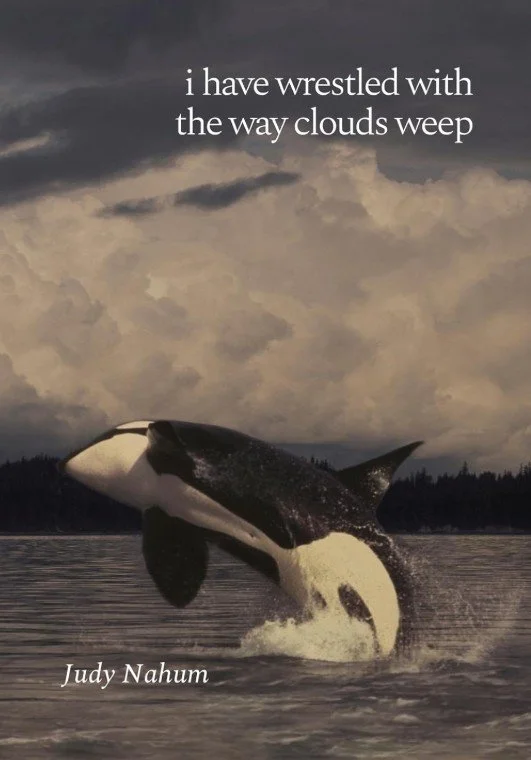
Judy Nahum’s I Have Wrestled with the Way Clouds Weep is a poetry collection of emotional depth and lyricism, where the personal and universal collide in a mesmerizing dance of language, memory, and the natural world. Published by Querencia Press in 2024, this collection invites readers into a world of fragmented, tactile experiences and explores themes of grief, longing, survival, and transformation, all set against a backdrop of elemental imagery.
The book opens with the poem “Brighton Beach,” an unapologetically fierce exploration of self and identity. Nahum’s speaker stands at the intersection of vulnerability and strength, confronting “the male gaze” (9) and the burdens of external expectation. Lines like “But they don’t know the weapon of my tongue, how it lashes”(9) set the tone for a collection that refuses to shy away from difficult emotions or experiences. The poem unfolds like a defiant act of self-possession, with the sea—both literal and metaphorical—offering solace and transformation: “I will gorge myself on the ocean floor & rise up, / grinning / a mouth full of shells / ready to shatter into words” (9).
The poems in this collection have an unmistakable, elemental quality, often blurring the lines between the human and the natural world. In “The earth wove a casket of reeds,” Nahum portrays nature as both violent and tender: "I am a shard of glass, scraping blood lines across a jetty" and “I drink from wild honeysuckle, suck bare fishbones” (10). This tension between beauty and decay, creation and destruction, recurs throughout the collection. Nahum writes with a precision that elevates the ordinary into the extraordinary, crafting images that linger like vivid fragments of a dream.
What’s striking about Nahum’s work is the rich, sensory texture of her language. Her poems are filled with tangible moments. The collection is dotted with details that heighten the senses, bringing the reader into a visceral relationship with the world. In "Swinging steadfast from a tender branch," Nahum confronts pain and resilience, using the metaphor of trees and decay to explore how hardship becomes a part of the body, yet also a means of eventual liberation: “when poplar leaves tremble, they do not ache. / Cottonwoods drop their boughs of hollow heartwood and something is set free” (17).
There is also a subtle political undercurrent to Nahum’s work, particularly in poems like “Migrants,” where human suffering intersects with a landscape marked by displacement and trauma. “Mornings I lick crocuses from pavement” (14), the speaker says, and the image of this small, strange gesture against a harsh backdrop becomes emblematic of the book’s broader themes of survival, longing, and resilience. Nahum speaks to the human experience in all its fragility and tenacity, acknowledging the wounds we carry and how we adapt to the world’s harshness, but also how we continue to grow and find light in the cracks.
In poems like “Yakamoz,” Nahum grapples with the ineffability of grief, borrowing from the Turkish word for “the reflection of moonlight on water” (29) to evoke a cosmic and intimate mourning process. The speaker desires to “steal this from the whales” (29) to find a way to carry her grief, not as a burden but as a luminous presence: “I want the moon in one pocket / & the ocean in the other” (30). The metaphor here is both tender and haunting, offering a balm for emotional wounds while also acknowledging the cyclical, inevitable nature of loss.
One clearly defining characteristic of these poems is Nahum’s ability to seamlessly integrate the personal with the universal. They do not merely dwell on individual moments or isolated emotions; they reach into the realm of collective human experience, inviting the reader to see themselves reflected in the landscape of the book. The collection is as much about internal landscapes—about the mind, the body, and the heart—as it is about the external, physical world. Nahum’s juxtaposition of the two invites reflection on how they intersect and shape one another.
Judy Nahum has crafted a collection that is both intimate and expansive, one that lingers long after the last page is turned. In the act of wrestling with clouds, Nahum offers us a way to reckon with grief and hope, to confront the moments that shatter us, and to emerge—like the shards of glass or the broken wing of a gull—into something new and full of light.
Leslie Harper Worthington holds a PhD in Southern Literature and is the author of the poetry collection Why Would You Leave Me? A Memoir (2026) and Cormac McCarthy and the Ghost of Huck Finn (2012) as well as the co-editor of Seeking Home: Marginalization and Representation in Appalachian Literature and Song (2017).