Review, “The Geography of Hate” by Jennifer Sdunzik.
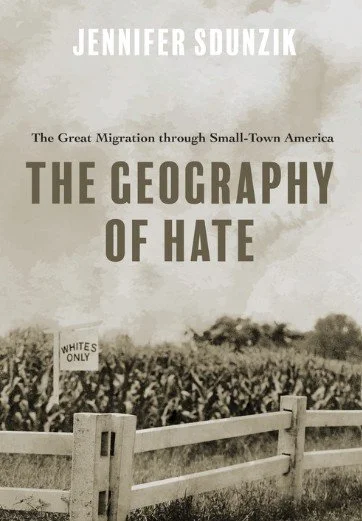
Jennifer Sdunzik. The Geography of Hate: The Great Migration through Small-Town America. Illinois: University of Illinois Press, 2023.
In the preface to The Geography of Hate: The Great Migration through Small-Town America, Jennifer Sdunzik invites readers into an archive and a history that will be uncomfortable, a count on which this book succeeds remarkably. This book is constructed as a new perspective on the Great Migration, in which millions of Black Southerners moved north during the early to mid-twentieth century. Specifically, Sdunzik sets out to counter conventional, urban-oriented scholarship on the Great Migration by showing how the rural and small-town Midwest were desirable destinations for Black Southern migrants. Given that many fewer Black Southerners remained in Midwestern small towns than showed interest in moving there, The Geography of Hate also challenges the notion that the small-town Midwest is a particularly welcoming place.
Sdunzik focuses her study on rural Clinton County, Indiana, which includes the county seat of Frankfort, several smaller towns, and much farmland. The county serves as representative for the state and region, which Sdunzik reinforces by including similar examples from other communities across Indiana and the Midwest. The book’s goal, then, is not to provide a focused history of the Ku Klux Klan in Indiana, nor an exhaustive study of Hoosier racism, but to demonstrate how the patterns and behaviors of one place may be extended to other, similar locations.
This book centers the erasure of Black Hoosiers in both real life and cultural memory. Chapter One offers a history of Black people in Indiana prior to the Great Migration, which includes pre-1900 Black farming settlements as well as lynchings and the expulsion of Black residents from white communities that span a much longer period. Near the end of the chapter, Sdunzik gestures toward the implications of this history, quoting an Adams County historian who describes the average white resident’s belief that the county is and has always been all-white. The following chapters detail the active and passive means of erasure that effect such a faulty and enduring communal self-image, including sundown towns, vigilantism, segregated schools, tokenizing, and white indifference.
The Geography of Hate is at its strongest when it situates its analysis in relation to the main streams of academic writing, such as the confluence of stereotypes of both the Great Migration and the Midwest that results in the elision of Black experiences from histories of rural life. Sdunzik disrupts the patterns of erasure by building a wide-ranging archive, moving from interviews to local histories, newspaper accounts to museum displays. One particularly compelling section examines an exhibit at the Indiana State Museum which juxtaposes a 6x8 inch postcard of the 1930 lynching of Thomas Shipp and Abram Smith in Marion, Indiana, with a large display of a red silk Ku Klux Klan robe, worn in 1979 by the Huntingburg, Indiana, chief of police. Sdunzik illustrates how the comparatively larger size of the Klan display and the wall text focusing on KKK history from the 1920s calcify the notion that Indiana’s racist history is well behind it—which enables the persistence of attitudes that dismiss the existence of present-day racism, even in the face of well-documented recent bigotry.
At times, questions of terminology make the analysis less persuasive. For instance, when examining the letters sent by Black Southerners seeking information or employment in the North, Sdunzik notes a trend of potential migrants who wish to move to small towns near Chicago, and the examples include cities of up to twenty thousand residents. Such passages are emblematic of slippage between terms like city and country as well as urban, rural, and small town; further parsing may have helped clarify potential migrants’ mindsets and desires. A related challenge emerges regarding the book’s memorable title, which works better as a concept than an analytical term. For some readers, deploying “the geography of hate” as a label may distract from or flatten the nuance in Sdunzik’s analysis.
This book’s diverse, interconnected archive will make it eminently citable in studies of Indiana, the rural Midwest, or the Great Migration. Sdunzik’s clear, committed social justice perspective offers opportunities for teachers and public historians who aim to challenge their audiences to reconsider the most commonly told stories of Midwestern history and culture.
Andy Oler PhD. is the Chair of the Department of Humanities and Communication at Embry-Riddle Aeronautical University and obtained his PhD in English from Indiana University. He is the author of Old-Fashioned Modernism: Rural Masculinity and Midwestern Literature and has published widely in peer-reviewed journals and edited collections. Andy serves as the departments editor at The New Territory magazine and edits the "Literary Landscapes" online series. His research focus is on American literature, masculinity, regional identity, and the cultural landscape of the American Midwest.