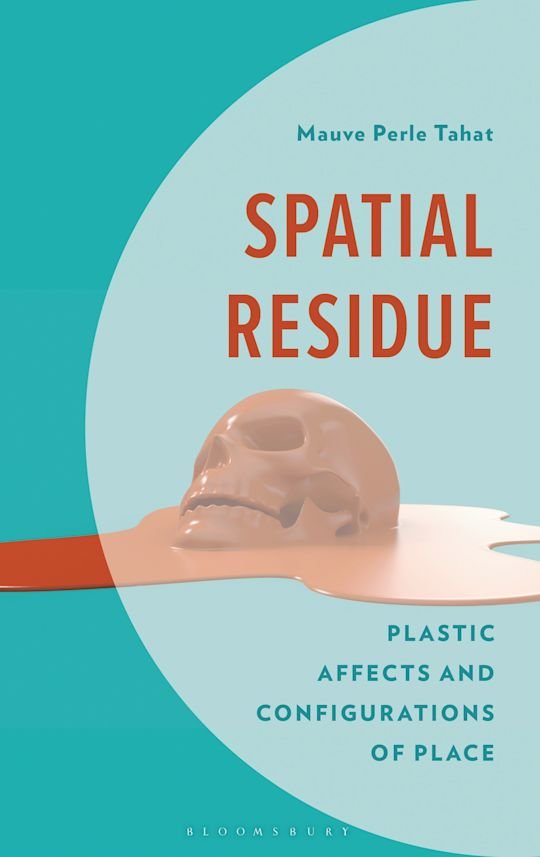
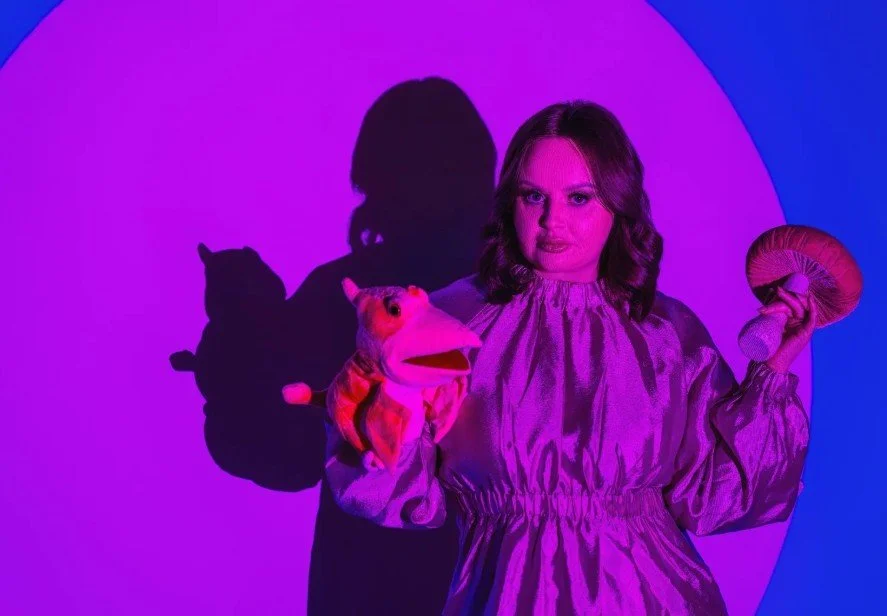
“Spatial Residue: Plastic Affects and Configurations of Place,” Interview, Mauve Perle Tahat and Lindsay Holman.

In Spring 2026 North Meridian Book Review Editor Lindsay Holman sat down with Poetry Editor Mauve Perle Tahat to discuss her new book “Spatial Residue: Plastic Affects and Configurations of Place” (Bloomsbury, 2026). The book examines how plastic both as an actual material but also as a metaphor intersects with society in terms of environment, memory, and culture. Tahat argues how sites of ruin and waste reveal how society views survival, persistence, and belonging. The following interview has been edited for clarity and length.
Lindsay Holman: When I read your manuscript, Spatial Residue: Plastic Affects and Configurations of Space, it reminded me a little bit of the different approaches we're seeing in current scholarship and in the way in which you were embedding narrative into explaining the theory of plastic affect in your project. What called you to write this project in this way? What was inspiring that approach?
Mauve Perle Tahat: The more I think about it, it’s part of my grandfathers’ work. My grandfathers, when I was growing up, they were like amateur historians. They were very invested in the history [of] what was around them. I talk about them a little in my first book, kind of in passing, especially my maternal grandpa; how he went to Bikini Atoll, The Marshall Islands when he enlisted in the military, and how this connects me to the Anthropocene. And I try to tell readers, “think about how we're all connected to the Anthropocene.” This is just one example, you know, my Grandfather there during these nuclear tests in Bikini Atoll, finding that out, thinking about our family medical history.
I’m always thinking about how much place is a part of my life and a part of everyone else's lives. It's this little background character. But when we're thinking about the environment and what needs to be involved in the discourse, it needs to be more of a main character, I think.
For a lot of us, we go to a place, at least when I was growing up, you go to a place and it's this generic sanitized version of a place. Like there's a lot of whiteness. Some theorists (like Diana Regan) are now calling them “Slop Cities.” I can go to any town in America and I can be at a White Castle. I can be at a Burger King. I can be at a KFC. Many of us grew up like this, right? When we go to the mall, you know, we can go to a Victoria's Secret. I can go to The Limited (maybe not anymore, I think they stopped that particular brand from proliferating). And then we all found out this was stuff that was owned by the same guy with a lot of, we'll say targeted ideas, of what women should be (see: pedophelia).
I remember driving around with my grandfathers and they would always tell me what a place used to be before, as far as they knew. They knew all these eras of what happened in that house, in that neighborhood, on that spot. And that was really influential for me. My one grandfather, he only completed the 5th grade. My other grandfather, he didn't graduate from high school. This type of skill they had was, in my mind, made you a good citizen, a well-rounded person, somebody who knew stuff if you knew the history of the land that you were on. Now I think it has come more into a public discussion, especially for a while there with the land acknowledgement, which people seem to still do once in a while, but may be searching for less symbolic ways to understand the land. In my first book, Ecologies of Incarceration: Carceral Discard Studies in the Anthropocene, I talk about that episode in Reservation Dogs where they explain the land back movement by showing this old white couple bickering “they can’t mean all the land can they?” and then they hit a deer. Yes, we conclude it does mean giving the land back to its original stewards because we turned it into Slop Cities, didn’t we… But anyway, I think place always has figured strongly for me and I wanted to, pun intended, map that out theoretically and talk about it also in relation to literary history as well as cultural history.
Lindsay: I was also struck by the examples that you bring up in several chapters in your exploration of the way in which you can apply a spatial narrative to different cultural forms. What drove you to make these choices? You talk about it specifically in Chapter One: A Living Memorial, but I'm curious, you know you're making references to Atlanta, Dawn of the Dead, to different poets and other forms of media that tell spatial stories. What was your methodology in excavating these sources?
Mauve: I think whenever I'm bringing in a source, I like to add whimsy and be silly sometimes, in a maybe darkly humorous way, but also I’m bringing them in because to me that seemed like the very best example that I could find. When I talk about portals, you'll see in that chapter, I open it up with Meow Wolf. It does these art installations inside of malls, because what is a mall if not a weird little portal? They make it literal and they bring in all these working artists and they say: let's make this space even weirder, even more uncanny. The saying from literary studies comes into my mind “make it strange.” How do you understand something better? You make it strange. You make it seem that it needs to be analyzed. Otherwise, you can't understand it as deeply as you want. In different chapters, I think I mentioned too, I love genre crossing. So when I say things like, “Donald Glover is one of my favorite modern theorists,” like some people say, “oh, Donald Glover is an actor.” People can use different mediums to create and to portray theories. Not everyone needs to sit there and write literary criticism. They're making theory all the time. I did that in my last book too. I said “the theorist Tupac Shakur.” Readers might think, oh, maybe that's a mistake, but it's not.
Lindsay: Yeah, you're very intentional with your language and I think you're asking a very relevant question about who creates knowledge, who creates theory, and what mediums do we expect it to come in? And to me, that also resonates with the question that you're posing readers in your book, where you're arguing that we should reconsider spaces of abandonment as places of transformation. For you to call out these spaces and to think about the urban explorers who are currently creating content around this, why do you think we should be talking about these spaces not as places left behind, but as places of transformation and of active agency?
Mauve: Eve Sedgewick was really skilled in her work of asking “at what point does a (what she called) suspicious reading stop being useful? When does that become at best unhelpful at worst damaging? Like, we know all these facts. We know all these statistics. And she was just like, what then? And she was really good at making us look at ourselves and how we were reading and say: you're right…what are we even doing with these readings?
I see it also in modern activist spaces. I think we're trying to overcome that right now in our in in activism. Partly it’s the need to be suspicious of other people and what their intentions were with us. We were just sitting there pondering if we can throw them out if they do a microaggression. So, there was no transformation. It was just kind of like, OK, who am I going to cut off this week because they rubbed me the wrong way. And I think abolition theorists have been saying for a long time, you cannot do politics like that with people who come out saying they want to be your ally. You have to figure out a different way that doesn't mirror the prison industrial complex. You have to be non carceral with your friends because otherwise there's nothing for you. There's no future. Basically you're a nihilist.
So, when we're talking about space, I think it's the same way. It's like, OK, I'm giving a spatial critique. So, what am I going to say? The modern shopping mall is like ugly and I'm just so glad that all of them are being abandoned and knocked down? That's not 100% true. My older son, he says, “you know what I'm going to do when I become an adult?” He says this all the time. “When I'm an adult, I'm going to buy a shopping mall and I'm going to turn it into [basically] low-income housing.” And that's brilliant, right? But nobody is doing it. It's like, oh, that's just a simple idea that a six-year-old has. Oh, well, if it's so simple to transform a space, the complex critique is actually hurting. We're saying we want to come up with a society that's better for everybody, right? And that's what Sedgwick was always trying to say. It's like, OK, great, be suspicious of people, talk about power and control. But in the end, what are you left with?
That's what I think I aspire to do in my own writing. We got to figure out what comes after a suspicious reading of something because it can't just stop there.
Lindsay: I think so. When I was reading that section of your book, I was thinking back to my camera roll on my phone because my new penchant whenever I go to a Roman amphitheater or an ancient space where it's either been reconstructed or it's lying in ruins, I take pictures of wildflowers growing through the crevices.
Mauve: That's beautiful, yeah.
Lindsay: And it always reminds me that for thousands of years we've been reclaiming spaces or materials and repurposing them. When I read your book, especially the reclamation chapter, thinking about, OK, yes, we can be skeptical and we need to be critical, but also why can't we interpret these spaces as places of transformation that is not either negative space or spaces to just critique and then move on with our lives?
There's both producing a framework for understanding how we're moving through potentially this plastic era, as you note, and also hope for how can we move through these spaces and how are our emotions going to be shaped by the places we inhabit?
I'm wondering how you feel if you had to summarize how the spaces you've moved through have affected you as an individual and how you think you might have affected the spaces in turn? Because you asked this question of how does space impact an individual and how does an individual impact or affect their space?
Mauve: Yeah, I think growing up near New York City influenced me a lot. New York City, it was always just implied that you go there and there's some kind of electricity when you set foot there or even when you're planning your trip. “What are we going to do? What's going to run into us today?” And depending on who you go with, who you're sharing the space with, it would be a different experience. And in my next writing project, actually I do a little bit more exploration into that. The idea of the ley lines that run all over. Have you heard of this?
Lindsay: Yes, I'm a little bit familiar, but keep going.
Mauve: Ley lines and the holding of energy…there's lots of different ways, I guess you could approach how you influence the space, but it does happen. You occupying a space changes it as much as it occupying you. We've heard of the haunted house that doesn't want certain people to live there, right? Or the haunted house that only likes children and doesn't trust adults. So I think this is very much in my mind when I go to places, almost like when you meet with any creature, like if you go into a space and there's a cat and the cat seems to really like you? That's how I see a building. The house I live in now, I always think about what energy the people gave to it before I got here. I think my space likes me, to be quite honest. I think we like each other.
When I moved into it, I was very cynical about it. It's in a newer development, built in 2009. It's kind of like a box with some windows cut out into it. That's what I felt about it when I moved into it. Researching this book, and I think I talk about it in the book, just briefly, I read about how this place that I live now in Indiana, Pennsylvania, it was historically a transient space for indigenous people. The fact that it's still a transient space is amazing to me because I'm like, OK, that didn't change, even though it's for a different reason. Now people come here for a university in the town. They come for school and they might stay up to a decade, and then a lot of them end up leaving and then some of them end up staying.
It's not the same type of migration that used to happen, but it's still a transient space. And I'm just thinking, wow, that kind of serendipity is very unusual. But maybe not. That's the thing. Is it unusual or does that tend to happen in different spaces? That what happened there before gets repeated? If you've ever seen the film A Ghost Story, did you ever see that film?
Lindsay: I don't think so, but it is ringing bells at the moment.
Mauve: It’s basically a movie about a sheet ghost and you find out who the sheet ghost is. You see how this ghost died. That's the first part of it. But then it throws you for a loop. This wasn't a super popular movie, but I think it's just so, so neat. But they start out, they're in this house and there's a couple, the guy dies and then the timeline goes back like as far as it can go. You see that place and what it used to be. You see it just as like kind of like land with indigenous folks. And then you see the settlers. There was a ton of violence. They show the violence, they show buildings being constructed, being torn down, people dying, they show all of it. And then it leads up to that house being built where the ghost is. The ghost has to go back to those Indigenous times, colonial times, all of it. And they watched from the spot that they died, all the way. And then they have to see themselves die. They see what happens to them. They see what happens to their partner. Then they move into the future and they see so, so, so, so far into the future. Then eventually the movie, I think he even repeats. He goes back through that time again. So the film did a great job of thinking of space and time together and how places can have resonances. It even has this kind of funny little scene where a ghost looks out a window and sees another ghost in the house next to it. And he's like: hey, do you remember why you're here? And they're like, “not really.” And then it goes back to that ghost and they're just staring at each other for who knows how long. It's just like, do you remember why you're here? I don't, but, you know, we're here.
I think what we do in a space that definitely does resonate and that's why I think any country itself is influencing place all the time, with the choices we make, especially any policies we have that hurt people, right? Those harmful things I think stay in places. I think neighborhoods, communities, they hold on to that.
If you try to like gentrify a place, it's going to hold those ghosts. Those ghosts are still going to live there. So, all of that I think factors into what you're asking me, although I got a little long winded there.
Lindsay: No, telling me about A Ghost Story really does drive this home. I could visualize the film as you were describing it, and it really does connect to the themes that you've explored in your book about the connective tissue between time and space and how you know with portals we see sometimes that collapse and you can see a history and I think to tying into the deep mapping framework you proposed in the book of not just looking horizontally at a at a space but also vertically. And how that impacts how we as individuals move through a space, and how we in turn leave our marks on it, and how that space can come back and affect us as we move through the world and through time.
I love the way that you described how you came to the name and the theoretical framework you've developed with “plastic affects.” If I'm understanding your first chapter correctly, you call it an accidental detour when you were reading the article and you clicked on a link to an article about plastic emotions. Well, I think there are two questions embedded in this one. One, how do you approach research and those accidental detours when they come up? And two, how did that accidental detour in this instance impact how you've developed this this theory of plastic affect and the concept of plasticity in both psychology and in spatial narratives.
Mauve: Well, some of it I don't talk about in the book. That title, in a roundabout way, comes from the boon in scientific research, that happened right around when I started researching, about how much microplastics we have in our blood. Actually the book was going to be called Microplastic Blood.
I had a little podcast going and on it I interviewed my friend, a poet, Cleveland Wall, and that was the title of our interview. It's called “Microplastic Blood.” And we really wanted to talk about a lot of different things, transformative justice included. We ended up talking about this new information that was coming out all over the place, which is how much microplastics we have in our bodies. Thinking about that bit of news and everything I learned from abolitionists about what really needs to change if we want to imagine a future for ourselves that is sustainable, not just environmentally, but interpersonally, because so much of our problems are relational, influenced the direction of this book.
Somebody's trapped in a room. I don't know if this is going to be the best analogy…but if they're trapped somewhere, let's say, you know they can't get out of somewhere. They're not going to say over and over and over again, “Oh man, I wish I wasn't trapped in this place” because that's not a good survival strategy. They're going to start figuring out what they can do to stay alive.
They're going to [ask], “how much oxygen do I have left? Do I have any access to food? Am I injured?” So, when we find out, “Oh yeah, we have microplastics in our blood.” Do we just abort mission as people? No. We keep living and we try to figure out what we have to do next.
For example, in our environment, humans have done some abhorrent stuff. Every day it feels so insurmountable. It's like we're making this worse. We're making this worse. “What should we do now?” And yet, we're still living here. We're daily waking up.
I'm involved with some folks in in my community. I live near Homer City. I don't know if you heard about the massive AI data center they're trying to steamroll in here, right?
Lindsay: Yeah.
Mauve: So a lot of people in my community have said “we're invested in what happens here.” Every step of the way they've been pushing against this data center, right? All of that struggle has history in this community of “investors” (extractive people) coming in and thinking “oh, this is not only a rural place that has lots of open land, but it also has people who historically don't have a lot of access to literacy.” They feel like they're just going to come in here and nobody's going to say anything.
Lindsay: Right.
Mauve: This illustrates how every day there's this push and pull of all the things we've done and then all of the ways that we actually learn from that and what we're going to do to make it better. Because we can't say, “Oh yeah, I'm gonna give up.”
So, I think microplastic blood was the first analogy for me that really made sense based on the stuff that I've read about transformative justice, because transformative justice too is all about changing the systems and not individualizing it. Saying “here’s what we’re ALL dealing with because this is our community. What caused this? How can we change the system?”
Restorative justice, for example, is like, OK, we're going to take this incident that just happened, like somebody stealing food, right? And we're going to say, how can we just make it right with what happened? Oh yeah, let's pay back the store owner and then let's apologize to this or that person, right? But transformative justice, ideally you would make it so that nobody is hungry enough to steal food. You would offer food freely so that people don't have to steal.
Thinking about how these plastics exist, but we still have to continue surviving, that was kind of the underlying idea behind all of it and just seeing what we've done over time, you know? What we've done in ambiguity was really interesting to me in this book.
Lindsay: Yeah. So, when you say “what we do in ambiguity” or just what we do in times of uncertainty, we're faced with these headlines that are coming out, particularly around plastics and microplastics and how do we as a species move forward, is that it?
Mauve: Yeah, pretty much. It's like, OK, well, what do we say? It's just, “oh, yeah, we're cooked,” It's like people are making wars all around us all the time. They're destroying our environment. They are extracting from poor people. We feel like we have no say. These corporations, they just like, do whatever they want. It's like, OK, but if we feel that way, it's kind of like the suspicious reading. “What's the point in going any further?” So, the analysis only takes you so far. At some point you have to see the beauty and the magic in space to try to hone in on some kind of survival instincts for you to keep going.
We live for those moments in relationships where you feel seen by another person, that's a way that you can get through the fact that sometimes they screw up and they're terrible, you know? So, that's part of the human experience, I think in itself.
Lindsay: Right, right. Well, and I think it echoes back to the beginning of our conversation where there's been this narrative or dialogue that skeptical reading or suspiciousness in reading. And as soon as somebody makes a mistake, it's closing that door or cutting them off or moving on. But what you Transformative Justice are asking is how do we build together? In the face of all of this adversity, how do we become more malleable and adaptive in the face of our changing spaces? To me, and I thought this was really interesting in your book, you talk about these applications to studying presentism and looking at how are we moving through in our present bodies, in our present spaces, but also you argue that this all has ramifications for the possible futures we can envision. So I wonder what is the possible futures that you are envisioning right now as we're getting inundated with these microplastics in our blood and the other themes that you explore in your book?
Mauve: Right now I envision a future that only our immediate and close knit communities can create as we also create them…I'm getting like a little bit emotional because I've been working so closely with my community especially over these last six months. All we have is each other, you know? Doing all of it in practice obviously is hard, but people have done it for millennia, right? The species somehow still survives. And so, we're thinking about how we can share skills with each other. We're thinking about how we can keep each other safe. I'm giving a little book group and lecture on the text Mutual Aid by Dean Spade next week. And I'm reading about what I felt to be the best example of mutual aid, which was the Underground Railroad.
We're thinking like that again. Maybe there was a little time where we had a little break. But it's important to say to ourselves, people have thought about this way in crisis before and we can think through it again. We're not defeated. So, I envision a world where communities are in charge. They're in charge of themselves and they're not run by billionaires. Imagine billionaires don't run our communities anymore. They don't have us in a chokehold, we don't depend on them for what we need, and I think a lot of us are trying to see what that looks like.
I'm looking hard at Appalachia where I'm living now and how gritty they've needed to be. If you look at Appalachian folk tales, Appalachian witchcraft is in this book. I was just telling a friend the other day I would spend hours researching Appalachian scary folk tales. I'd be in total adrenaline mode researching these. “If you hear your name in the woods, no, you didn't.” This kind of stuff, thinking about just how these hills are as old as the earth itself. If you can think about all the spirits that must be all around us that have seen a lot of this stuff play out over and over again and somehow they get through it with each other and they learn to survive.
I imagine a future where we do survive. I imagine a future where we problem solve and we depend on each other like never before. Because living in America, it breaks your bonds with your neighbor. It breaks your bonds with even your family. Just to serve this collective of people that kind of has control over a lot of things, you know?
Lindsay: Yeah, I know it's everything you've said is resonating with what I've been experiencing reading your book and what I have been learning about transformative justice and in climate activism circles the call for community because we see hyper consumerism and individualism prioritized in this very capitalist society. So, the work and the path forward seems to be community building. I love that you put it as a way of restoring agency and then tying it back to space. In Appalachia, what all have these mountains witnessed? There's this energy and spirit of grit. And tapping back into the history of these spaces could potentially be a way forward.
Mauve: Yeah, definitely. I didn't expect to get a little choked up over that question, but I was thinking of my group chats [laughs].
Lindsay: Yeah. It's hard not to be emotional. And I do appreciate your response and also the way in which you are advocating for, in the book, especially, not only, deep mapping asks us to look at the psychological, to look at how we emotionally are reacting to the spaces we're inhabiting, to the news we're receiving. And you're really, to me it seems, helping us develop a framework to experience our present. I read the last chapter as ending on a hopeful note, as a possible future and a way forward, in the midst of all of the news we have been inundated with in the last few weeks alone.
I do want to ask one last question. And it's probably a lighter question, hopefully. Do you have a chapter you would recommend someone to read? Because you've got a very interesting narrative structure where you explicitly state that it's not, it's not going to be chronological, it's not going to flow in a particularly formulaic way that many of us might be used to. And you're at the end of the first chapter you called it a Wayfinder. Is there a particular chapter that you had a really good time writing and you'd like other people to jump into?
Mauve: It's a good question. I'm a big fan of the “Fugazi” chapter. I think that was a surprise chapter that popped up. It was like an offshoot of another chapter. I was like, oh no, this has to be a whole new chapter here. It just came out. Going through a record shop in New Hope, debating language. I mean, this was a scene from my youth. This is what as kids we liked to do. The fact that it was kind of a training to think about those exact same things today is a testament to how space and time is such a portal.
Lindsay: Absolutely. We keep having these conversations, which I think is, as you said, a testament to the portals and that kind of collapsing moment of space and time. It's just been such a pleasure to read your work, and I hope you know how much I enjoyed the book. I have lots of questions about your new work on ley lines, but I might have to just schedule another time to talk with you about that.
Mauve: That's so kind.
Lindsay: Is there anything you can say about your current research project or does that need to be reserved for another time?
Mauve: Well, if you can imagine, I turned in this book last April. It's coming up on a year when this book was finished and it's just coming out now because it has to pass through production reviews and all that. So, I've been working on this new project for almost a year. It's been cooking for a while and by the time it's released it will be almost two years that I'll be working on this new one called th0t cr1mes.
The newer projects is something that I wanted to explore more from my first book. I have this chapter in my first book titled “Having a Body” And I explore gender expressions and how the prison punishes what they would consider deviant gender expression, both inside the prison and then society pushes people towards getting enmeshed in the carceral system if they deviate from what people would consider the social norms that they tried to enforce, right? So, I felt like I wanted to explore that more, having a body, you know, what kinds of things are projected onto us in our daily experiences? I wanted to explore more and I also ended up focusing on the life cycle because child abuse was the number one thing that I noticed when I was reading narratives of people who had been incarcerated. And child abuse, in my mind, is systemic. It's avoidable. It's something that is a public health crisis because we refuse to support moms and children. And that can change. And at any time, our systems can say we are going to support moms, we're going to support kids.
This next book I wanted to look at embodiment and the life cycle. I have a chapter called Britney as MLM. I look at the life and works of Britney Spears, especially her memoir. And I talk about mid-level marketing schemes and transactional relationships and all that kind of stuff while thinking about how people engage with Britney Spears. Because Stuart Hall was the one who said that pop culture is, he wasn't the only one who said that, but he likes to say that culture is so important. It's how we construct everything around us.
Lindsay: Yeah. And I think the more we can engage with that discourse and to be part of the relevancy of the work that we're doing can hopefully reach a wider audience and not be as siloed, kind of connecting back to our first question at the beginning of our conversation. Just who are we writing for and what audience or do we want to reach? Did you have a particular audience in mind when you were writing your book?
Mauve: That's a good question. I'm a big believer in the spirit world. I think I write for people who passed on who've been really close with me. As far as living audience, I think of the people from my neighborhood or my students or like my best friends, you know, when I'm writing, like, what would they love to read about? Because I felt like, when I was growing up, it did feel like, you want to see somebody writing for you, for the people you grew up with, you know? So, I try to think of them a lot.
Lindsay: That's fantastic. Spatial Residue, I'm excited to have gotten to read it, and it does feel like a project that is meant for a community audience. It's not talking to the few scholars who are discussing theory. It's meant for the people.