“The Original White Lotus: A Renewed Call for Civil Disobedience,” Review Essay, Philip D. Wetjen.
I was recently presented with a copy of John Hersey’s classic book, Hiroshima. The story was initially published in The New Yorker magazine on August 31, 1946, and for many Americans, it was their first glimpse into the human side of the atomic bombing that took place a year before, on August 6, 1945. Recognizing its importance, the editors of The New Yorker elected to devote that entire issue to Hiroshima. The narrative relates the experiences of six individuals on the day the attack occurred and over the days and weeks that followed.
The copy of Hiroshima I was given now holds a treasured place in my library. It’s from the third printing, published in August of 1956 by Alfred A. Knoph, Inc. This particular book was formerly found in another library: the ‘Information Office Library’ of the Japanese Consulate-General in New York. There is a standard library pocket inside the back cover, with a card indicating it was shelved in location ‘230.8 He’. No one in the Consulate-General’s office was listed as having borrowed the book.
Perhaps the staff there already knew the story.
Acquiring this treasure by John Hersey prompted me to wonder about another book of Mr. Hersey’s— this one my personal favorite. Curious, I entered the book title into one of the standard search engines and scrolled through the first twenty pages of results. None dealt remotely with the book I had inquired upon— a book that I regarded as one of Hersey’s finest, and perhaps as important as Hiroshima.
The book I was searching for was White Lotus. Hersey wrote it in 1964, and so I suppose the search engines can be forgiven for allowing the very popular television series to dominate the search results. However, despite being intrigued by Parker Posey’s distinct accent, my loyalty remained with the book.
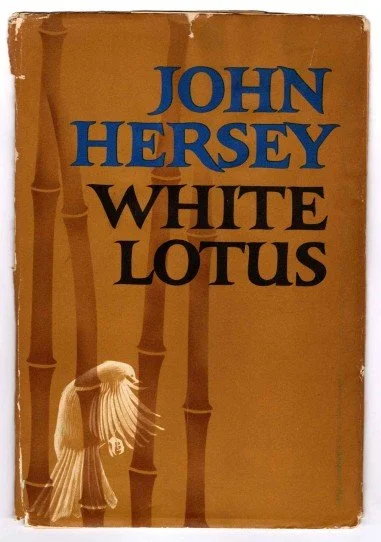
My copy of White Lotus is the hardcover Alfred A. Knoph edition published in 1965. The jacket of the book (well tattered in my case) states that the story is about “racial struggle.”
And undoubtedly it is.
Set in 1930’s China, it relates the hardships and hopes in the life of an enslaved white girl. An American girl. Her enslavement the result of China having overcome the United States in an armed conflict. The details of the conflict are not specified in the narrative— it is simply referred to in racialized terms as the “Yellow War.” The story opens with a Chinese sponsored raiding party attacking a compound of rural Americans sheltering in the Arizona desert. A large number of the compound residents are captured and marched, under guard and in a coffle, to a California port.
From there they are shipped to China.
Most American readers of White Lotus saw it as an allegory of race relations in the United States. And having been written in the mid-sixties, that interpretation is certainly valid. Race today remains as contentious a topic as it was in 1964.
Other readers see the book as a warning of the growing strength of China. With China’s first successful test of an atomic weapon occurring on October 16, 1964, the American public’s attention began to regard Russia and China with equal concern. In either of these interpretations, the theme is without a doubt racialized struggle. Either the ever present black-white relations in the United States, or something stemming from anti-Chinese imaginings periodically voiced by some westerners.
Those imaginings did not emerge in a vacuum. Long before White Lotus appeared, the United States had translated anti-Chinese sentiment into law through measures such as the Chinese Exclusion Act of 1882, the first major federal immigration restriction aimed at a specific nationality. Hersey's imagined reversal therefore asks readers to inhabit a relationship already shaped by exclusion, racial hierarchy, and unequal power.
Hersey offers a glimpse into his perspectives in an Author’s Note that appears directly after the dedication page:
This book is not intended as prophecy; perhaps it should be thought of as an extended dream about the past, for in this story, as in dreams, invisible masks cover and color known faces, happenings are vaguely familiar yet “different,” time is fluid, and there is a haunting feeling that people just like us, and maybe we ourselves, have lived in such strange places as these. It is, in short, a history that might have been, a tale of an old shoe on a new foot. (White Lotus, by John Hersey, 1965 Alfred A. Knopf; Author’s Note)
Throughout historic racial struggles, an ever-present reaction has been protest. Protest by the enslaved, the underrepresented, the underserved, the undervalued. Civil disobedience, as articulated by Henry David Thoreau in 1849. Civil disobedience, as artfully employed by Mahatma Gandhi and the Reverend Martin Luther King, Jr. Standing up, calling out, exposing injustice. Not by armed uprising, but by informing, educating and lodging protest. And this aspect of White Lotus is voiced in the first two paragraphs of the Prologue:
“I must compose my face and push the fear and doubt beneath the skin. Nothing must show on my face today but white skin. All that I have done and known must shine in this act. I must stand alone out there, a solitary ‘sleeping bird’, for on this day I have been chosen to make the symbolic individual protest that our movement has found so effective in recent months.” (White Lotus, by John Hersey, 1965 Alfred A. Knopf; pg. 3)
The entirety of White Lotus is related as a narrative in the first person. From the point of view of an enslaved white girl. Her name, given to her by her first owner, is ‘White Lotus.’ She can only be described as a ‘former American’ white girl. After years of enslavement, she has long since given up any hope of ever returning to her homeland. Her thoughts never drift in that direction. She can only comprehend her life in China: her life as a slave - moved among different owners in different provinces, all based on the economic circumstances of those owners. Or in some cases, purely on their whims.
Hersey's choice of protagonist is itself revealing. Rather than asking readers simply to sympathize with those historically subjected to slavery and racial discrimination, he invites predominantly white American audiences to imagine themselves in that position. It is an unusual feature of American storytelling that empathy for injustice is sometimes most readily elicited when the imagined victim resembles the reader. Hersey's inversion does not diminish the historical realities of slavery or segregation. Instead, it asks whether moral imagination can be expanded through reversal.
The Prologue section of the book is titled ‘The Sleeping Bird Method’. In it, we see White Lotus choosing her roost in the reviewing ground in front of a provincial yamen. This is not the town of her current residence. She has travelled far to lodge this protest. She is an outside agitator. She is there to face the provincial governor:
“To dominate is hard work! He really is squirming with annoyance and sheer jadedness, as he sighs again and shifts his weight on his feet. The trouble with ‘Only the powerful are free’ is that the powerful are enslaved by their own power. They have to tend it, be clever for it, and sometimes even wait patiently all day for its sake. It may drive them to crimes they dread committing: it may bore them at the very brink of murder.” (White Lotus, by John Hersey, 1965 Alfred A. Knopf; pg. 676)
White Lotus was taken from her home compound at the age of fifteen. We never learn her English name. With 275 of her fellow captives, she is marched from Arizona, overland to the California coast. Never having been to the sea before, she is terrified by the waves, which she imagines are ‘lines of white fire coming to the strip of sand on the bank of the sea’. There she also sees her first Chinese person, and is recoiled by his appearance, which she describes as ‘skin the color of curds.’ It is from this person, called ‘Big Number One’, that she first understands that she will be a slave. The yet unnamed white girl is sold for: a brass incense bowl, three lengths of cotton cloth, a bag of pomegranate seeds, and ten dollars Mex.
White Lotus’ first owner is a man named Venerable Shen. His household in the capital includes five other slaves, or ‘smalls’, as they are referred to by their owners. Her name is chosen here, by Madame Shen, who explains the naming decision by stating that the lotus flower ‘was perfection rooted in mud and slime’.
White Lotus becomes a domestic servant, an errand girl and a handmaid to Madame Shen. She learns the language and acquires the ability to move around the capital, wearing clothing that clearly identifies her status. Over time, she realizes that there are opportunities to momentarily escape the gaze of her owners and meet with other ‘smalls’ in the capital. She discovers that this can be done between errands, or even by surreptitiously leaving the hutong at night.
After a year of ‘service’, White Lotus and the other smalls in the Shen household are sold. Venerable Shen has concluded that yellow indentured servants will be more economical than whites– who, from Shen’s perspective, all seem to be ‘bred for agriculture’.
White Lotus is separated from her fellow slaves, and shipped by boat, and then oxcart, to ‘South of the River’ province. There she joins fifty-two other slaves on a rundown tobacco farm. She describes the farm as ‘sketchy and crass’, and notices that all the local farmers are exhausting the soil with their unsustainable practices.
Although confined to the fields, the slaves do hear that Emperor Yung-t’ai is dead, and that they should now wish long life for Emperor Ch’ang-lo. The new emperor is said to be more liberal – a ‘scholar & philosopher’. He proclaims that ‘The Nine Flowers of Virtue’ will rule the land. The slaves can only wonder if his benevolence will extend down to them.
“Oh, none of us has lost his tongue in these recent months; neither whites nor yellows have lost the power of speech. It is just that we have not spoken to each other for a very long time. We whites have been issuing statements at large, and so have the yellows, but these preemptory utterances on both sides have amounted to nothing better than silences. It has been a long time since we have spoken to each other and longer since we have heard each other’s words. They will not listen to us; we think we know the lies and hypocrisy they will spit out. Yet now at last I have had the urge to convey something directly to a hateful yellow man.” (White Lotus, by John Hersey, 1965 Alfred A. Knopf; pg. 680)
While working on the farm, White Lotus is involved in the periphery of an unsuccessful slave rebellion. As a result, she is again sold. And at a bargain price – there is a glut on the market due to the rebellion. This time she is transported, again by oxcart, to a poor cotton farm in ‘East of the Mountain’ province. She is now eighteen years old and has been a slave for three years.
While in the fields, she hears news of an ‘Uncage the Finches Society’ in the capital, a group led by Buddhists who have a stated goal of freeing all slaves throughout the empire. White Lotus plots an escape and returns to the capital. There, she finds that the slaves have been freed in the ‘core ‘provinces’ around the capital. The national government had issued a proclamation that the whites in the population can no longer be owned as property. But they are not citizens. They have no rights. They have no protections. Fleeing the chaos of the capital, White Lotus journeys to the city ‘Up from the Sea’, Shanghai.
Economic conditions for whites in Shanghai are no better than the capital, but there is some sense of freedom there, simply due to the preponderance of whites living in ‘The Enclave’. They are limited to jobs as rickshaw coolies or working in the silk filature. White Lotus works in the filature, extracting silk from cocoons, and her man, Rock, works as a coolie. All better jobs are held by the yellows. A few strikes are attempted, but in every case put down quickly and violently.
Over time, White Lotus, and the group of whites she has fallen in with, invent a new method of protest, one that is intended to ‘shame the yellows in grudging change’.
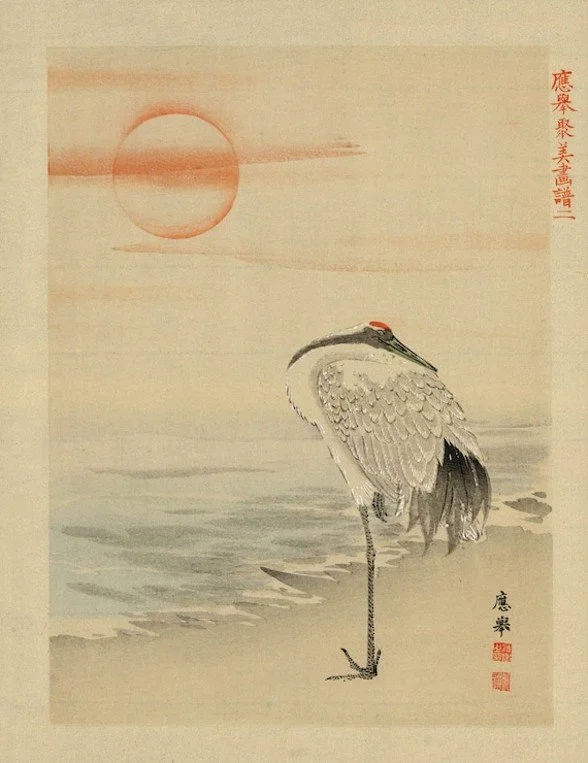
“The Sleeping Bird Method caught on after that with brushfire irresistibility as the one means we had in our power to disturb the yellows, to push the yellows, to shame the yellows. It was so simple, so pure, an invention of genius by Groundnuts’ hawk-eyed friend, the priest named Runner: merely to stand on one leg, like a bird settled on a perch for the night, helpless as a sleeping bird, in a large flock of sleeping birds.” (White Lotus, by John Hersey, 1965 Alfred A. Knopf; pg. 9)
This new method of protest proved to be more effective than anything attempted previously.
“For some reason this gesture reached the very roots of the yellows’ conscience, obliging them to face up to the intolerable conditions of our lives, wringing their guilty souls with that sweetest of all Buddha’s teachings, ‘Harm no living creature.’ For as sleeping birds we seemed to have at last forced ourselves on their minds as vividly living creatures.” (White Lotus, by John Hersey, 1965 Alfred A. Knopf; pg. 9)
Although the Sleeping-Bird Method enabled some progress on white rights in the capital (along with the core provinces and Shanghai), in the hinterlands far from the capital even the modicum of emancipation granted by the central authorities was essentially ignored. White Lotus, and the individuals who share her cause, journey to ‘Four Rivers’ province, the most steadfast bastion of reactionary thought and activity. There they plan to demonstrate the Sleeping-Bird Method before Governor K’ung. By the time of this trip, the members of the group have implemented a modification of the Method.
“This was the time when our movement seemed to be bogging down in a vagueness of its own, and this was when Rock, at that bicycle-wheel plant at Hankow, invented the individual protest that we have been using ever since: one sleeping bird standing alone. I have been chosen for this solo task today because in earlier group perches I have shown endurance. I have been thought stolid; some have called me courageous. If I have been courageous, then courage is something quite different from what I had always thought, for it must be something less than pure self-possession in the face of clear danger, it must be compounded of misgivings, anxiety, confusion, desperate and sinking efforts to master one’s doubts, and even uncertainty as to the meaning of one’s actions.” (White Lotus, by John Hersey, 1965 Alfred A. Knopf; pg. 10)
A crowd had gathered around the edges of the reviewing ground, facing the Governor’s yamen. The individuals had been animated— there was laughter and catcalls as a white food vendor walked among them. The crowd was silenced when White Lotus assumed her perch and faced the yamen. The silence continued as Governor K’ung emerged from his abode. White Lotus assessed her counterpart as he walked across the reviewing ground toward her.
“He is wearing a conical hat of the old-fashioned mandarin style – even to the spray of red silk threads that falls from the apex. He dresses out of, as he lives, for the past. He has a row of medals on his vast chest. The medal circles overlap each other, hanging from their ribbons, but they seem to be identical, and the one fully exposed has in low relief an unmistakable profile of Governor K’ung himself. Ai! The self-praising hero.” (White Lotus, by John Hersey, 1965 Alfred A. Knopf; pg. 24,27)
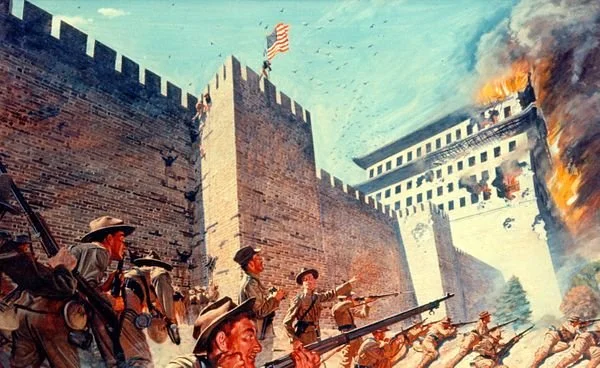
Despite the imagined history of White Lotus, the United States participated in the international invasion of China during the Boxer Rebellion (1899-1901). Hersey's reversal therefore carries an unmistakable irony. Rather than imagining an impossible world, he inverts one built upon genuine histories of imperial intervention and unequal power, inviting American readers to occupy a position their nation more often imposed than experienced.
John Hersey’s White Lotus is about racial struggle, a noble theme about the most ignoble condition. The story is set in 1930s China, but its themes transcend both place and time. Across societies and across epochs there has always been fear of the other. Hersey understood something uncomfortable about the American imagination. A nation that had enslaved Africans, excluded Chinese immigrants, and intervened militarily in China could nonetheless most readily be moved by imagining white Americans as the conquered and enslaved. The irony is precisely the point. By reversing history, Hersey exposes the structures of oppression rather than simply their participants, challenging readers to cultivate empathy without requiring themselves to become the victim.
“Governor K’ung is planted with a straight back, holding the sword pointing forward, parallel to the ground, and he seems willing to wait all day, or till I faint from exhaustion; he is yellow power, arrogance, contempt. I balance on one leg, and I am white defiance. We are at an impasse. We stand. We glare. We cannot move.” (White Lotus, by John Hersey, 1965 Alfred A. Knopf; pg. 30)
White Lotus is a story of protest. Standing up, exposing, educating. And it is that aspect that dominates my personal memory of this book, from my very first reading in the 1960’s, right up to the present day. And for today, in 2026 in the United States of America, I believe that element of White Lotus may truly be the most relevant. And the most needed.
“Somewhere in these confused actions I had come to realize that freedom could be felt at best only for moments: that even for the powerful, it was inconstant, elusive, fickle and quickly flown. It turned out to be an experience rather than a status. Ayah, much needed to be changed in our lives, to give us not freedom, but mere humanity. Freedom was not to be bestowed, but grasped– and only for a moment at a time.
I look at him, wanting to engage his eyes again. Now I am really convinced that if the deeper impasse that today’s lock represented is ever to be broken, we must speak to each other, I to him, and he to me, openly, in such a way that eventually nothing is held back, each having the courage to hear the most dreadful truths that the other may harbor for the present, even from himself.” (White Lotus, by John Hersey, 1965 Alfred A. Knopf; pg. 670)
Phil Wetjen is an independent scholar, retired from a career in IT that allowed him to travel internationally to over twenty countries, including multiple visits/extended assignments in Japan, Germany, the UK and the People's Republic of China.