“Body of Work,” Interview, Julia SH and Wesley R. Bishop.
In 2025 artist Julia SH sat down with North Meridian Review managing editor Wesley R. Bishop to discuss her work, representation in art, and the way images can challenge concepts of norms in everyday life. The following interview has been edited for clarity and length. This is a two part interview. For the second part, where Bishop talks with model Angelina Duplisea please read here.
Wesley R. Bishop: Thank you for talking with us.
Julia SH: Thank you!
WRB: Can you begin by telling our readers a little bit about yourself and your work?
JSH: I was born in Stockholm, Sweden, and grew up as a very extroverted yet deeply introverted person. I loved theater because it gave me permission to be wacky, weird, and free. At the same time, I was extremely shy and anxious. Somewhere around fifteen or sixteen, when I was in theater school, I realized I had a bit of a problem with authority. Acting no longer felt right, partly because I wanted more control over what was happening. One of my teachers suggested I move into directing, which I really liked.
Directing was both good and bad. In some ways it made my anxiety worse, because the stage had been a place where I could work through that fear, and suddenly that outlet was gone. It felt like another step back. Around that time, though, I started taking photography more seriously. I realized the camera functioned like a passport. It gave me a reason to approach people, a context for why we were socializing or spending time together. I was very insecure, and photographing people who then felt beautiful or cool was incredibly meaningful. It felt like a real exchange. They received something, and I got to meet people I might never have dared to approach otherwise.
That was probably what was going on for me at that age. I later moved to London for my BA and MA in fine art, where I worked primarily in film and video and barely touched photography at all. It wasn’t until I moved to the United States around 2007 that I had a realization. Film and video require permission, time, and infrastructure. Photography, by contrast, was self-contained. It still held all the elements of art I loved, drawing from sculpture, movement, dance, and painting. Because of that, I picked up the camera again here, eased back into it, and have stayed with it ever since.
WRB: So around 2007 or 2008, was that when you began to pursue photography more seriously?
JSH: I think seriously, probably not until around 2012. I did smaller things before that, but it wasn’t until then that I really decided to go for it. I realized I had been sitting around waiting for other people to get excited about the work I was making. I was making work, and some of it still materializes now, but film takes a long time. So around that time, I made a conscious shift.
The catalyst was a former classmate who was doing an exhibition in Argentina and asked if I had any work. I panicked, because I realized I hadn’t really produced anything since finishing my MA. It felt terrible. I immediately said yes, of course I did, which forced me to make new work.
I didn’t have a clear plan. I only knew that I wanted to photograph women. I imagined several women arranged in a kind of sculptural constellation. When they came into my studio, I remember thinking, I don’t know what to do with all this clothing. It felt distracting. So I asked if we could photograph them nude, even though it felt like a strange question to ask. Thankfully, it was a wonderful group of women and they were completely open to it.
That experience clarified something for me. Clothing can overpower the body and strongly dictate how it is read. It suggests posture, emphasis, and intention. Removing it stripped everything back. Those early, almost casual nudes really cemented my love for the naked body. I suddenly felt like I could breathe as a photographer, in terms of what I was working with and how I was engaging with my subjects.
WRB: That’s really interesting. As you suggest, clothing shapes how bodies are read, including what we choose to reveal or conceal, the intentions embedded by designers, and the social meanings we may not even be fully conscious of, such as class or regional identity.
I’m curious whether your focus on photographing women nude emerged immediately, or if it developed more gradually over time. Was there a specific motivation behind that choice?
JSH: I wasn’t entirely sure until that first shoot. It was in that moment that I realized how deeply interested I was in working this way. The reason is fairly simple. I’m a woman, and I relate very directly to the body dysmorphia that so many women experience. I’ve lived with it myself. There are shared struggles around having a body that is painful every month, that is complicated, sexualized, and constantly judged.
From that perspective, I felt confident that there isn’t a single woman I could speak to who wouldn’t carry some version of that experience. Women hold so much history and meaning in their bodies. I didn’t want to feel as though I was commenting on a reality I hadn’t lived. I only know this body, my own.
At this point, I’m more open to the idea of photographing men, but I also feel there are many photographers who could do that work far better than I could. I’ve been asked why I don’t photograph men, or whether that choice is exclusionary. My honest answer is that I think I might do them a disservice. I don’t know their embodied experience in the same way, and I feel others who begin from that place might be better suited to it.
WRB: As you began working more extensively with nude photography, did questions of body image come to the forefront fairly quickly? Specifically, did you consciously begin thinking about fatness and size as subjects you wanted to address, or did those concerns emerge more organically as the work developed?
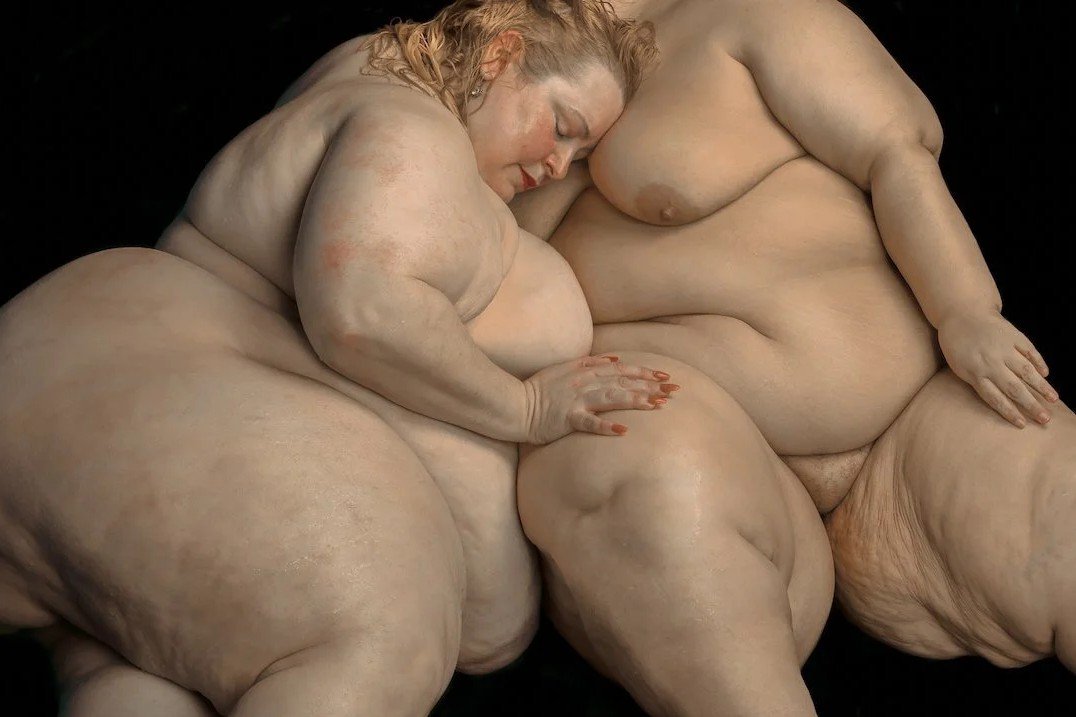
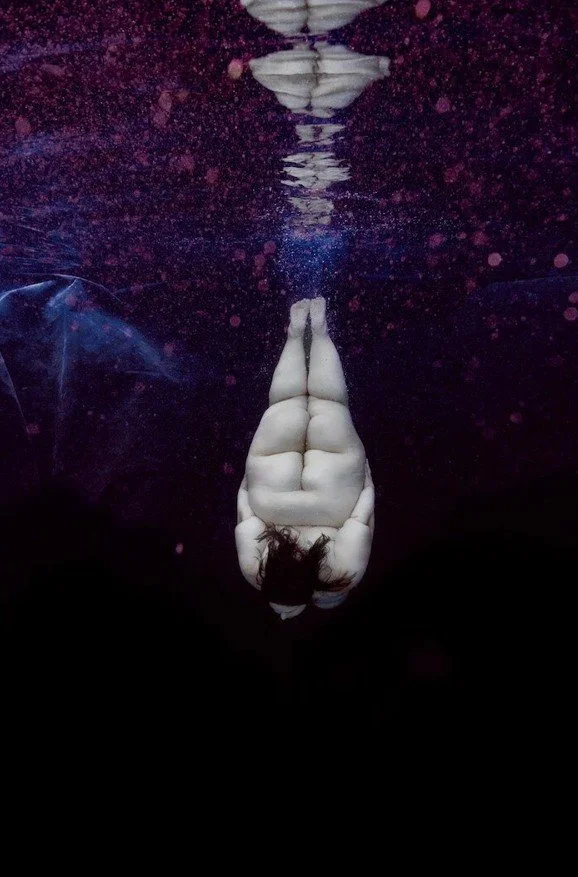
JSH: I was working on a commission for a company that required a larger body, mainly for visual effects work. That’s when I met Angelina, who I’ve since worked with many times. She came in completely unapologetic, very professional, and immediately ready to work. I remember thinking, this is something I see walking around me all the time when I’m outside, and yet I had never really seen it like this, especially not nude.
Seeing her without clothing was a revelation. She felt like a living sculpture, as if she had stepped out of an art book I’d read. I was completely mesmerized. I thought she was stunning, and I had to pause and check myself. Why is this evoking such a strong response in me? Around the same time, another model said something that really stayed with me: that the largest bodies are often the most invisible in the room. That clicked. I was surrounded by these bodies all the time, yet I had barely paid attention.
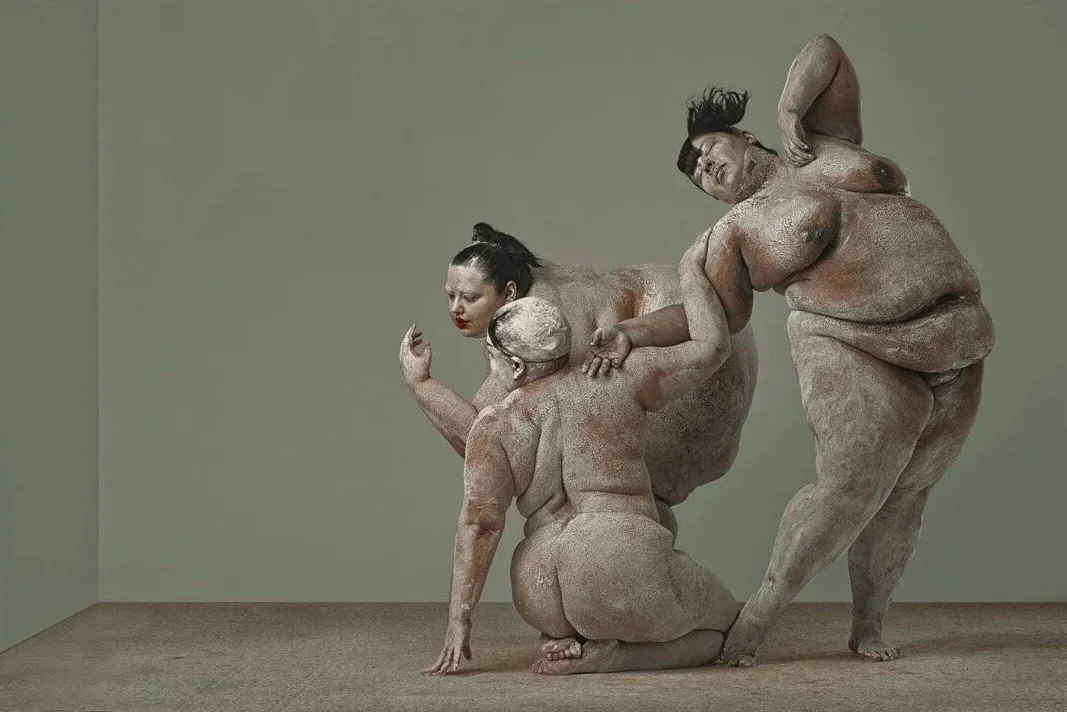
I had always wanted to work in sculpture, but I’m terrible with my hands. I can’t paint. Photography was, in many ways, what I had. And suddenly I felt very strongly that whatever brought her into my studio couldn’t end there. She needed to be photographed differently, placed on another kind of stage. That first session became my initial experience working closely with a larger body, and I found it incredibly poetic.
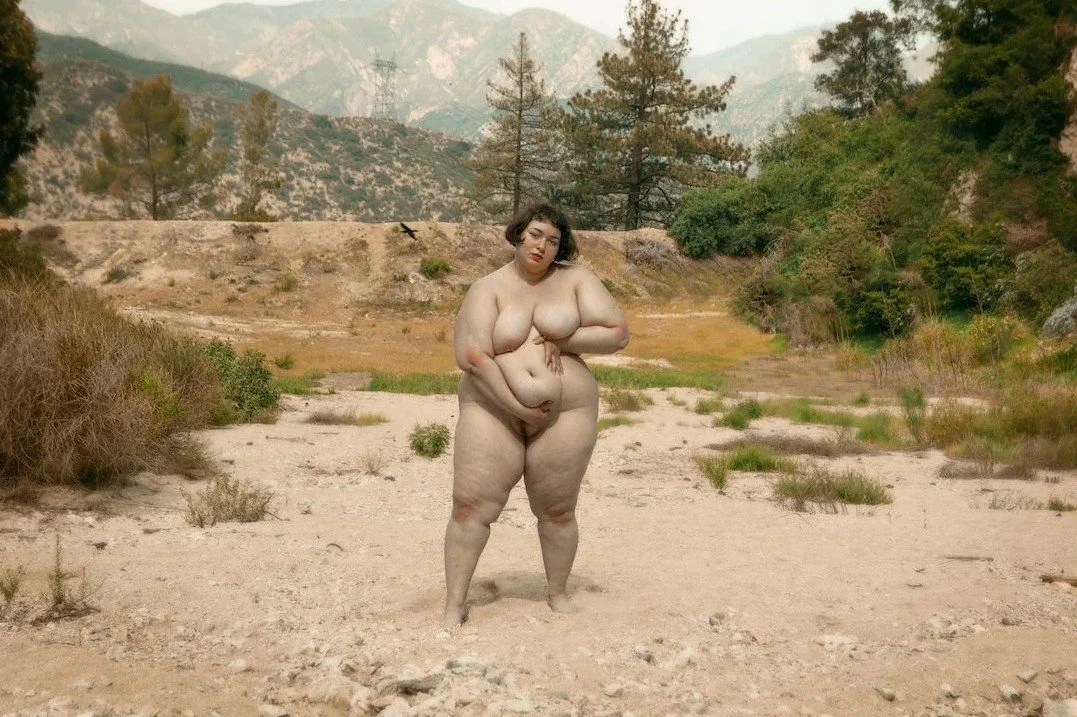
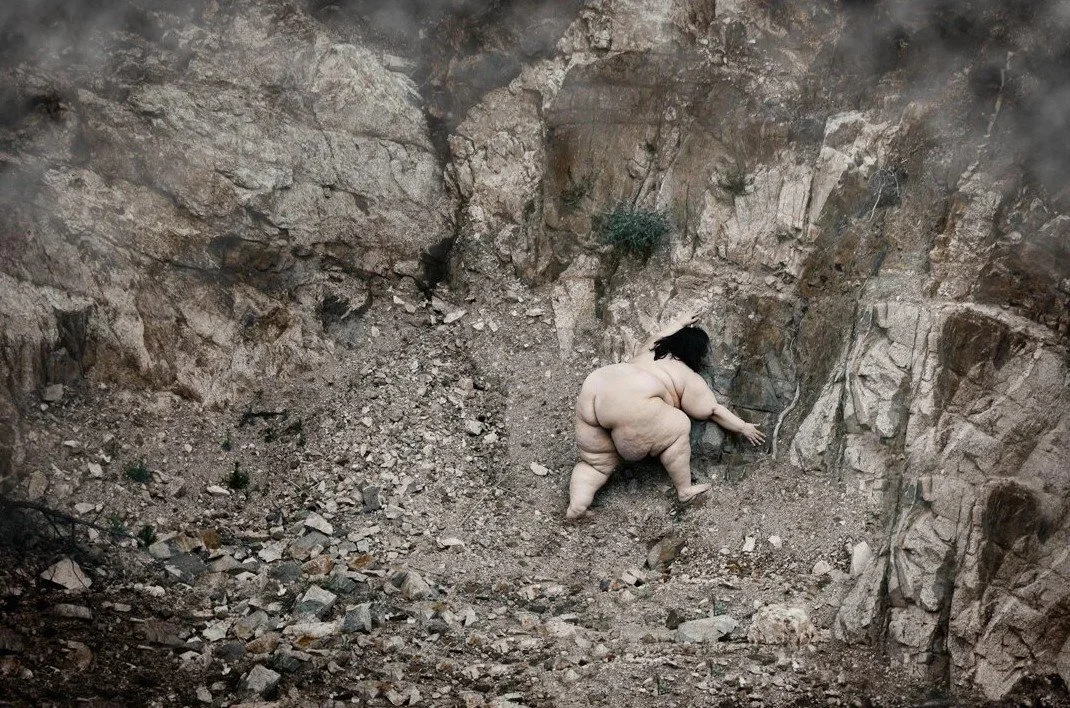
I’m aware there is always a degree of objectification involved, and I don’t shy away from that tension. But it also felt like I was witnessing something private, almost intimate, in the same way you might feel watching someone perform on stage and wondering whether you’re allowed to be seeing this. That feeling really energized me. All I could see was painting, and the question became how to translate that into photography.
That was the beginning of everything. It felt like there were endless possibilities for what we could make together. She was open to experimentation and brought her own ideas, which made the work feel collaborative. It became a challenge I was deeply excited by: how might we move her through art history? What would those references look like with her body at the center?
I was always adamant that I didn’t want to retouch her into a generic photographic body. I wanted to keep what was human and textured. That’s why I care so much about large prints. On a screen, you lose something. But in a big print, the texture of skin becomes undeniable. For me, that closeness feels similar to how a painter might have worked historically, except now we have photography, and with it, an even greater level of detail. I really love that.
WRB: The models you work with, are they primarily professionals, or do you also photograph people without formal modeling experience? If so, do you notice meaningful differences in how those sessions unfold? I’m also curious whether comfort in one’s body tends to differ between professional models and non-models, or if that assumption doesn’t really hold in your experience.
JSH: I work with both. Some are highly professional and completely at ease in front of the camera, while others have never been photographed before. People come to me for many different reasons. Some are working through unkind feelings about themselves and see the session as a step toward self-acceptance. Others may have seen photographs that resonated with them—ways of portraying the body they hadn’t imagined for themselves. And some are just very free with themselves. Everyone brings something unique.
Personally, I love working with people who’ve never been in front of a camera. I find it an honor. There’s usually a lot of conversation beforehand, and I always assure them that if they genuinely don’t like any of the images, we can scrap them. The process has to feel good. I encourage as much freedom as possible during the session, so they aren’t hiding or holding back. Often, people have assumptions about their “good side” or how they should look, and discovering something unexpected in the photos can be really exciting.
Working with larger bodies, in particular, is endlessly fascinating for me. I don’t have preconceived notions or a roadmap the way I often do with traditionally modeled, very thin bodies. Many of the people I work with haven’t been photographed in diverse ways, so there’s more space for experimentation. The process becomes more fluid and pliable, and that freedom is something I really enjoy as a photographer. Everyone comes to the work with different reasons and intentions, and that mix makes each session unique.
WRB: When people are photographed, how do they typically react? You mentioned that many come in with preconceived ideas about how they want to be seen. Have you found that they are often surprised by the results—either pleasantly, realizing they look better than they imagined, or more critically, feeling dissatisfied? I’m curious whether you’ve observed both responses, particularly given how body size stigma can affect someone’s self-perception regardless of how they are photographed.
JSH: I would definitely say one reaction is far more common than the other. I’ve rarely had a subject withdraw from a session, and when that happens, it usually has more to do with how the session itself felt. I always make sure people know there’s a lot we can control in the room—how we pose, the lighting, the environment—but once the photos are out there, control is limited. I can present the work according to my vision and on the platform I choose, but I can’t control how it spreads or what people will say.
There are always going to be people who respond harshly or cruelly. That’s something my subjects have to be aware of, and it’s part of the conversation I have with anyone new in front of the camera. We discuss the potential for negative responses, but the focus is on how the session feels for them. If they feel fundamentally comfortable with the images, then that’s what matters most. My goal is always to create a space where the experience feels good and empowering for the person being photographed.
WRB: You mention how a photograph can take on a life of its own once it’s released. In the age of social media, where have you received the most positive and negative responses? Are there particular platforms where reactions tend to be better or worse? When posting, do you anticipate which images will be well received or provoke criticism? Have you noticed certain times or periods when the feedback has been notably different?
JSH: A few years ago, people would take the time to email me with harsh critiques—accusations that I was glorifying obesity or perpetuating harmful ideas. Since around the COVID period, I’ve noticed a shift. Attention spans are shorter, and negative feedback tends to appear only in brief comments on platforms like Instagram. It’s been years since anyone wrote a long, detailed email. The form of critique has changed, even if the underlying reactions still exist.
WRB: Actual hate mail? As in they took the time to write out a letter’s worth of attacks?
JSH: Yes.
WRB: How old school. How romantic.
[Both laugh]
JSH: I was just like, ‘Wow, you guys have so much time. That's amazing. Imagine if you use that for something else to make your own stuff. That'd be amazing.’
WRB: Do you post your work on X, formerly Twitter, or have you ever used that platform for sharing your photography?
[JSH shakes head no]
WRB: Never?
JSH: No, I haven’t used X or Twitter. I don’t feel there’s a good platform right now for this kind of content. There’s so much censorship. I’ve had my account suspended multiple times, sometimes for no clear reason, and posts can get reported and removed seemingly at random. Occasionally, a small group of people will target my work, and I’ve had content disappear because of that.
Right now, it’s been a quiet period—I haven’t been reported in a while, which is nice—but there’s also less exposure for the work. Many people have moved away from platforms like Instagram. I primarily show my work on my website, though most people only find it through articles, exhibitions, or social media like Instagram.
WRB: That makes sense. I think you’re right on several points. A few years ago, Instagram and Meta were very aggressive with anti-fat censorship, and many accounts were taken down. During COVID, there seemed to be a shift, and then after Trump’s first administration, there was this odd rhetoric of absolute free speech—though in practice it didn’t really hold. Meta appears to have pulled back on overt censorship but seems to rely more on shadow banning and subtle forms of content suppression. It’s possible that political considerations play a role, since marginalized groups—Palestinian, fat, Black, and others—still face disproportionate targeting.
JSH: No, I think you’re completely right. Shadow banning is very common for me now, especially with the new engagement tools. These days, it really feels like you have to pay to play.
WRB: Right. So, less overt censorship and just punishing anyone who doesn’t pay to have views. Which hits smaller, independent artists.
JSH: I feel like even when you boost a post, you’re mostly just showing it to the same audience you would normally reach. I really don’t know how it works. I’d actually prefer not to be on the platform at all. I wish there were an alternative where you could post freely. Didn’t Instagram even censor classical paintings at one point? It’s frustrating.
WRB: I agree with you. Social media now often feels dominated by much larger issues—live coverage of atrocities, extremist groups organizing without checks—so the landscape has shifted, and not necessarily for the better.
Shifting to galleries and professional spaces, do you encounter backlash related to fat phobia in those contexts, or is the response different than what you’ve seen online?
JSH: I would say it really depends on where I show the work. Generally, I find that people respond positively, even if their first reaction is, “Wow, this is a lot.” Most viewers are patient; they take time to sit with the work and see it differently. I had a few pieces travel as part of a nude photography show, and that context was great. My images were singled out, but in a way that encouraged people to really look.
I think my work is especially suited for museums and galleries because the expectation there is to engage with art in a contemplative way. You’re standing in front of a piece, taking it in, not scrolling quickly on a screen where judgment often comes first. That slower, more intentional viewing allows for a more compassionate interaction with the work.
Overall, the response has been very positive. I’ve also participated in panels and Q&As—for example, one in Estonia—where a few people raised concerns about health, asking whether the models are “unhealthy.” I always find those questions irrelevant to the work and a narrow way of looking at it. My work isn’t about commenting on anyone’s health. Sometimes cultural perspectives come into play, and I try to acknowledge that, but my focus is on the bodies as they are and the visual, sculptural experience they create.
WRB: Well said.
JSH: So I always try and cut those questions off and be like, yeah, maybe that's your opinion and we'll move on.
WRB: You might agree or disagree with this, but I think it’s often challenging for people who aren’t overtly misogynistic or hostile in their perspectives to see images in the realm of fat liberation.
The misogynists— they are easy to recognize—they’re clearly bad faith. But with fat liberation and presenting larger bodies as forms of beauty, I’ve noticed that many people simply shut down. They’ve been taught their entire lives that these bodies are “bad,” and if your work confronts that directly… sometimes, even people who are themselves fat will react negatively, not out of malice, but because the work challenges internalized self-hatred and ingrained ideas of beauty. Have you noticed anything like that in your experience?
JSH: Yeah. Oh yeah. That’s a layered question, and I don’t know if I have a perfect answer for it. But it’s something that definitely comes up. I’m often asked, why are you, as a thin, athletic woman, making this work? And I understand why people ask that. It’s a fair question on some level.
At the same time, it’s not a very interesting question for me. It tends to flatten the work into an identity check rather than engaging with what’s actually happening in the images. I feel like it can become a way of avoiding the discomfort the work brings up, by redirecting the focus onto me instead of sitting with what the photographs are asking the viewer to confront.
That question usually comes up first, along with the idea that I’m somehow glorifying obesity. I always try to clarify this: I’m not trying to make a statement with my work. I’m not glorifying anything. All I’m doing is placing a subject in a particular environment. Honestly, the less I understand my own photographs, the more compelling they are to me. When there’s a sense of mystery, when the image feels transporting, that’s when I’m most engaged.
Some of my favorite photographs are ones I can sit with and think, I have no idea what’s going on here. I love that. That’s what I love about art in general. It asks more questions than it answers. If I were trying to make clear statements, the work would feel much narrower. And I also don’t feel that, from my position, I can make statements about what it means to live in a fat body. That isn’t my lived experience.
That doesn’t mean those conversations never happen. I talk with my subjects all the time, especially when I’m working with someone new, and often people come to me precisely because they’ve seen the work and feel connected to it. But I think it gets complicated when we start assuming that all art must function as a statement. That expectation feels relatively recent, and I don’t agree that it should be a prerequisite.
For me, art—and comedy, too—are spaces where expression doesn’t have to be declarative or didactic. If someone wants to make that kind of work, that’s great, but it isn’t an obligation. What I make is indulgent. I make it largely for myself. I look at these women and think, you’re extraordinary, and I want to photograph you. I sit with the images, and they make me happy. It’s really that simple.
I think people often expect a more explicitly political or personal justification for the work, but for me, it comes down to beauty. I don’t see these images being made elsewhere right now, and I find them endlessly compelling, so I keep returning to them.
WRB: That makes perfect sense.
JSH: There are obviously very strong opinions around this work. For me, having grown up in a fairly liberal society in Sweden, nudity itself is completely unremarkable. I grew up around it. It’s deeply uninteresting to me in that sense. So people sometimes ask, why make these pictures at all? And the answer is precisely because I experience nudity as something entirely natural.
If I ever look at an image I’ve made and feel that it could be read as erotic, that’s when I lose interest. The same goes for the gaze. If the subject’s gaze invites the viewer in, if it feels like she is offering herself to be consumed, I’m not interested in that either. What I respond to is a direct gaze that I can’t quite read, where she stands fully in her own presence without inviting anyone in.
That’s something I’m very intentional about during a photographic session. There are many images of bodies, but once the gaze enters the frame, it becomes crucial. I want it to remain peculiar and mysterious. I don’t want the viewer to feel welcomed in. That distance becomes a kind of strength, and also a shield. It protects the subject. No one can claim her. She isn’t for the viewer. She belongs to herself.
WRB: The idea of resisting the construction of desire as it’s typically framed, particularly through a male gaze, seems central here. Once desire is structured that way, the body becomes something to be consumed, almost like a product. Would you say that your work consciously avoids that dynamic, and that this resistance is an intentional part of your practice?
JSH: That’s actually what’s funny about it. Yes, the bodies are nude, but I don’t want the nude to automatically be read as sexual. If there’s one thing I’m pushing for in the work, even subconsciously, it’s to de-sexualize the nude and allow it to exist simply as a vessel.
WRB: As you developed this photographic series and the larger project it became, did you consciously avoid engaging with theoretical texts on fat liberation and feminist discourse, or did you initially explore that material and then move away from it? I’m asking because I understand your desire to keep the work from becoming didactic. I’m curious how that balance shaped your process.
JSH: I didn’t really dive into reading theory. Most of my understanding came through organic conversations with the people I was photographing. Everyone had very different perspectives, but there was one conversation in particular that stayed with me. A model talked about aiming for neutrality with her body rather than positivity. She said that neutrality felt more attainable than the constant pressure to love everything about herself.
That really resonated with me. Even though my body is very different, more athletic, it’s been through a lot. Surgeries, pushing myself too far, feeling frustrated or angry when my body didn’t perform the way I wanted it to. She said that for her, standing in front of the mirror and simply saying, there I am, felt healthier than demanding love all the time. I remember thinking how radical that actually is. It felt grounded and doable.
I think body positivity was trying to move us in that direction, but the stakes started to feel very high. There was a lot of pressure to perform positivity, to constantly affirm. What she described felt quieter and more sustainable, and it aligned closely with where I wanted the work to go. So while I wouldn’t say I completely stopped engaging with those ideas, that conversation really clarified things for me and beautifully summed up the direction I was already moving toward.
WRB: So in your view, body neutrality is meaningfully different from body positivity?
JSH: I think so, yes.
WRB: Would you consider fat liberation as a distinct framework from body positivity and body neutrality, or do you see it as closely related? If it’s something you haven’t thought about in those terms, that’s fine—I understand it can be a complex landscape of overlapping ideas.
JSH: I tend to be quite reluctant to label my work too specifically. I’m not opposed to other people seeing it as part of a particular framework, but I like to keep it more general. That allows the work room to evolve instead of being boxed into one category. Culture shifts constantly, and even my own thinking about this work has changed over the years, informed by conversations with others and by broader cultural shifts.
I try to focus on what I hope the work can do. It’s not necessarily about talking about these bodies as “fat bodies,” though that can certainly be part of the discussion. What matters most to me is that someone interacting with the work—whether in a gallery or elsewhere—might leave with a bit more warmth toward what they see, and perhaps a little kindness toward themselves. There’s already so much pressure and so many insecurities that people carry; the last thing I want is to add another benchmark or comparison. I want the experience to feel transporting, simple as that.
At the same time, I feel honored when the work appears in broader discussions or discourses. That’s wonderful. And I also think that some of my subjects, especially those I work with over a longer period, are often better positioned than I am to speak to the political dimensions of the work.
WRB: That makes perfect sense. Shifting gears, you mentioned your work in Estonia in 2022. Could you tell us a bit more about that project? As I understand it, it engaged with themes of mental health—is that correct?
JSH: Yeah, I was honestly surprised to be selected for the project, but also really excited. I love commissioned work and would do more of it. It felt like a wonderful compliment because, as they explained, they’d seen my work with larger bodies and felt that my approach didn’t glamorize or push anyone in a particular direction—it simply showed people as people. That aligned perfectly with what they wanted to do with this project, so it felt both general and very meaningful.
I traveled around Estonia for a few weeks photographing people. The goal was to document individuals in assisted living situations that were being relocated into city life. Previously, these facilities had been isolated, which wasn’t healthy for the residents. We ended up doing a show with the resulting images, which was really rewarding. Even in smaller towns, people were surprised to learn about these living arrangements.
Of course, there were some odd reactions. Some viewers asked why I was photographing people with mental illness and why they looked happy. I thought, why would I focus only on their sadness? Everyone has good days and bad days. My goal was to create life-affirming images. Many of the residents were nonverbal, so I worked closely with caregivers to learn what each person liked—music, being indoors or outdoors—and I tried to engage them in ways that felt natural.
One memorable moment was a young woman who loved music. She went outside and started dancing, and it just unfolded beautifully. The process was challenging, especially with the language barriers—Estonian, Russian, or nonverbal—but I loved that challenge. It pushed me to stretch and adapt, and all I could do was hope that I was doing my best. But it ended up being a wonderful, very human experience.
WRB: That is great to hear. The other series I’d like to discuss is Pull Up Here: A Sex Worker’s Guide to Parenting. Could you tell us a bit about this project and explain to our readers what it entails?
JSH: Yes, I was commissioned by ProMomme: A Sex Worker’s Guide to Parenting, which was creating a publication about sex-working parents. I had the opportunity to meet and photograph parents in the sex work community, and it was an incredible experience. The stories I heard were amazing and often very complex—not because of the parents themselves, but because of societal judgment and assumptions about what it means to be both a parent and a sex worker.
Before making the work, I spoke with each participant about how to approach the project. I realized I wanted to stay consistent with how I approach my work with larger bodies: to simply present, rather than push a narrative. Nudity came up naturally, too, because many of the participants work with their bodies and see that as entirely natural. The resulting series was published last year, and it remains one of the most rewarding projects I’ve done.
WRB: That’s wonderful. How many subjects did you photograph for the sex-working parent project?
JSH: I believe it was five. Part of the complexity comes from the legacy and realities of sex work—many of the parents have children, and there’s the question of how open they want to be about their work with their kids and the people around them. For those who decided to participate, there was a clear understanding and agreement about how we approached the project.
WRB: I understand. Having interviewed people as OnlyFans was emerging, it raises that question of how public someone wants to be. It’s fascinating because some sex workers can be extremely successful, even widely known within the adult industry, yet their work is still treated as private. There’s this paradox: they’re celebrities that everyone knows but no one openly talks about.
When you bring that visibility into a gallery space—offering, in a sense, a form of respectability— maybe it challenges society to confront it. It’s similar to what I’ve seen in fat liberation: people’s desires or realities exist, but society often ignores them. Exhibiting this work forces acknowledgment. It’s powerful—whether about fat bodies, sex work, or mental health—because it asserts that these people and experiences are part of society, whether we like it or not.
JSH: It’s interesting—just showing a fat body in a photograph seems so ordinary to me, but once it’s out in the world, it becomes a big deal. The same goes for sex work, mental health, or any marginalized experience. That’s part of why I’m drawn to these spaces. I have friends and family who inhabit them, and I think it’s unhealthy to pretend they don’t exist.
Alienation is one of the biggest threats to our well-being, especially today. One of our most valuable resources is genuine interaction with other people, especially face-to-face. For instance, if someone makes a judgment about a sex worker without knowing them personally, and then later meets them in public and learns something about their work, it challenges their assumptions. It shows that a person can’t be reduced to a single facet of their identity.
WRB: Very well said. Again, thank you for taking the time to sit down and discuss your work.
JSH: Thank you so much!