“Religious Liberty at 250: An Ideal, a Necessity, and a Work in Progress,” Essay, Wesley R. Bishop
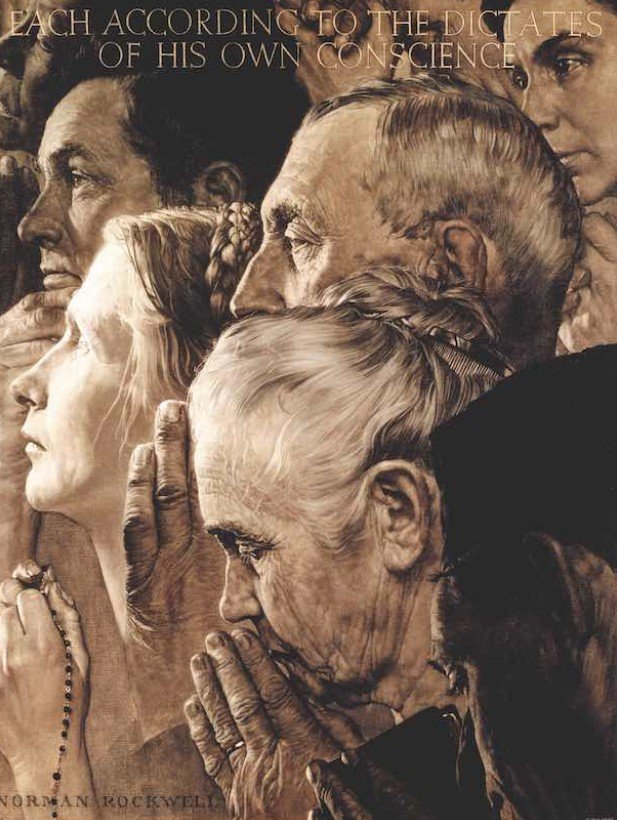
Norman Rockwell, 1943.
The following is an essay form of a keynote lecture managing editor Wesley R. Bishop gave in February 2026 at Christ Cathedral in Indianapolis, Indiana. His talk was part of the Center for Interfaith Cooperation’s public programing around the 250th Anniversary of the U.S. Declaration of Independence.
To begin, we should ask a very basic question. What do we mean when we talk about religious liberty? And why, on the 250th anniversary of the Declaration of Independence, do we so often assume that the answer begins there?
Historians and critics have long drawn a line between the Declaration of Independence and the Constitution, sometimes treating them as twin pillars of American freedom, and other times as documents in tension with one another. They are related, but they are also profoundly different in purpose and character. The Declaration was, above all, a legal and international statement. It announced that ongoing military and political resistance to the British Empire was not disorder or treason, but part of a deliberate effort to leave that empire and establish a new nation. The Constitution, by contrast, was a document about governance. It restructured political power, replacing a colonial system with a federated republic and defining how authority would be exercised and constrained.
From this difference, a familiar interpretation has emerged. The Declaration is often described as radical, even revolutionary, while the Constitution is framed as conservative, designed to restrain that radical energy. One document, the story goes, unleashed democratic possibility. The other contained it, placing limits not only on government officials but also on popular will itself.[1]
There is much to debate in that interpretation, but for our purposes today, it obscures more than it reveals. The Declaration does not articulate a doctrine of religious liberty. Its famous opening gestures toward natural rights and divine authority, but it offers no framework for the free exercise of religion. The Constitution, on the other hand, does contain the foundation of what we now call civil liberties, most notably in the First Amendment’s protection of religious exercise, or at least in how we have come to understand that protection over time.[2]
And this brings us to the heart of this lecture and to the work of the Center for Interfaith Cooperation. Religious liberty exists as an ideal, but it has no single moment of creation. It was not born fully formed in 1776, ratified once and for all in 1788, or settled by any single Supreme Court case. Instead, it has evolved unevenly over centuries. It became a necessity before it became a principle, and over time it took on a near sacred status as a defining feature of American identity. Yet it has never been enjoyed universally, evenly, or without fierce contestation.
That contestation did not end in the founding era. It did not end in the nineteenth century. It did not end with the expansion of rights in the twentieth. It persists into our own time. Consider, for example, the hysteria generated in the early twenty first century over the so-called Ground Zero Mosque.
In 2009 a project known as Park51 was proposed in Lower Manhattan as an Islamic led community center and prayer space located several blocks from the World Trade Center site. Its organizers envisioned a mixed-use facility that would include recreational, educational, and interfaith programming alongside Muslim prayer space, modeled on existing religious and civic community centers across the city. Almost immediately, opponents rebranded the project as the “Ground Zero Mosque,” a term that was both inaccurate and rhetorically charged. The building was neither at Ground Zero nor exclusively a mosque, but the label proved effective in mobilizing fear and resentment. What followed was a highly organized national campaign that framed Muslim religious presence itself as a threat, implicitly linking Islam as a faith to terrorism and casting Muslim Americans as perpetual outsiders. Protestors, media figures, and elected officials argued that Muslims should forgo their constitutional rights out of deference to national trauma, a demand never imposed on other religious groups. While supporters of Park51 appealed to the First Amendment and the promise of religious liberty, the controversy exposed how quickly those principles could be subordinated to suspicion, exclusion, and religious intolerance when the faith in question was Islam.[3]
The limits of American religious liberty become especially visible when viewed through the experience of Native Americans, for whom religious practice has often been treated not as belief to be protected but as behavior to be suppressed. In the late twentieth century, the Supreme Court repeatedly ruled against Native American religious claims, most notably in Employment Division v. Smith in 1990, which upheld the denial of unemployment benefits to members of the Native American Church who used peyote in a religious ceremony. The Court reasoned that generally applicable laws could burden religious practice without violating the First Amendment, a logic that effectively stripped constitutional protection from many Indigenous traditions.[4] The irony was unmistakable. While peyote use was criminalized despite its central sacramental role, Christian practices such as Catholic children receiving communion wine were treated as uncontroversial and routinely accommodated. Taken together with earlier decisions limiting Native claims to sacred land and ceremonial access, these rulings underscore a persistent reality. Religious liberty in the United States has often functioned not as a neutral principle, but as a culturally selective one, extending broad protection to familiar forms of worship while constraining or denying protection to Indigenous religious life.[5]
Ongoing antisemitism in the United States offers another sobering illustration of how fragile religious liberty can be when prejudice is given public license. Despite Judaism being one of the oldest and most established religious traditions in American life, Jewish communities continue to be subjected to conspiracy thinking, harassment, and violence.[6]
Violence against religious communities further underscores how conditional religious liberty can be in practice. Even groups often perceived as nonthreatening or apolitical, such as the Amish, have been targets of hate crimes, including vandalism, harassment, and attacks rooted in resentment of visible difference and separatism. These incidents echo a longer and far more devastating history, most starkly illustrated by the bombing of Black Baptist churches during the civil rights era.[7] The 1963 bombing of the Sixteenth Street Baptist Church in Birmingham, which killed four young girls, was not only an act of racial terror but also an assault on religious life itself. Black churches were targeted precisely because they functioned as spiritual, social, and political centers for their communities. Taken together, these examples remind us that religious liberty is not threatened only by law or policy. It is also undermined by violence, intimidation, and the willingness of society to tolerate attacks on houses of worship when those worshippers are deemed marginal, dangerous, or expendable.[8]
These examples are only a small sampling of the ongoing struggle to make religious liberty a lived reality for millions of Americans who find themselves, because of race, ethnicity, country of origin, or religious practice, unable to fully enjoy its promised peace and security. They remind us that religious liberty is not merely an abstract constitutional guarantee, but a condition that must be actively protected, interpreted, and negotiated in everyday life.
However, before we can hope to address these ongoing issues in any meaningful and informed way, it is useful to return to the eighteenth century, to the moment when the two documents we most closely associate with American liberty, the Declaration of Independence and the Constitution, were first drafted, debated, and contested. Doing so reminds us that religious liberty did not emerge as a fully articulated principle or a settled right. It grew out of practical concerns, political anxieties, and lived conflicts in a deeply divided society. Over time, and often through struggle, those necessities were transformed into an ideal. Understanding that process helps us see religious liberty not as a fixed inheritance, but as a concept shaped by circumstance, compromise, and continual reinterpretation.
To understand why religious liberty became a necessity in the eighteenth century, we must recognize that the founders did not invent the problem of religious conflict, nor did they confront it without precedent. They inherited a world already shaped by experiments in pluralism, confederation, and the management of difference. Long before 1776, the Iroquois Confederacy, had developed a sophisticated political system known as the Great Law of Peace. This constitution established a federated structure among distinct nations, balancing unity and autonomy while protecting certain forms of internal governance and civil order. Scholars continue to debate the degree to which this confederacy directly influenced the framing of the United States Constitution. What matters for our purposes is not a simple claim of borrowing, but the broader fact that models of federated governance and negotiated coexistence already existed on this continent. The idea that diverse communities could retain identity while participating in shared political structures was not unprecedented. It was visible and, for some founders, instructive.[9]
Within the colonies themselves, figures such as Roger Williams sharpened this necessity into political argument. Banished from Massachusetts Bay for his dissenting views, Williams founded Rhode Island on principles of religious toleration and argued that civil government should concern itself with property and public order, not the salvation of souls. He believed that compelling religious conformity corrupted both church and state. By separating civil authority from ecclesiastical control, Williams sought to protect not only conscience but also social peace and property. His insistence that the magistrate’s authority was limited helped lay intellectual groundwork for later arguments about free exercise and disestablishment.[10]
Taken together, these examples reveal that religious liberty was born from layered necessities. It was shaped by Indigenous models of confederation, haunted by European religious violence, sharpened by colonial dissent, and codified in revolutionary statecraft. It did not emerge as a purely abstract declaration of universal harmony. It arose because pluralism, conflict, and memory made coercive religious uniformity both dangerous and unsustainable.
But if we are looking for a single revolutionary era figure who helps us see religious liberty as necessity, as work in progress, and as ideal, George Mason stands out. Mason was not a systematic theologian, nor was he primarily a philosopher of abstract rights. He was a planter, a legislator, and a political pragmatist operating in a colony fractured by religious hierarchy. To see why religious liberty became a necessity in Virginia, we have to begin with the structure of the colony itself. For much of the colonial period, the Church of England was legally established. Anglican parishes were supported by tax revenue. Vestries exercised significant local authority. Dissenting ministers, particularly Baptists and Presbyterians, were required to obtain licenses to preach, and those who refused could face fines or imprisonment. By the 1760s and 1770s, evangelical revival movements had expanded dramatically in Virginia, creating a large population of dissenters who resented paying taxes to support a church they did not attend. Religious inequality was not theoretical. It was woven into law, finance, and local governance. As revolutionary agitation intensified, the colonial leadership faced a practical problem. How could they demand liberty from Britain while maintaining religious coercion at home?
It was in this setting that George Mason drafted the Virginia Declaration of Rights in 1776. Article 16 addressed religion directly. Mason’s initial draft language stated that all men should enjoy the fullest toleration in the exercise of religion according to the dictates of conscience. During debate, James Madison proposed a crucial revision, replacing the language of toleration with a stronger formulation. The final text declared that religion can be directed only by reason and conviction, not by force or violence, and that all men are equally entitled to the free exercise of religion according to the dictates of conscience. That shift was significant. Toleration implies permission granted by a dominant authority. Equal entitlement suggests a right inherent to individuals. The article did not instantly dismantle the Anglican establishment, but it provided a constitutional foundation for doing so. In the years that followed, Virginia moved toward disestablishment, culminating in the Virginia Statute for Religious Freedom in 1786.[11]
Mason’s work in the Declaration of Rights reveals why religious liberty was a necessity rather than a decorative ideal. Revolutionary leaders in Virginia needed the political support of dissenting communities. They also recognized that continued establishment risked internal division at a moment when unity against Britain was essential. Protecting free exercise reduced sectarian grievance and aligned the rhetoric of natural rights with lived practice. At the same time, Mason’s language elevated the argument beyond expediency. By grounding religious exercise in reason and conviction rather than state power, he helped articulate a principle that would echo into the First Amendment. In Virginia, then, religious liberty emerged from a concrete conflict over taxation, authority, and equality. It was forged in debate, refined through revision, and gradually transformed from a practical solution into a constitutional commitment.[12]
George Mason’s influence did not end with the Virginia Declaration of Rights. His articulation of religious liberty as an equal entitlement grounded in conscience shaped the political imagination of both Thomas Jefferson and James Madison, even where they diverged from him in emphasis or strategy. Mason helped establish the vocabulary through which Virginians would debate church establishment, taxation, and civil authority. Jefferson and Madison would take that vocabulary and extend it.
Jefferson’s Virginia Statute for Religious Freedom, drafted in 1777 and enacted in 1786, echoes Mason’s insistence that belief cannot be compelled. The statute declared that no man shall be forced to support any religious worship, place, or ministry whatsoever, nor suffer on account of his religious opinions. Where Mason’s language in the Declaration of Rights framed free exercise as an entitlement, Jefferson sharpened the argument by explicitly attacking religious taxation and civil penalties for belief. He expanded the scope from protection of worship to protection of opinion itself. The statute completed in law what Mason had initiated in principle, formally disestablishing the Church of England in Virginia and severing the financial ties between church and state. And as President, Jefferson assured Baptists in Connecticut that the religious persecution they were facing was unfair, and in his opinion “unAmerican” as it violated what he saw as a theoretical “wall” which “separated church and state.”[13]
Madison, for his part, absorbed both Mason’s constitutional framing and Jefferson’s disestablishment logic. His 1785 Memorial and Remonstrance Against Religious Assessments argued forcefully against a proposed bill that would have taxed Virginians to support Christian teachers. Madison’s reasoning tracks closely with the trajectory Mason helped set in motion. He insisted that religion is wholly exempt from the cognizance of civil society and that it must be left to the conviction and conscience of every individual. This was not mere toleration. It was a claim about the limits of state authority. Later, as a principal architect of the First Amendment, Madison carried that logic into the federal Constitution, ensuring that Congress would make no law respecting an establishment of religion or prohibiting the free exercise thereof.
When the Constitutional Convention met in Philadelphia in 1787, its official mandate was to revise the Articles of Confederation. What emerged instead was an entirely new framework of government. For critics like Mason, this shift represented more than procedural boldness. It raised serious concerns about consolidated power and insufficient safeguards for individual rights. Mason attended the Convention and participated actively in debate, but he ultimately refused to sign the final document.
His objections were multiple, but central among them was the absence of a bill of rights. Mason believed that without explicit protections, the new federal government could threaten the very liberties the Revolution had claimed to secure. Drawing on his experience drafting the Virginia Declaration of Rights, he argued that civil liberties, including freedom of religion, should not be left to implication or assumption. The proposed Constitution included structural checks and balances, but it did not enumerate individual protections. To Mason, this omission was dangerous. He feared that a powerful national government, unrestrained by clear limits, might replicate the very abuses Americans had resisted under British rule.[14]
Mason’s refusal to sign the Constitution placed him among the Anti Federalists, who warned that the new system represented an overreach beyond the Convention’s charge. Whether or not one agrees with their procedural critique, their alarm produced tangible results. The demand for a bill of rights became one of the central conditions for ratification in several states. In this sense, Mason once again embodies your three themes. He recognized the necessity of structuring government to preserve liberty. He understood that constitutional design was a work in progress, not a finished achievement. And through his insistence on enumerated rights, he helped transform religious liberty and other civil freedoms from state level commitments into national ideals. The Bill of Rights, including the First Amendment’s protection of free exercise, owes much to the pressure exerted by Mason and others who refused to treat liberty as secure simply because American independence had been declared.
Even with the adoption of the Bill of Rights, though, the meaning of federal liberty was far from settled. Almost immediately, a fundamental question emerged. Did the Constitution articulate a shared national ideal of liberty that bound the states and protected everyday people, or did it merely limit what the federal government could do while leaving most questions of rights to state authority? The early republic wrestled with this ambiguity. The Bill of Rights originally applied only to Congress, not to the states. This meant that protections such as free exercise of religion and other civil liberties constrained federal action but did not necessarily prevent state governments from maintaining establishments, restricting rights, or enforcing local hierarchies. Liberty existed, but its reach was uneven.
This ambiguity took on dire consequences as slavery hardened into the defining moral and political crisis of the antebellum period. Enslaved people were denied not only civil and political rights but also the most basic claims to conscience and self determination. Southern states defended slavery as compatible with constitutional order, arguing that the federal government had no authority to interfere with state institutions. Meanwhile, abolitionists increasingly appealed to the language of natural rights and human equality first articulated in revolutionary documents.
The murder of Elijah Lovejoy in 1837 crystallized these tensions. Lovejoy, a Presbyterian minister and abolitionist editor, had moved his printing press several times after mobs destroyed it for publishing antislavery materials. In Alton, Illinois, a pro slavery mob attacked the warehouse where his press was stored. Lovejoy was shot and killed while attempting to defend it. In the immediate aftermath, outrage spread across the North. Many framed the killing as a direct assault on freedom of the press and freedom of speech. Yet because Lovejoy’s abolitionism was rooted in his religious convictions, the attack also exposed the vulnerability of religious conscience. He was not simply expressing a political opinion. He was acting on what he understood to be a Christian obligation. His death forced Americans to confront whether constitutional liberties were real protections or fragile abstractions that dissolved under local hostility.[15]
The location of his murder is equally telling. Alton sat along the Mississippi River, near regions that would witnessed the violent persecution of Latter-day Saints in Illinois and Missouri. In the same decades that Lovejoy was killed for publishing abolitionist arguments grounded in faith, Mormon communities were being driven from their settlements, their leaders imprisoned, and their property destroyed. These episodes reveal a limited and uneven understanding of constitutional rights in the antebellum republic. If freedom of speech and free exercise bound only the federal government, and if local majorities could intimidate or expel dissenters with impunity, then liberty functioned more as aspiration than guarantee. Lovejoy’s death and the persecution of Mormons alike exposed a stark reality. The question was no longer abstract. Could a person live out deeply held religious convictions without fear of violence when those convictions challenged dominant social or political norms?[16]
The Civil War and the Reconstruction Amendments marked a constitutional rupture. The Thirteenth, Fourteenth, and Fifteenth Amendments were not minor adjustments to the existing framework. They were an attempt to resolve the crisis exposed by slavery and to redefine the relationship between the individual, the states, and the federal government. Most crucial for our purposes is the Fourteenth Amendment. By declaring that no state shall deprive any person of life, liberty, or property without due process of law, and that no state shall deny any person the equal protection of the laws, it opened the door to a new understanding of rights as national in scope rather than merely federal limitations.
Yet the promise of that amendment was not immediately realized. In the late nineteenth century, the Supreme Court interpreted the Fourteenth Amendment narrowly, and the protections of the Bill of Rights were not automatically applied to the states. For decades, religious liberty and other civil freedoms remained largely dependent on state law and local practice. It was only in the twentieth century, through a doctrine known as incorporation, that the Court began applying most provisions of the Bill of Rights to the states via the Fourteenth Amendment’s Due Process Clause.
Incorporation demonstrates again that religious liberty has been a work in progress. Its necessity was recognized in the eighteenth century. Its scope was contested in the nineteenth. Its national enforcement emerged only after the bloodshed of civil war and the slow evolution of constitutional interpretation in the twentieth and twenty-first.
The Fourteenth Amendment, ratified in 1868, declares that no state shall deprive any person of life, liberty, or property without due process of law, nor deny equal protection of the laws. [17]
Appointed in 1937, Justice Hugo Black argued that the Fourteenth Amendment was originally understood to make the entire Bill of Rights binding on the states. In his dissents and concurrences, he maintained that “no state shall” meant exactly that, and that courts should not pick and choose which rights were fundamental. For Black, incorporation was not judicial creativity but constitutional fidelity. It was an originalist reading rooted in the debates of Reconstruction and the framers’ desire to protect newly freed people from hostile state governments.[18]
Beginning with cases like Cantwell v. Connecticut, which applied the Free Exercise Clause to the states, and Everson v. Board of Education, which incorporated the Establishment Clause, the Supreme Court made clear that religious liberty was not merely a federal restraint. It was a national guarantee. In this way, the Fourteenth Amendment transformed religious liberty from a limitation on Congress into a constitutional promise enforceable against every state and locality. What began in the eighteenth century as a shield against centralized power became, in the twentieth, a tool to protect minorities from majoritarian rule at every level of government.
A careful look at Cantwell v. Connecticut reveals just how fragile religious liberty remained at the state level well into the twentieth century. The case arose during the Great Depression in New Haven, Connecticut, when Newton Cantwell and his two sons, members of the Jehovah’s Witnesses, went door to door in a predominantly Catholic neighborhood distributing literature and soliciting donations. Connecticut law required anyone seeking funds for religious or charitable purposes to obtain a certificate from a state official. That official had the authority to determine whether a cause was “religious” or “legitimate” before granting permission. Cantwell refused to apply for the certificate, arguing that the requirement itself violated his freedom of religion.[19]
When the case reached the Supreme Court, the constitutional stakes were far larger than a local disturbance. In 1940, the Court unanimously reversed Cantwell’s conviction. Justice Owen Roberts wrote that the Free Exercise Clause of the First Amendment was protected against state infringement through the Fourteenth Amendment’s Due Process Clause. This marked the first time the Court explicitly held that the Free Exercise Clause applied to the states. The justices struck down the licensing requirement because it vested discretionary power in a state official to decide what counted as a legitimate religion. That kind of prior restraint, the Court concluded, invited censorship and discrimination. At the same time, the Court overturned the breach of the peace conviction, holding that while offensive speech may provoke anger, it is still protected unless it poses a clear and present danger of violence.
A similar constitutional turning point came seven years later in Everson v. Board of Education, a case that forced the Supreme Court to confront the meaning of the Establishment Clause and its application to the states. The controversy arose in Ewing Township, New Jersey, where a local school board authorized reimbursement for transportation costs to parents whose children attended public schools. The program also covered students attending Catholic parochial schools. A taxpayer, Arch Everson, challenged the policy, arguing that reimbursing transportation for children attending religious schools amounted to public support of religion and thus violated the First Amendment.[20]
The legal question was straightforward but profound: did the Establishment Clause, which begins “Congress shall make no law respecting an establishment of religion,” bind state and local governments? And if so, what did it actually prohibit? Writing for a narrow majority, Justice Hugo Black concluded that the Establishment Clause, like the Free Exercise Clause before it, applied to the states through the Fourteenth Amendment. In doing so, the Court completed the incorporation of both religion clauses of the First Amendment.
Black’s opinion is famous for its sweeping historical language. Drawing on the writings of Thomas Jefferson and James Madison, he described the Establishment Clause as erecting a “wall of separation between church and state.” That metaphor has echoed through constitutional debates ever since. Yet in the same breath, the Court upheld the reimbursement program. It reasoned that the payments were made to parents, not directly to religious institutions, and that the policy was neutral, providing a general public benefit to all students regardless of faith.
Everson therefore embodies a tension that continues to shape religious liberty jurisprudence. On one hand, it announced a robust principle of separation and firmly nationalized the Establishment Clause. On the other, it permitted a form of indirect aid to religious schools, signaling that strict separation would not always prevail over neutrality. The decision set the stage for decades of litigation over school prayer, public funding, and the proper relationship between government and religion. In doing so, it illustrates how incorporation did not settle the meaning of religious liberty but instead opened a new era of constitutional interpretation, one in which the ideal of separation and the practical realities of public life would repeatedly collide.
It is important to remember that “Separation of church and state” is not a phrase that appears in the Constitution. It comes from Thomas Jefferson’s 1802 letter describing a “wall of separation,” a metaphor later constitutionalized in Everson v. Board of Education. Constitutionally, what we actually have are two religion clauses in the First Amendment: the Establishment Clause, which prohibits government from establishing religion, and the Free Exercise Clause, which protects religious practice. Through incorporation under the Fourteenth Amendment, beginning with cases like Cantwell v. Connecticut, those constraints apply not only to Congress but to the states as well.
Religious liberty, then, operates in two directions. It protects individuals and communities from government interference in belief and practice. It also protects the political community from government favoritism toward a particular faith. The tension is built in. Too much entanglement risks establishment. Too much restriction risks suppressing free exercise.
Can public funds flow to religious ventures without violating the Constitution? The Supreme Court’s modern answer is “yes,” but under certain conditions. The key principle that has emerged is neutrality. If the government creates a generally available public benefit program and religious institutions qualify on the same terms as secular ones, excluding them solely because they are religious can itself violate the Free Exercise Clause.
At the same time, there remain limits. Government may not directly fund religious worship as such, nor may it coerce participation in religious activity. The older test from Lemon v. Kurtzman once required a secular purpose, a primary effect that neither advanced nor inhibited religion, and no excessive entanglement. Although the Court has recently moved away from the formal “Lemon test,” the underlying concerns about coercion, endorsement, and entanglement persist.[21]
So where does this leave us? Constitutionally, separation today does not mean absolute exclusion of religion from public funding. It means that government cannot establish, coerce, or prefer religion, but it also cannot single religion out for exclusion from otherwise neutral programs. Religious liberty, as currently interpreted, protects both non establishment and equal participation. Whether that balance fully honors the spirit of the First Amendment is precisely the kind of question that keeps religious liberty not only an ideal, but a continuing work in progress.
In Lemon v. Kurtzman the justices announced what became known as the Lemon test. Under this framework, a law would be upheld only if it satisfied three requirements. First, it had to have a genuine secular legislative purpose. Second, its principal or primary effect could neither advance nor inhibit religion. Third, it could not foster excessive government entanglement with religion. In practice, this meant courts were asked to scrutinize legislative intent, evaluate the real world impact of a policy, and assess the degree of administrative interaction between church and state. For decades, Lemon shaped Establishment Clause jurisprudence, particularly in cases involving public funding of religious schools, religious displays, and prayer in public settings. Critics argued that it was unpredictable and too malleable, while defenders believed it offered an important safeguard against subtle forms of establishment.
Justice Sandra Day O'Connor sought to refine this analysis with what became known as the endorsement test. In her concurring opinions, she argued that the core concern of the Establishment Clause was whether government action sends a message to non adherents that they are outsiders and to adherents that they are insiders in the political community. Rather than focusing only on abstract purpose or administrative entanglement, O'Connor emphasized perception and political equality. Would a reasonable observer view the government as endorsing religion? Her approach shifted attention toward the lived civic meaning of state action. Although the Court has recently moved away from the formal Lemon framework, both Lemon and O'Connor’s endorsement analysis continue to influence debates about neutrality, equality, and the symbolic power of government involvement with religion.
In recent years the Court under Chief Justice John Roberts has steadily moved away from the Lemon framework. The Roberts Court has favored an approach that asks whether a challenged practice is consistent with the Nation’s historical understanding of the Establishment Clause and whether it involves coercion. In place of the three-part Lemon inquiry, the Court now looks to history, tradition, and the absence of governmental compulsion. Supporters argue this method provides greater clarity and fidelity to original meaning. Critics contend it risks privileging majoritarian religious practices embedded in historical tradition. Either way, the departure from Lemon marks a significant doctrinal turn in how separation of church and state is evaluated in contemporary constitutional law.[22]
When I raise this issue with my students, I often frame it as a thought experiment. Is publicly funded religious education, in itself, a violation of religious liberty? Many of them instinctively say no.
They are comfortable with tax dollars flowing to religious schools. If the school is Protestant, they see little difficulty.
If it is Catholic, they are untroubled.
If the school is Jewish, they remain at ease. The principle of neutrality seems, at first, easy to affirm.
But when I introduce a hypothetical Satanic school, funded on the same neutral terms, the room grows quieter. The hesitation is not usually about constitutional doctrine. It is about discomfort. It reveals how quickly our commitment to religious liberty can narrow when the faith in question feels alien, unsettling, or morally opposed to our own convictions.
That moment of pause is instructive. Religious liberty, if it means anything, must extend beyond the familiar and the respectable. A constitutional system built on neutrality cannot operate only when the beneficiaries share our theological assumptions. The question is not whether we approve of a particular belief system. The question is whether we are prepared to protect equal access to public benefits even when doing so unsettles us. That tension exposes the enduring challenge at the heart of religious liberty. It is easy to defend in theory, harder in practice, and hardest of all when it protects those we would rather exclude.
As we stand on the threshold of the nation’s 250th anniversary, the story of religious liberty remains unfinished. What began in the eighteenth century as a practical necessity in a religiously diverse and often fractious society gradually matured into a constitutional ideal. That ideal was refined through the labors of figures like George Mason, sharpened through conflict in the early republic, tested in moments of violence such as the murder of Elijah Lovejoy, and expanded through the Reconstruction Amendments and the doctrine of incorporation. It has been interpreted and reinterpreted by generations of jurists, from Hugo Black’s insistence that the Fourteenth Amendment nationalized the Bill of Rights to more recent debates over neutrality, vouchers, and the limits of establishment.
If religious liberty is an ideal, it is one forged in conflict. If it is a necessity, it is because pluralism is not optional in the American experiment. And if it is a work in progress, that is because each generation must decide whether it will narrow the circle of protection or widen it. As we commemorate two and a half centuries since the Declaration announced that all are created equal, the enduring question is not whether we admire religious liberty in principle. It is whether we are prepared to practice it in full, especially when doing so protects those whose faith, culture, or convictions differ from our own.
Wesley R. Bishop is an Associate Professor of American and Public History at Jacksonville State University, Alabama. He is the founding and managing editor of North Meridian Press.
Works Cited
[1] Howard Zinn, Declarations of Independence: Cross-Examining American Ideology (New York: Perennial, 1990).
[2]The Declaration of Independence, July 4, 1776, National Archives, https://www.archives.gov/founding-docs/declaration-transcript; U.S. Constitution, National Archives, https://www.archives.gov/founding-docs/constitution-transcript.
[3]Newsweek, August 23, 2010.
[4]Employment Division v. Smith, 494 U.S. 872, 878 (1990).
[5] “President Signs Law Protecting Ceremonial Use of Peyote by Native Church Practitioners,” Association on American Indian Affairs, April 11, 2025, https://www.indian-affairs.org/blog/president-signs-law-protecting-ceremonial-use-of-peyote-by-native-church-practitioners
[6] “Mass Shooter Found Guilty of Murdering 11 People at Tree of Life Synagogue in 2018,” PBS NewsHour, June 16, 2023, https://www.pbs.org/newshour/nation/mass-shooter-found-guilty-of-murdering-11-people-at-tree-of-life-synagogue-in-2018; Andy Borowitz, “Marjorie Taylor Greene Accuses Jewish Space Lasers of Trying to Shoot Down Santa,” The New Yorker, December 25, 2021, https://www.newyorker.com/humor/borowitz-report/marjorie-taylor-greene-accuses-jewish-space-lasers-of-trying-to-shoot-down-santa.
[7] Joanna Walters, “‘The Happening’: 10 Years After the Amish Shooting,” The Guardian, October 2, 2016, https://www.theguardian.com/us-news/2016/oct/02/amish-shooting-10-year-anniversary-pennsylvania-the-happening.
[8] “America Sees the Truth,” National Museum of African American History and Culture, accessed March 26, 2026, https://nmaahc.si.edu/explore/stories/america-sees-truth.
[9] Jennifer Davis, “The Haudenosaunee Confederacy and the Constitution,” In Custodia Legis (blog), Law Library of Congress, September 21, 2023, https://blogs.loc.gov/law/2023/09/the-haudenosaunee-confederacy-and-the-constitution/.
[10] Roger Williams, On Religious Liberty: Selections from the Works of Roger Williams, ed. James Calvin Davis (Cambridge, MA: Belknap Press of Harvard University Press, 2008).
[11]Virginia Declaration of Rights, adopted June 12, 1776, National Archives, https://www.archives.gov/founding-docs/virginia-declaration-of-rights.
[12] Jeff Broadwater, George Mason: Forgotten Founder (Chapel Hill: University of North Carolina Press, 2006); Robert S. Alley, ed., James Madison and Religious Liberty (Buffalo, NY: Prometheus Books, 1985).
[13] "Virginia Statute for Religious Freedom," Thomas Jefferson Encyclopedia, Thomas Jefferson Foundation, last modified June 27, 2022, https://www.monticello.org/encyclopedia/virginia-statute-religious-freedom; James Hutson, "Jefferson's Wall of Separation: Letter to Danbury Baptists Reexamined," Library of Congress Information Bulletin 57, no. 6 (June 1998), https://www.loc.gov/loc/lcib/9806/danpre.html.
[14] Saul Cornell, The Other Founders: Anti-Federalism and the Dissenting Tradition in America, 1788-1828 (Chapel Hill: University of North Carolina Press, 1999).
[15] Andrew Delbanco, The War Before the War: Fugitive Slaves and the Struggle for America's Soul from the Revolution to the Civil War (New York: Penguin Press, 2018).
[16] Benjamin E. Park, Kingdom of Nauvoo: The Rise and Fall of a Religious Empire on the American Frontier (New York: Liveright Publishing, 2020).
[17] US Const. amend. XIII, https://constitution.congress.gov/constitution/amendment-13/; US Const. amend. XIV, https://constitution.congress.gov/constitution/amendment-14/; US Const. amend. XV, https://constitution.congress.gov/constitution/amendment-15/.
[18] Howard Ball, The Power of the Right: Hugo L. Black and the Ford Court, 1970-1971 (New York: Oxford University Press, 1992).
[19]Cantwell v. Connecticut, 310 U.S. 296 (1940).
[20]Everson v. Board of Education, 330 U.S. 1 (1947).
[21]Lemon v. Kurtzman, 403 U.S. 602 (1971).
[22] David Schultz, "The Roberts Court Takes Aim at the Establishment Clause," The Hill, May 31, 2023, https://thehill.com/opinion/judiciary/4026628-the-roberts-court-takes-aim-at-the-establishment-clause/.